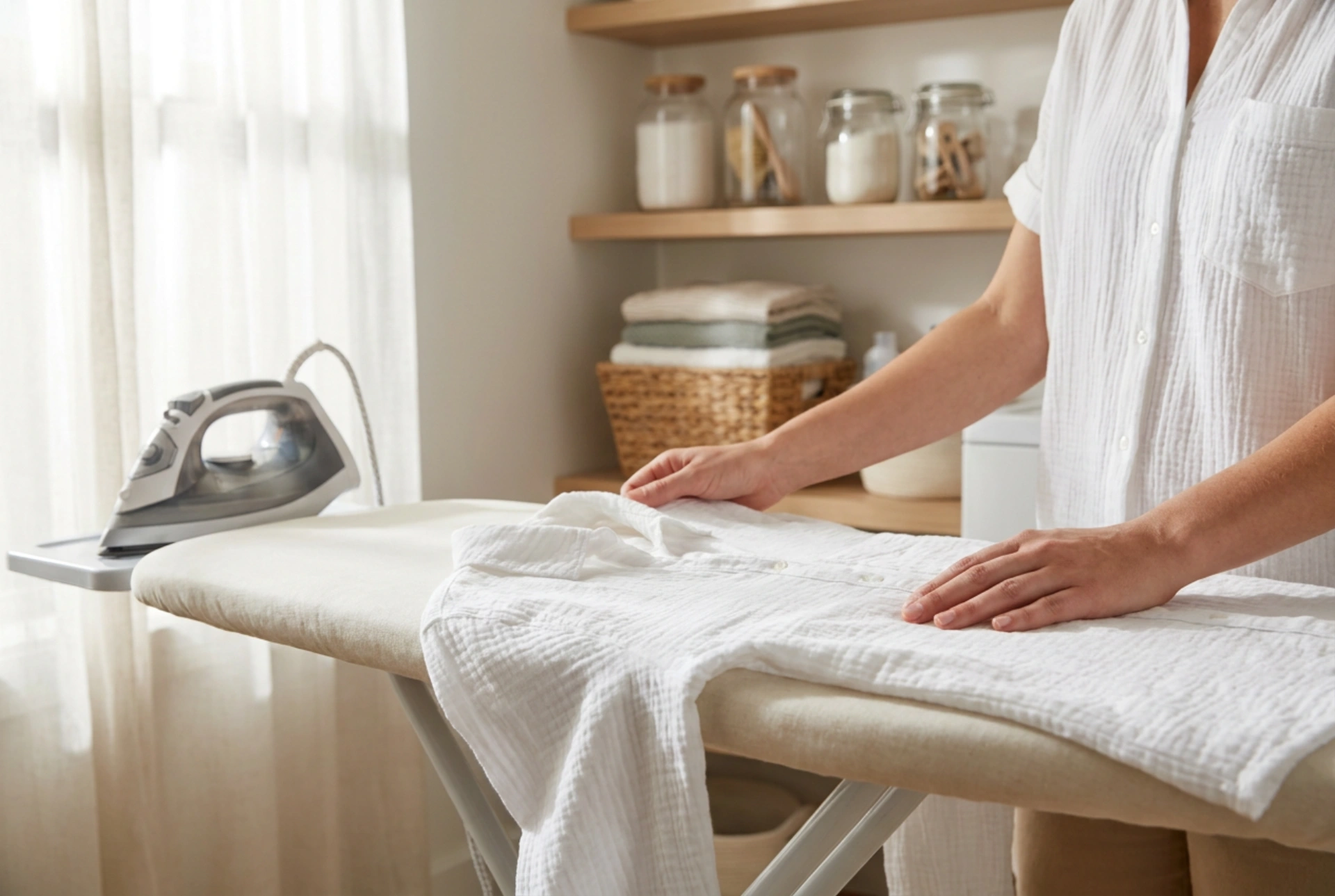


Ironing board dimensions directly dictate how efficiently heat, steam, and mechanical tension are applied to textiles of varying sizes. Selecting the correct width and length of your pressing surface minimizes fabric repositioning, prevents secondary creasing, and enhances ergonomic efficiency during garment care.
The Physics of Surface Area and Fabric Thermal Setting
Ironing is not merely about smoothing wrinkles; it is a thermal-mechanical process that temporarily alters the polymer chains within textile fibers. Heat and moisture break the intermolecular hydrogen bonds holding the fibers in their wrinkled state. When pressure is applied and the fabric cools, these bonds reform in a flat, smooth configuration. Every time you reposition a garment on an undersized board, the fabric cools under uneven tension, which often sets new, unwanted creases. Minimizing the number of times you shift the fabric is critical to preserving fiber structure and achieving a clean finish.
Decoding Standard Ironing Board Classifications
Ironing boards are generally categorized into standard dimensional categories, ranging from compact tabletop models to expansive professional surfaces:
- Compact (Size A): Typically measuring around 110 cm in length and 30 cm in width. While highly portable, these boards require frequent fabric shifting and are poorly suited for structured garments.
- Standard (Size B): Measuring roughly 124 cm by 38 cm. This is a versatile option for basic households but still presents limitations when pressing large linens or wide trousers.
- Wide (Size C): Spanning approximately 124 cm by 45 cm. This width is highly recommended for structured clothing, as it accommodates the entire back of a standard shirt in a single pass.
- Extra-Wide (Size D and E): Reaching up to 135 cm in length and 49 cm or more in width. These surfaces are designed for rapid ironing of large table linens, bedding, and heavy wool jackets.
Optimizing Board Width for Specific Garment Types
Structured Shirts and Blouses
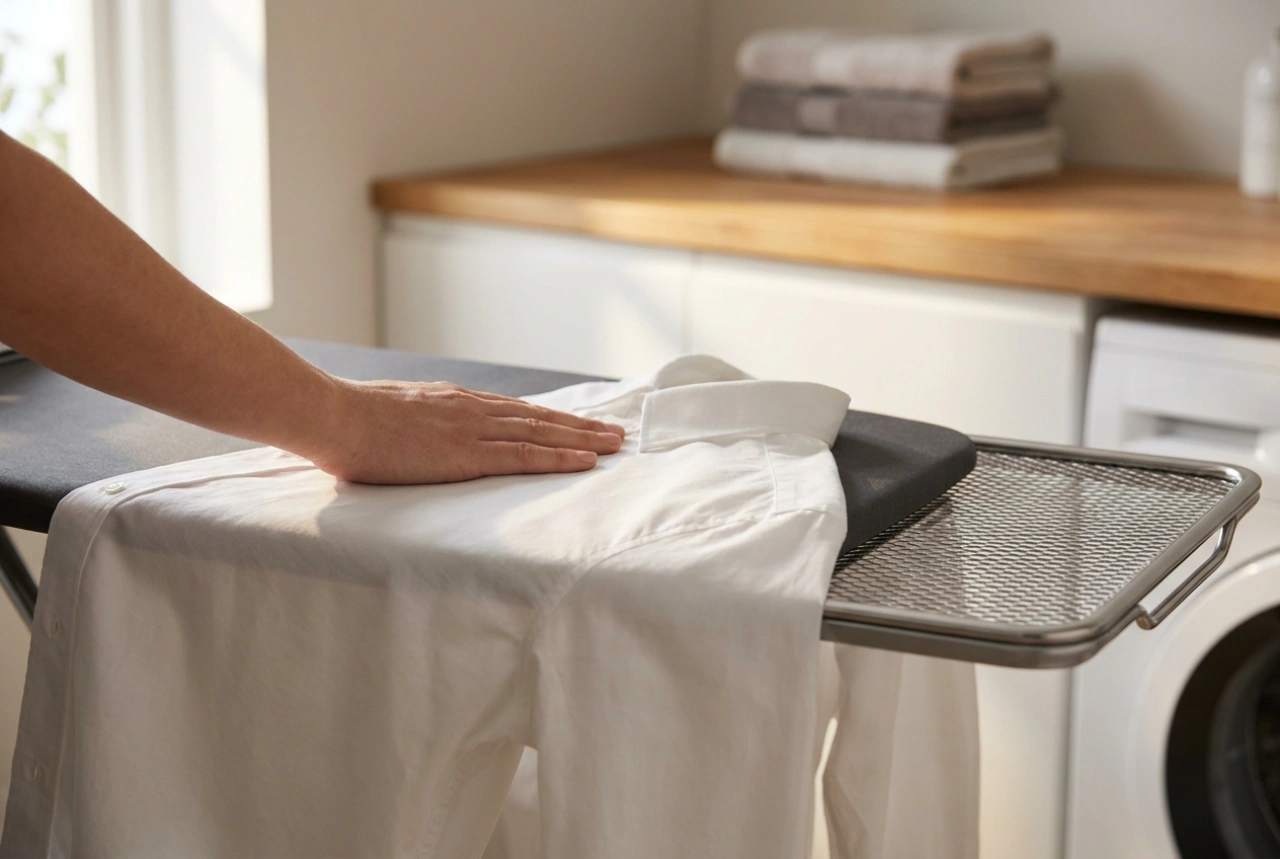
Pressing a collared shirt requires a board that accommodates the shoulder yoke and back panel without distorting the sleeves. A board with a width of at least 45 cm (Size C) allows you to lay the entire back flat. The tapered tip, or nose, of the board must be narrow enough to slide inside the shoulder sleeve caps. This allows you to press the yoke section independently without pressing creases into the collar or the adjacent sleeve seams.
Trousers and Long Skirts
For trousers, length is just as critical as width. A board length of 120 cm or more allows you to lay the entire trouser leg flat from the waistband to the hem. If the board is too short, the leg must drape over the edge, causing the fabric to pull downward under its own weight. This gravity-induced tension makes it difficult to align the inseams and outseams perfectly, often resulting in skewed leg creases.
Large Textiles and Bedding
Ironing tablecloths, curtains, or bed sheets on a narrow board is highly inefficient. As the pressed fabric hangs off the sides of a small board, its weight pulls the remaining fabric taut, introducing distortion. A wide board (48 cm or wider) provides a stable platform that supports the bulk of the fabric, ensuring that the cooled, set fibers remain flat as you transition to the next section.
The Crucial Relationship Between Padding and Board Mesh
While length and width define the working area, the quality of the pressing surface determines the heat distribution. Modern boards feature a perforated metal mesh that allows steam to pass through the fabric rather than condensing on the surface. To prevent this mesh pattern from transferring onto delicate materials like silk or wool, a dense underlay is required. A thick felt pad (ideally 4 mm to 8 mm) combined with a heat-resistant cotton cover provides the necessary cushioning to distribute the downward force of the iron evenly, protecting the fibers from localized overheating.