

Achieving perfectly dried laundry on a foldable drying rack is not just a matter of hanging clothes at random; it is a precise application of thermodynamics, airflow dynamics, and material science. By understanding how water vapor escapes woven fibers and how air moves around wet fabrics, you can significantly reduce drying times and prevent musty odors.
The Thermodynamics of Evaporation on a Drying Rack
To understand how clothes dry, we must look at the process of evaporation. Water trapped within textile fibers requires heat energy to transition from a liquid to a gas. When air passes over a wet garment, it absorbs this moisture. However, if the surrounding air is stagnant, a thin layer of highly saturated air—known as the boundary layer—forms immediately around the fabric. This boundary layer slows down further evaporation.
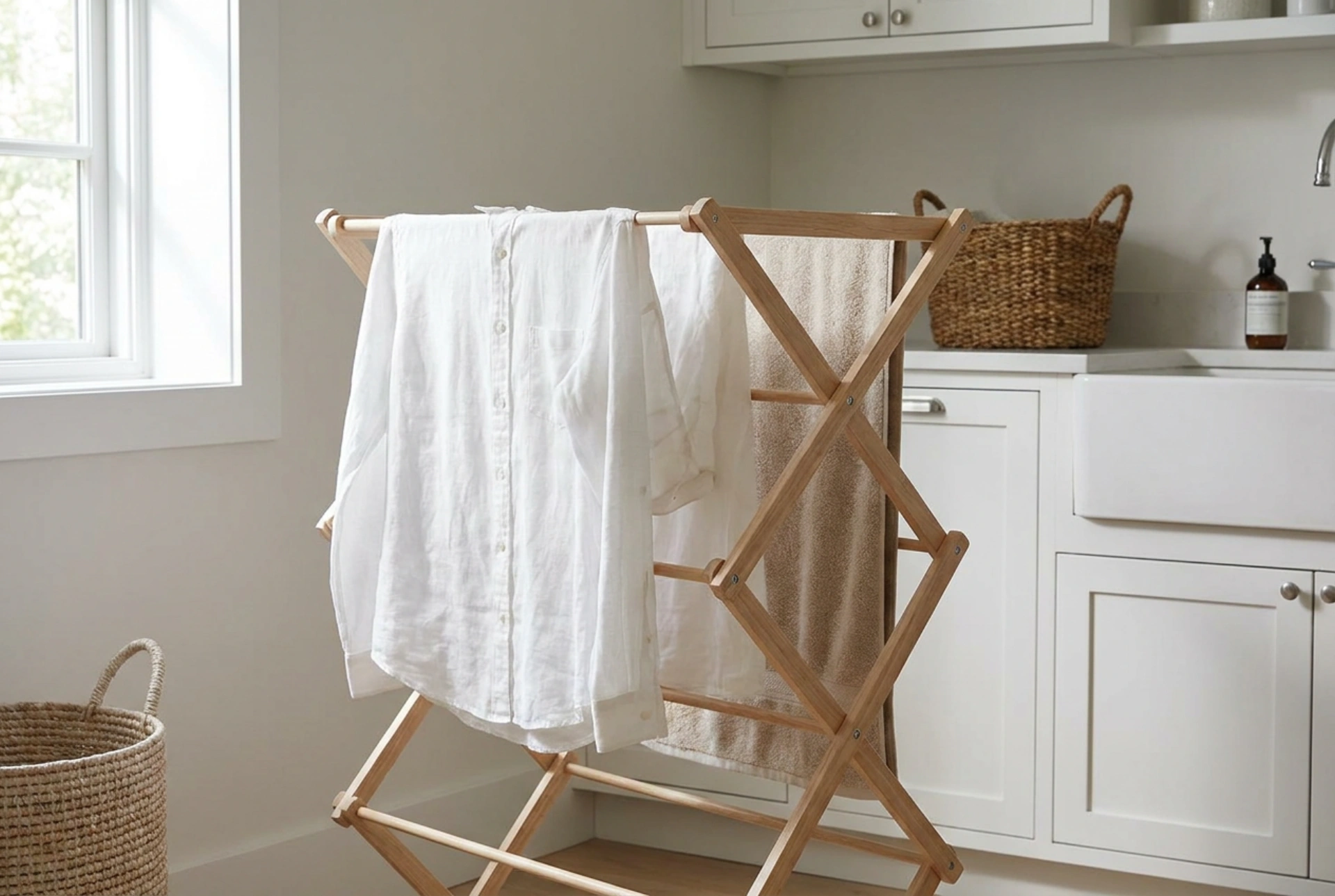
To break this boundary layer, active air movement is essential. A foldable drying rack should be positioned in a location with natural convection currents, such as near a draft, a window, or in a room with active mechanical ventilation. Spacing garments at least two to three fingers apart allows air to circulate freely between the rails, preventing the boundary layers of adjacent clothes from merging and trapping moisture.
Strategic Loading: Weight, Material, and Spacing
Efficient drying relies on a logical order of operations when loading your foldable rack. Heavy fabrics like denim, thick cotton sweaters, and towels hold the highest volume of water and require more thermal energy and airflow to dry. These items should be placed on the outer wings of the rack, where air circulation is strongest, or draped over two parallel rails to increase the surface area exposed to the air.
Conversely, lightweight synthetic materials like polyester or nylon are hydrophobic, meaning they repel water and dry rapidly. These can be placed on the inner rails of the rack, where airflow is slightly more restricted. When loading, always work from the inside out, placing lighter garments in the center and heavier items on the perimeter. This not only optimizes drying times but also maintains the physical balance of the rack, preventing structural warping or tipping.
Gravity and Water Migration in Textiles
Gravity plays a silent but significant role in the drying process. Water naturally migrates downward through the fibers of a hanging garment, collecting at the lowest points such as hems, cuffs, and waistbands. If these thick sections are folded over the rails, they become pockets of trapped moisture that take twice as long to dry.
To counteract gravity-induced moisture accumulation, hang heavier garments upside down using tension clips, or drape them so that the thickest seams are facing upward and outward. For delicate knits that are susceptible to stretching under the weight of retained water, flat drying is necessary. Laying these items horizontally across the top flat section of the rack prevents gravitational pull from deforming the woven structure while still allowing air to reach the underside of the fabric.
Optimizing Indoor Air Quality and Relative Humidity
As water evaporates from your clothes, the relative humidity in the room rises. Once the air reaches its saturation point (100% relative humidity), drying ceases entirely, regardless of how warm the room is. High humidity also creates an ideal breeding ground for mold spores and musty-smelling bacteria on damp fabrics.
To maintain a high rate of evaporation, the ambient relative humidity should ideally be kept below 50%. This can be achieved by utilizing cross-ventilation—opening windows on opposite sides of the room to create a low-pressure breeze—or by using a mechanical dehumidifier. Placing the drying rack in a spacious room rather than a cramped closet ensures a larger reservoir of dry air to absorb the escaping moisture, resulting in fresh, evenly dried garments every time.