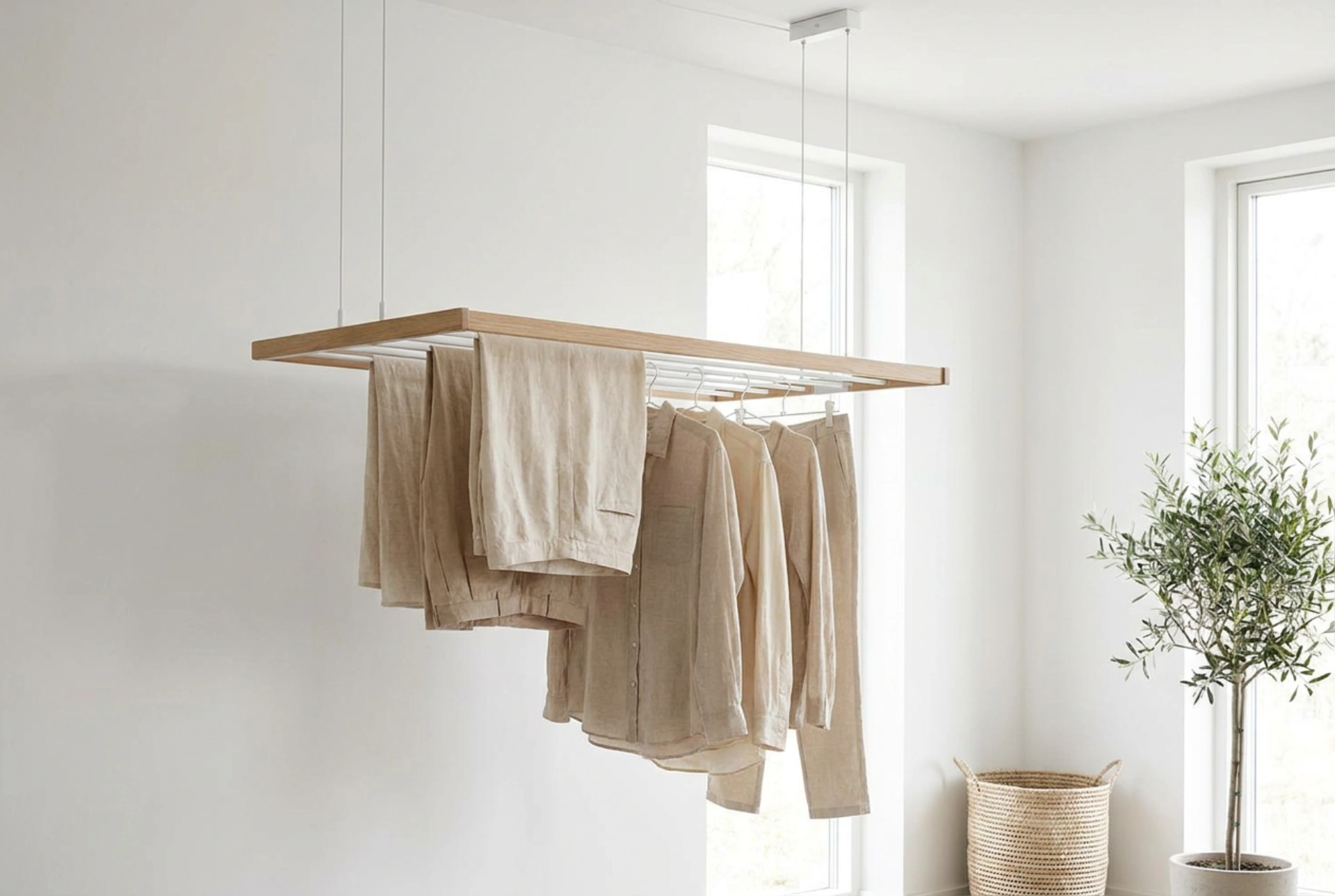


Ceiling-mounted drying racks utilize vertical space and natural convection to dry garments efficiently without cluttering floor areas. Understanding the physics of indoor air circulation and the structural mechanics of pulley systems allows you to optimize drying times while protecting your fabrics from stagnant humidity.
The Thermodynamics of High-Level Drying
The primary advantage of a ceiling-mounted rack lies in the physical behavior of indoor air. Warm air naturally rises because it is less dense than cold air, a phenomenon known as thermal stratification. The air near the ceiling of any heated room is typically 2 to 4 degrees Celsius warmer than the air near the floor. Additionally, relative humidity is often lower in these upper layers, creating a vapor pressure deficit that accelerates evaporation from wet textiles.
When water evaporates from clothing, it absorbs heat from the surrounding air and cools it, making the moist air denser. This cooled, humid air then sinks toward the floor, creating a natural convection current. A ceiling rack positions the wettest laundry in the zone of highest thermal energy, initiating this cycle of air movement and significantly reducing drying times compared to low-standing floor racks.
Mechanical Installation Principles and Substrate Integrity
To safely install a ceiling drying rack, you must match the fastening system to the specific ceiling substrate to handle dynamic loads. A fully loaded rack of wet garments can easily weigh between 15 and 25 kilograms. For solid concrete ceilings, steel expansion anchors or nylon wall plugs designed for high tensile loads must be used to resist the downward shear force. The drilling depth must match the anchor length precisely to ensure friction-tight fitting.
For plasterboard or suspended ceilings, direct mounting to the gypsum board is unsafe due to its low structural strength. Instead, you must locate the underlying wooden joists or steel stud work using a stud finder, then secure the mounting brackets directly into these load-bearing elements. If joists do not align with the desired rack position, a load-distributing wooden batten should be anchored to multiple joists first, and the rack brackets attached to that batten. Standard pulleys should be aligned parallel to the pulling force to minimize cord friction and prevent premature fraying of the synthetic lines.
Optimal Loading Patterns and Airflow Management
Hanging laundry efficiently requires understanding airflow dynamics. Air must pass freely between garments to carry away moisture. When clothes are packed too closely, boundary layers of saturated air form around the wet fibers, stalling evaporation and encouraging musty odors.
- Spacing: Maintain a minimum gap of five to eight centimeters between hanging items to permit adequate lateral airflow.
- Graduation: Hang larger, thicker items like heavy cotton towels or denim trousers on the outermost rods of the rack, closest to natural air drafts from windows or ventilation ducts. Thinner, synthetic items should occupy the center rods.
- Symmetry: Distribute the weight evenly across all rods. An unbalanced rack puts uneven stress on the pulley system, causing the rods to tilt, which slides the garments together and restricts airflow.
System Maintenance and Material Longevity
To keep a ceiling-mounted rack operating smoothly, regular maintenance of its mechanical components is essential. Over time, friction and dust accumulation can degrade the performance of the pulleys and cords.
Wipe down the metal or wooden rods monthly with a dry microfiber cloth to remove dust that could transfer to damp laundry. For wooden rods, avoid using harsh chemical cleansers that can strip protective oils, making the wood susceptible to splintering or absorbing moisture. Synthetic cords should be inspected regularly for fraying. Lubricate the pulley axles annually with a dry Teflon-based lubricant rather than grease or oil, as liquid oils attract airborne lint and dust, eventually gumming up the mechanism and increasing pulling resistance.