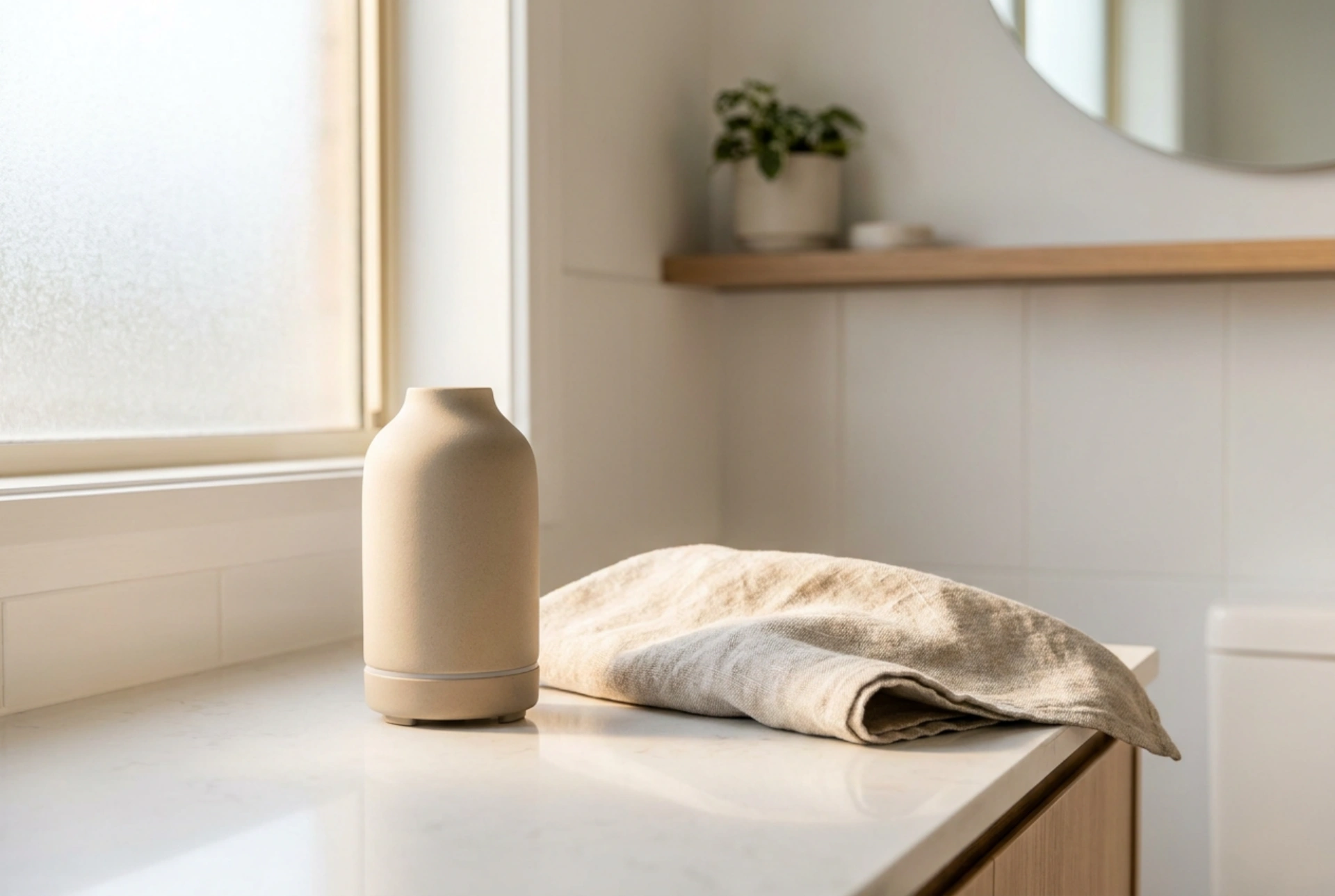


Damp bathroom environments generate specific volatile organic compounds and moisture-driven odours that require targeted molecular neutralisation rather than cosmetic masking. Selecting the right odour absorber involves understanding the distinction between absorption and adsorption, the behaviour of porous materials, and the impact of relative humidity on odour molecular transport.
Understanding the Science of Adsorption vs. Absorption
To choose an effective odour neutraliser, it is essential to distinguish between how different materials interact with airborne molecules. Most high-performing passive bathroom absorbers rely on adsorption—a surface phenomenon where gas or liquid molecules adhere to the outer and inner surfaces of a solid material. In contrast, absorption involves a fluid fully penetrating the bulk of a liquid or solid container.
Activated carbon is the gold standard of adsorbent materials due to its exceptionally high surface area-to-volume ratio. Created by heating carbon-rich materials like coconut shells or wood to high temperatures, this process opens up millions of microscopic pores. When volatile organic compounds (VOCs) and damp bathroom gases pass through these pores, they are trapped by weak physical intermolecular forces known as van der Waals forces. This physical trapping ensures that odour molecules are permanently removed from the air stream rather than masked by synthetic fragrances.
The Role of Mineral-Based Absorbers
Beyond carbon, volcanic minerals such as zeolites provide highly targeted molecular filtration. Zeolites possess a natural crystalline aluminosilicate structure with a rigid, three-dimensional framework resembling a honeycomb. This structure carries a negative charge, which attracts and holds polar molecules, such as ammonia and hydrogen sulphide, both of which are common culprits behind persistent bathroom drains and damp toilet odours.
Sodium bicarbonate (baking soda) offers a different, purely chemical approach. Instead of physical adsorption, it operates via chemical neutralisation. Because many unpleasant bathroom odours are acidic or highly alkaline in nature, sodium bicarbonate acts as an amphoteric agent, reacting chemically to convert these volatile gases into non-volatile, odourless salts. This makes dry powder beds highly effective in enclosed, low-airflow zones such as under-sink cabinets.
Managing Relative Humidity and Odour Synergy
High humidity accelerates the growth of odour-causing bacteria and fungi on porous bathroom surfaces. Water vapour also acts as a carrier, binding with volatile compounds and suspending them in the air. Therefore, an effective odour absorber must either work in tandem with a desiccant or contain hydrophobic components that do not lose efficacy when saturated with water vapour.
- Calcium Chloride Crystals: Primarily a desiccant, this chemical compound draws moisture directly from the air, dissolving into a brine. By reducing the local relative humidity below 60%, it halts the biological activity of mould spores and reduces the transport mechanism of water-bound odour molecules.
- Silica Gel: Highly porous silicon dioxide attracts moisture selectively. When combined with activated carbon, it prevents water vapour from clogging the carbon's micropores, preserving the carbon's capacity to adsorb larger organic odour compounds.
Form Factors and Passive Airflow Mechanics
The efficiency of any odour absorber is directly proportional to its surface area exposure and local air velocity. Solid blocks, loose powders, and gel-based systems distribute molecules differently depending on where they are positioned.
Gels typically consist of water-soluble polymers embedded with plant-based oils or neutralising agents. As the gel evaporates, it releases active molecules that bind with airborne odours. While effective for ambient air, they have a finite lifespan and decay as the carrier medium evaporates. Solid blocks and dry porous minerals in breathable textile pouches rely purely on passive air currents. For optimal performance, these pouches should be hung at mid-height, where convective currents created by warm, rising shower air can drive air through the porous matrix, maximizing molecular collisions with the adsorbent surface.