

Damp towels left in a humid bathroom environment serve as prime breeding grounds for microbial life, leading to musty odours and compromised hygiene. Utilizing an electric towel rail is not merely a matter of luxury; it is a highly effective thermodynamic method to accelerate evaporation and maintain textile sanitation.
The Thermodynamics of Towel Drying
To understand why an electric towel rail is efficient, one must look at the physics of evaporation. When a wet towel hangs at room temperature, water molecules must overcome intermolecular forces to escape into the air. In a damp, stagnant bathroom, the air layer immediately surrounding the towel quickly becomes saturated with moisture, slowing down further evaporation.
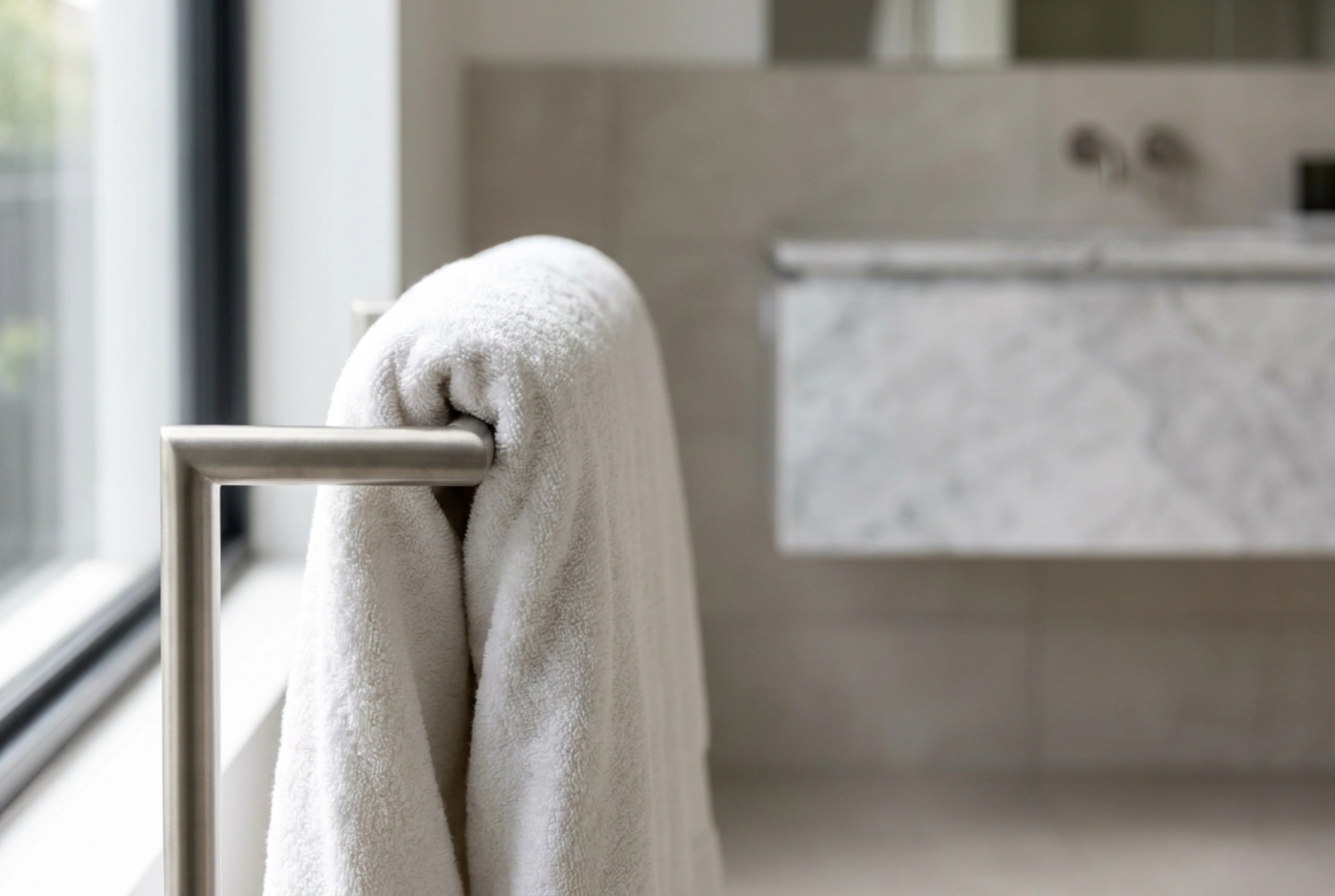
An electric heated rail introduces localized thermal energy. As the rail heats up, it transfers thermal energy directly to the towel through conduction. This heat increases the kinetic energy of the water molecules trapped within the cotton capillaries, transitioning them from a liquid to a gaseous state much faster. Simultaneously, the rising warm air creates a micro-convection current around the rail, carrying the humid air upward and drawing in drier ambient air to continue the drying process.
Preventing Bacterial Growth and Musty Odours
The unpleasant smell associated with damp towels is caused by volatile organic compounds produced by bacteria and fungi, such as Brevibacterium or mildew. These microorganisms thrive in warm, dark, and highly humid conditions, typically multiplying rapidly when moisture remains in the fabric for more than a few hours.
Rapid drying is the most effective mechanical defence against this biological colonisation. By raising the temperature of the fabric and removing moisture within a window of two to three hours, you deprive these microbes of the liquid water essential for their cellular functions. This prevents the formation of biofilm layers within the woven loops of the towel, ensuring that the fabric remains biologically clean and free of persistent odours without relying on harsh chemical disinfectants.
Material Science: Cotton Fibres and Heat
Most high-quality bath towels are made from cotton, a natural polymer consisting of cellulose. Cellulose is highly hydrophilic, meaning it readily absorbs water into its crystalline and amorphous regions through capillary action. However, cotton is also sensitive to excessive heat.
- Structure retention: High temperatures above 70 degrees Celsius can cause cellulose fibres to shrink, become brittle, and lose their natural elasticity. This results in a stiff, scratchy texture.
- Optimised heat transfer: Electric towel rails are typically calibrated to operate between 50 and 60 degrees Celsius. This range is high enough to induce rapid evaporation and inhibit bacterial growth, yet low enough to preserve the integrity of the cotton fibres.
- Weave density: Dense towels with a high GSM (grams per square metre) hold more water and require even heat distribution. Layering a thick towel properly across the horizontal bars ensures uniform thermal conduction.
Safe Operation and Optimal Folding Techniques
To maximise efficiency and ensure absolute safety, the physical arrangement of the towels is critical. Simply bunching a wet towel over a single bar restricts airflow and creates pockets of high humidity where heat cannot escape, which can lead to localized scorching of delicate synthetic blended fibres.
The optimal technique involves folding the towel lengthways once or twice and draping it flat across multiple horizontal rungs. This maximises the surface area in direct contact with the heated metal, facilitating faster heat transfer. Additionally, it is essential to ensure that the electric towel rail installed in your bathroom has an appropriate Ingress Protection (IP) rating, typically IP44 or IP55, indicating its resistance to water splashes and steam ingress, ensuring long-term functional safety in damp environments.