

Slower drying times in bathrooms lead to prolonged dampness, creating an ideal breeding ground for microbial growth and musty odours. Understanding the physical principles of evaporation and airflow allows you to utilise a standing towel rack to dramatically accelerate fabric drying without relying on mechanical heat.
The Thermodynamics of Drying: Vapor Pressure and Airflow
To accelerate drying, we must manipulate the microclimate immediately surrounding the wet fabric. When a towel is wet, water molecules on the fabric surfaces absorb thermal energy from the ambient air, transitioning from liquid to gas. This process creates a thin, saturated boundary layer of high humidity directly resting on the fabric surface.
If the surrounding air remains stagnant, this boundary layer prevents further evaporation because the local air reaches its moisture saturation limit (100% relative humidity). A standing towel rack facilitates continuous passive airflow. By placing the rack in a location with natural convection currents, dry air constantly displaces the saturated boundary layer, maintaining a steep vapor pressure gradient between the wet towel and the room air, which keeps evaporation running at its maximum potential rate.
Spatial Advantage: Surface Area and Tension
The geometry of how a towel is hung directly dictates its drying speed. When using traditional wall hooks, the fabric is bunched together, which severely restricts the available surface area exposed to the air. This traps moisture inside the folds, slowing evaporation and encouraging bacterial replication.
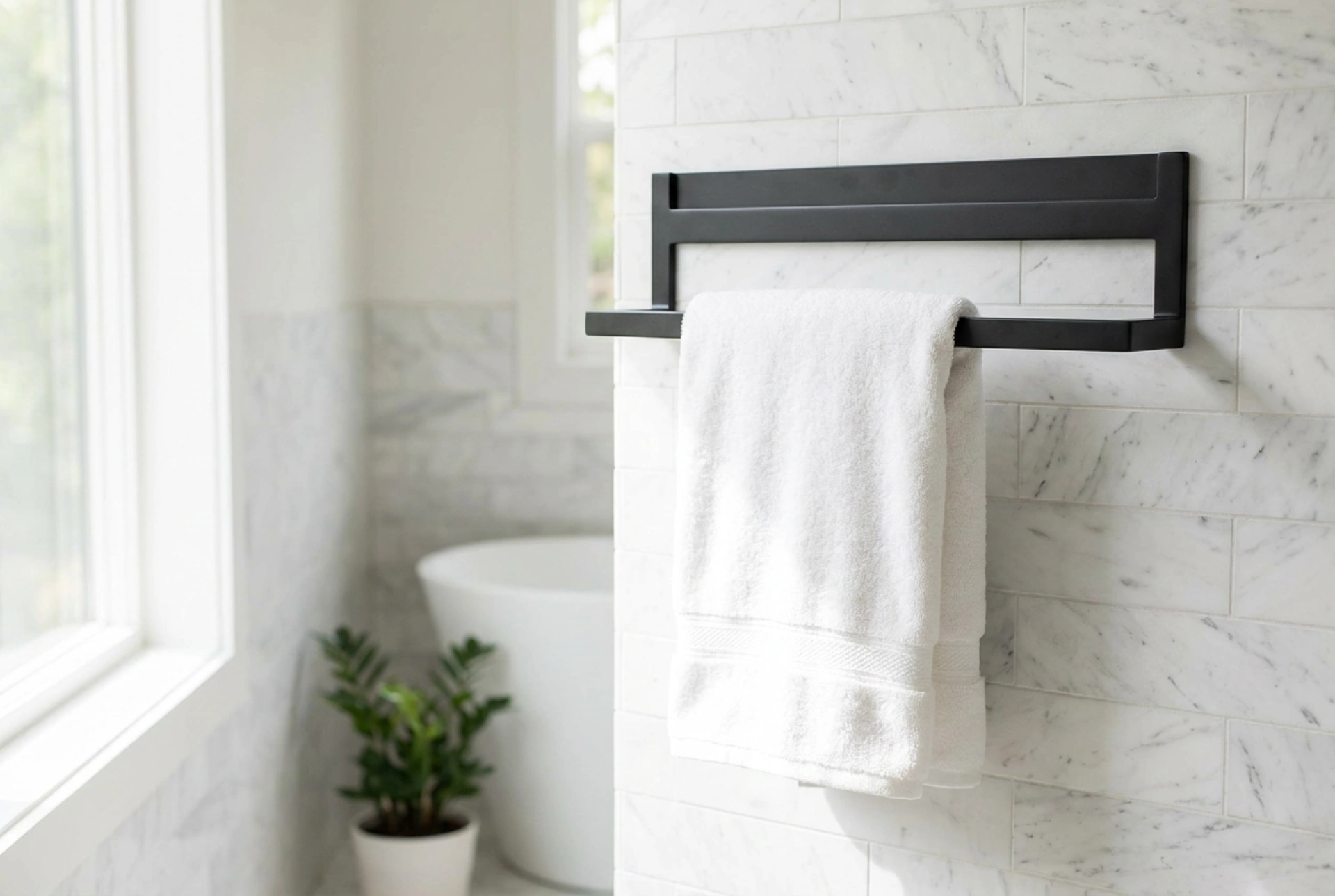
A standing towel rack allows you to spread the textile completely flat across horizontal bars. This arrangement maximizes the exposed surface area in two ways:
- Dual-sided exposure: Both sides of the fabric are in direct contact with moving air, effectively doubling the evaporation rate compared to a towel hung flat against a cold wall.
- Physical tension: Spreading the fabric taut reduces the density of the weave temporarily, allowing air to penetrate between the individual yarn loops of cotton terrycloth rather than just skimming the surface.
Optimising Hanging Techniques for Maximum Airflow
Simply throwing a towel over a bar is not the most efficient method. To achieve optimal drying rates, apply these systematic techniques based on physics:
The Offset Drape
Instead of hanging the towel symmetrically with equal lengths on both sides of the bar, drape it so one side is slightly longer. This uneven distribution alters the gravitational pull on the fabric fibers, opening up the weave on the upper curve. Furthermore, leave a gap between multiple towels on multi-bar standing racks. A minimum distance of 10 to 15 centimetres between hanging textiles is required to prevent the humid air shedding from one towel from saturating the adjacent one.
Leveraging Natural Convection
Warm air rises while cold air sinks. Position your standing rack away from tight corners and flush walls. Placing the rack near a heat source, such as a radiator, or in the path of passive ventilation grates utilizes natural convection. As warm air rises past the rack, it absorbs moisture and carries it upward, drawing cooler, drier air from the floor level through the bottom of the hanging fabric.
Material Science: How Fibers Release Water
Different textile compositions require specific handling on a standing rack. Heavy cotton terrycloth relies on capillary action to move water from the inner core of the yarn to the tips of the loops. Because cotton is highly hydrophilic, it retains water within its cellular structure, requiring consistent air movement to break those hydrogen bonds. Synthetic microfiber, being hydrophobic, holds water only in the microscopic spaces between its polyester and polyamide filaments. Spreading microfiber flat on a standing rack allows gravity to pull the moisture down to the lower edge, where it evaporates rapidly due to the high surface-area-to-volume ratio of the synthetic fibers.