

Packing a vacuum flask and mugs for a family outing requires more than just placing them in a bag; it involves managing thermal dynamics, mechanical shock, and fluid mechanics to ensure your drinks remain at the perfect temperature without leaks or damage.
The Thermal Dynamics of Vacuum Flasks
A vacuum flask relies on a double-walled construction where the air between the inner and outer walls has been evacuated. This near-vacuum drastically minimises conductive and convective heat transfer, as there are no air molecules to transfer kinetic energy. However, radiative heat transfer still occurs, which is why high-quality flasks feature reflective internal coatings—often a micro-layer of copper or silver—to bounce infrared radiation back into the liquid.
Before packing, you must address the "heat sink" effect. When hot liquid is poured into a room-temperature flask, the inner stainless steel wall immediately absorbs thermal energy to reach thermal equilibrium, lowering the drink's initial temperature. To prevent this, prime the flask by filling it with boiling water for three to five minutes. This preheats the internal metal. For cold drinks, prime with ice water. This simple thermodynamic preparation extends the thermal retention window by several hours.
Preventing Mechanical Shock and Thermal Bridging
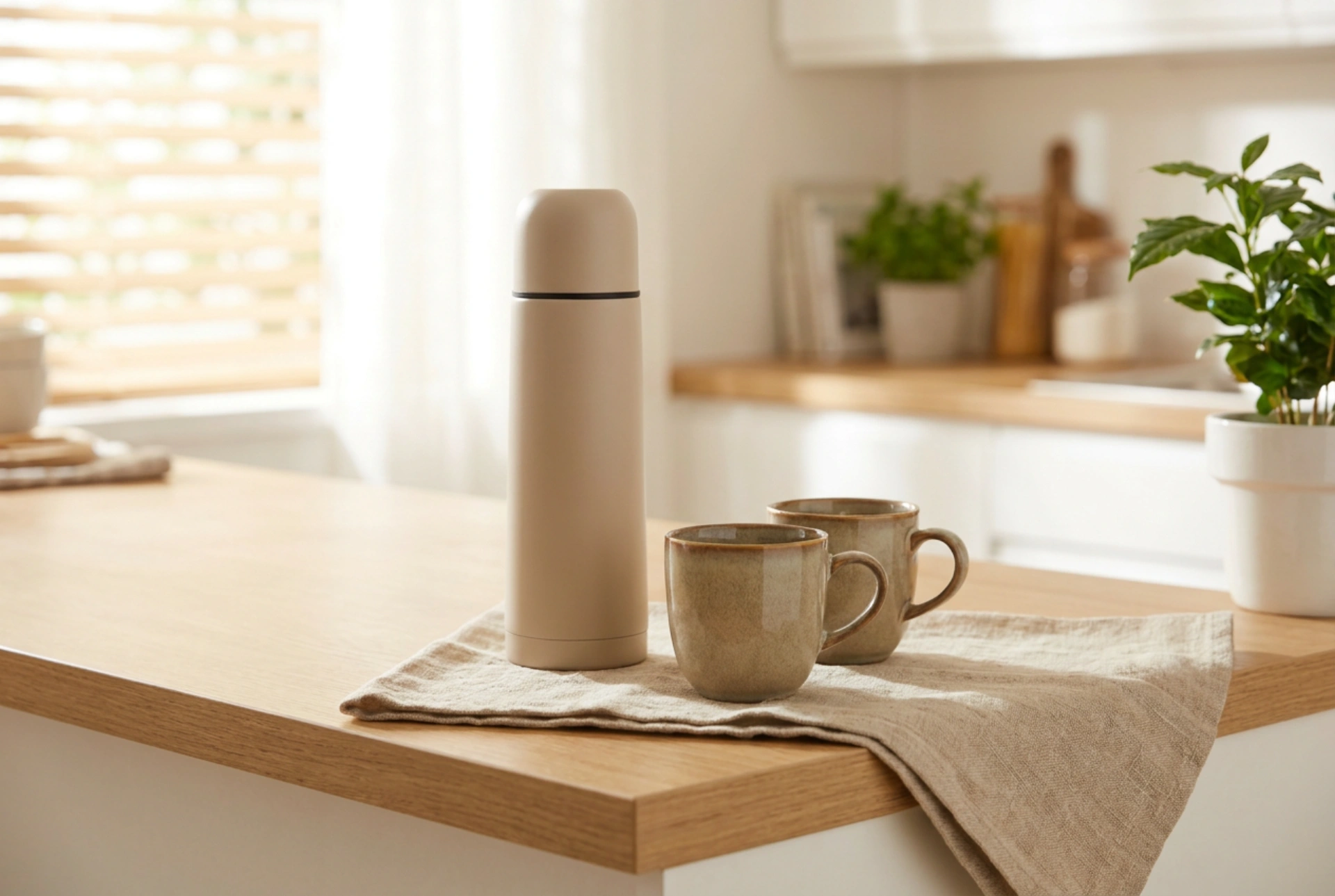
When transport involves two ceramic or glass-lined mugs, mechanical shock during transit can lead to structural failure or hairline fractures. Wrapping the mugs in a natural fibre, such as a woven linen napkin or cotton tea towel, serves a dual purpose. First, the fibrous structure acts as a viscoelastic damper, absorbing kinetic energy from bumps and vibrations. Second, it prevents thermal bridging.
Thermal bridging occurs when two conductive surfaces touch, creating a direct path for heat transfer. If a hot flask rests directly against a cold ceramic mug, heat will conduct rapidly out of the flask's lid or base. By placing a textile barrier between the flask and the mugs, you disrupt this conduction path, preserving the system's thermal equilibrium and preventing localised cold spots in your beverage.
Fluid Dynamics, Thermal Expansion, and Seals
Underestimating thermal expansion often leads to messy leaks during transit. As liquids heat up, their density decreases and their volume increases. If you fill a flask to the absolute brim with boiling water, the liquid will expand, compressing the air pocket (ullage) beneath the lid. This compression increases hydrostatic pressure, forcing the liquid past the elastomeric silicone gaskets.
Always leave a gap of at least 1.5 to 2 centimetres below the pouring lip or stopper thread. This headspace allows the air and liquid to expand safely without compromising the seal. Additionally, inspect the silicone gasket before sealing; it must be clean, free of grit, and properly seated in its groove. A single grain of coffee or speck of dust can break the seal, allowing capillary action to draw liquid outward. Silicone is highly flexible and thermal-resistant, but it requires uniform physical pressure to maintain a hermetic seal.
Strategic Load Distribution in the Backpack
The physical placement of the flask and mugs inside your bag affects both carrying comfort and safety. A filled vacuum flask is dense and heavy; placing it too high or far from your spine shifts your centre of gravity, causing strain. Position the flask vertically against the back panel of your pack, near the centre of your back.
The mugs should be nested around the flask using the protective linen wraps. Avoid placing the flask horizontally. When a flask lies flat, the liquid remains in constant contact with the lid area. The lid is typically made of plastic and silicone, which have higher thermal conductivity than the vacuum-insulated walls. Keeping the flask upright minimizes heat loss through the lid, as the rising hot steam interacts with a smaller surface area than the liquid itself would.
Pre-Departure Packing Checklist
- Pre-condition the vessel: Fill with hot or cold water for 5 minutes prior to filling with your beverage to neutralise the heat sink effect.
- Leave headspace: Keep the liquid level 2 cm below the stopper to accommodate thermal expansion and prevent gasket failure.
- Isolate the components: Wrap ceramic mugs individually in linen or cotton to prevent impact damage and eliminate thermal bridging.
- Pack vertically: Secure the flask upright against the pack's back panel to maintain your centre of gravity and minimise lid-contact heat loss.