

Properly organizing mineral water bottles on a pantry rack is essential to prevent structural failure of the shelving and preserve the chemical integrity of the water. Applying basic physics and material science ensures your storage setup remains safe, stable, and efficient over long periods.
The Physics of Weight Distribution and Gravity
Water is exceptionally heavy, weighing exactly one kilogram per litre. A standard case of twelve 1.5-litre bottles exerts eighteen kilograms of downward force. When loading a pantry rack, the fundamental rule of physics is to keep the center of gravity as low as possible. Always place the heaviest bottles—typically large glass carboys or multi-litre containers—on the lowest shelves of the rack.
Distribute the load evenly across the horizontal plane. Concentrating all weight in the center of a shelf causes structural deflection, commonly known as bowing. Over time, this mechanical stress weakens metal joints or warps wood, leading to sudden structural collapse. Position bottles starting from the outer support pillars and work inward to minimize bending moments on the shelves.
Horizontal vs. Vertical Storage Dynamics
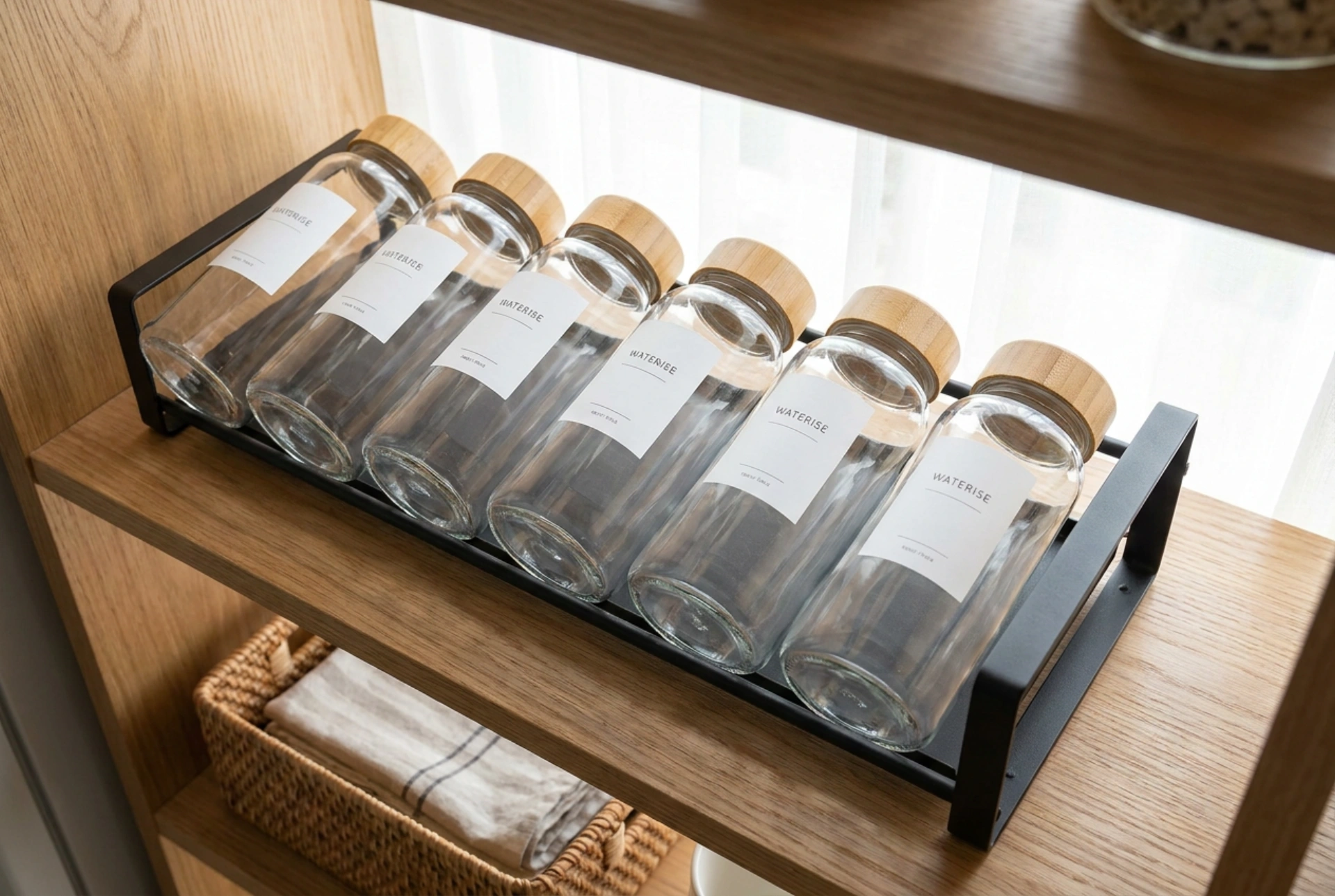
The choice between storing bottles vertically or horizontally depends on the container material and the rack design. Glass bottles are highly rigid and do not deform under pressure, but they are susceptible to impact damage. If using a horizontal rack, glass bottles must be secured in shaped cradles or on high-friction silicone liners. This prevents them from rolling and colliding, which can cause micro-fractures in the glass structure.
Polyethylene terephthalate (PET) plastic bottles behave differently. When stacked vertically, the weight of the upper bottles compresses the air inside the lower bottles. If the pressure exceeds the structural limit of the plastic seam, the bottles can rupture or deform, causing the stack to topple. Horizontal storage on dedicated curved racks distributes the weight of individual plastic bottles across their entire length, eliminating localized pressure points and preventing deformation.
Environmental Science in the Pantry: Light and Temperature
Even inside a dark pantry, environmental variables affect stored water. Mineral water in PET bottles is vulnerable to thermal degradation and ultraviolet (UV) radiation. Though pantries are shielded from direct sunlight, ambient heat can accelerate the migration of antimony and plasticizers from the PET matrix into the water. Therefore, water racks must be positioned away from heat-emitting appliances, hot water pipes, and vents.
Glass containers are chemically inert and do not leach substances, but they are highly sensitive to thermal shock. Rapid temperature fluctuations can cause glass to expand and contract unevenly, leading to structural failure. To mitigate this risk, ensure the pantry maintains a stable temperature between 10°C and 15°C, and avoid placing glass racks directly on cold concrete floors without an insulating base.
Step-by-Step Loading Protocol for Pantry Racks
To ensure maximum safety and structural longevity, follow a strict order of operations when loading your mineral water rack:
- Inspect the structural integrity: Ensure all rack joints are securely tightened and the unit is anchored to the wall to prevent tipping.
- Apply protective liners: Use non-slip, shock-absorbing silicone mats on metal wire shelves to prevent glass-on-metal contact.
- Load from bottom to top: Begin placing the largest, heaviest bottles on the lowest level, moving upward only when the lower shelf is fully loaded.
- Maintain structural spacing: Leave a gap of one to two centimeters between bottles to allow air circulation and prevent glass bottles from clinking together.
- Implement FIFO (First In, First Out): Place newly purchased bottles at the back of horizontal racks or on the left side of shelves, moving older stock forward to ensure continuous rotation.