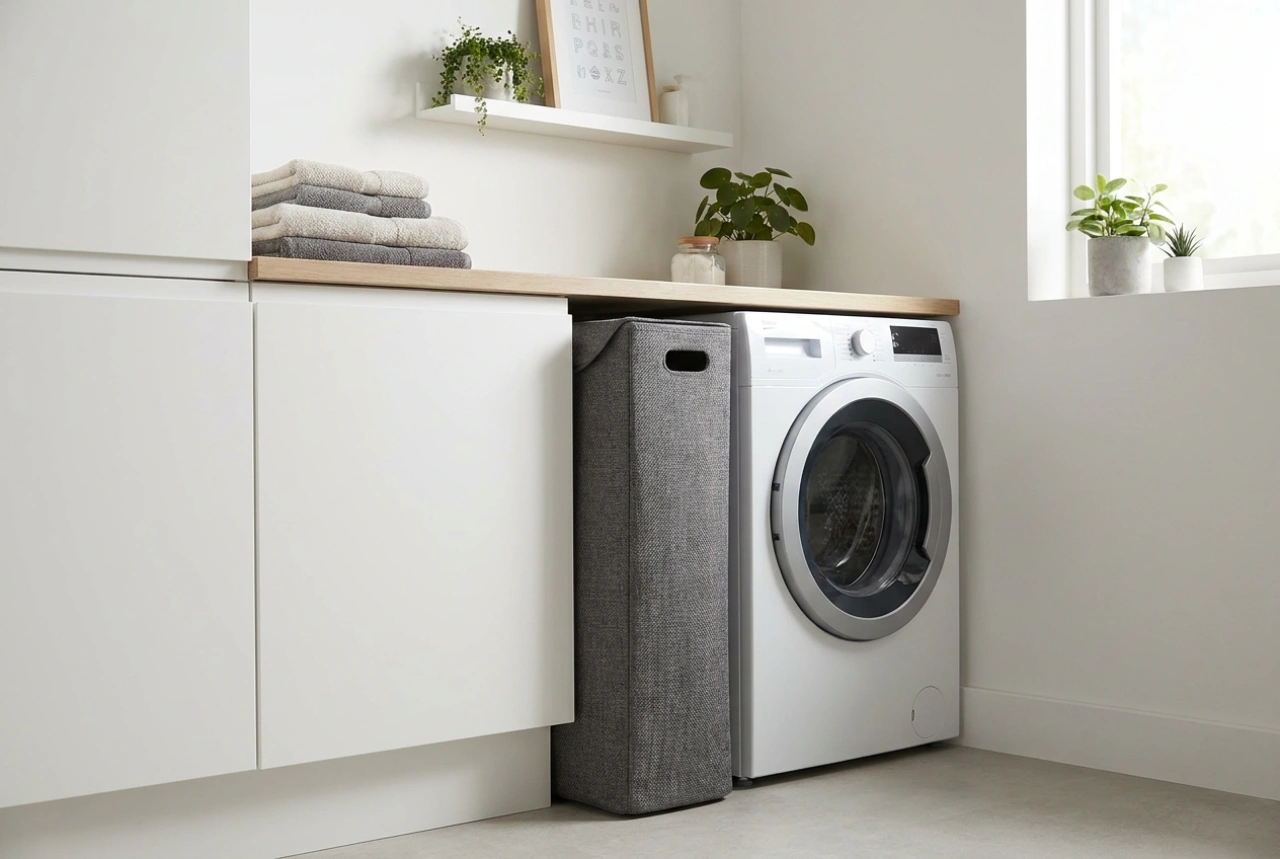


Integrating laundry storage into built-in cabinetry preserves clean interior lines, but enclosing damp garments in unventilated spaces triggers rapid microbial growth and persistent odours. Preventing these issues requires a design grounded in the physics of evaporation, natural convection, and proper material selection.
The Science of Stagnant Air and Microbial Growth
Damp textiles, such as used towels or gym wear, release moisture into their immediate surroundings. When confined within a sealed wooden or laminate cabinet, the relative humidity inside the compartment rapidly climbs toward 100%. This saturated microclimate provides the ideal breeding ground for mould spores and bacteria.
The Role of Bacteria and Fungi
Odour in dirty laundry is primarily caused by volatile organic compounds (VOCs) produced by bacteria, such as Staphylococcus epidermidis, as they break down organic matter in sweat and skin cells. In anaerobic (oxygen-deprived) environments caused by tightly packed, unventilated clothing, these bacteria multiply exponentially. Concurrently, mould fungi thrive in dark, humid, and stagnant conditions. Once mould establishes itself on natural fibres like cotton or linen, it can cause irreversible structural damage and staining through enzymatic decomposition.
Designing for Convection: The Chimney Effect
To keep textiles dry and odour-free, a built-in laundry cabinet must facilitate continuous air movement. This is achieved by exploiting the natural physical principle of convection, often referred to as the chimney effect.
Creating Air Intake and Exhaust Pathways
Warm, moisture-laden air naturally rises because it is less dense than cool, dry air. To harness this movement, a built-in cabinet must feature both lower intake vents and upper exhaust pathways.
- Lower Ventilation: Incorporate a recessed plinth or a physical gap at the bottom of the cabinet door. This allows cooler, denser room air to enter the base of the unit.
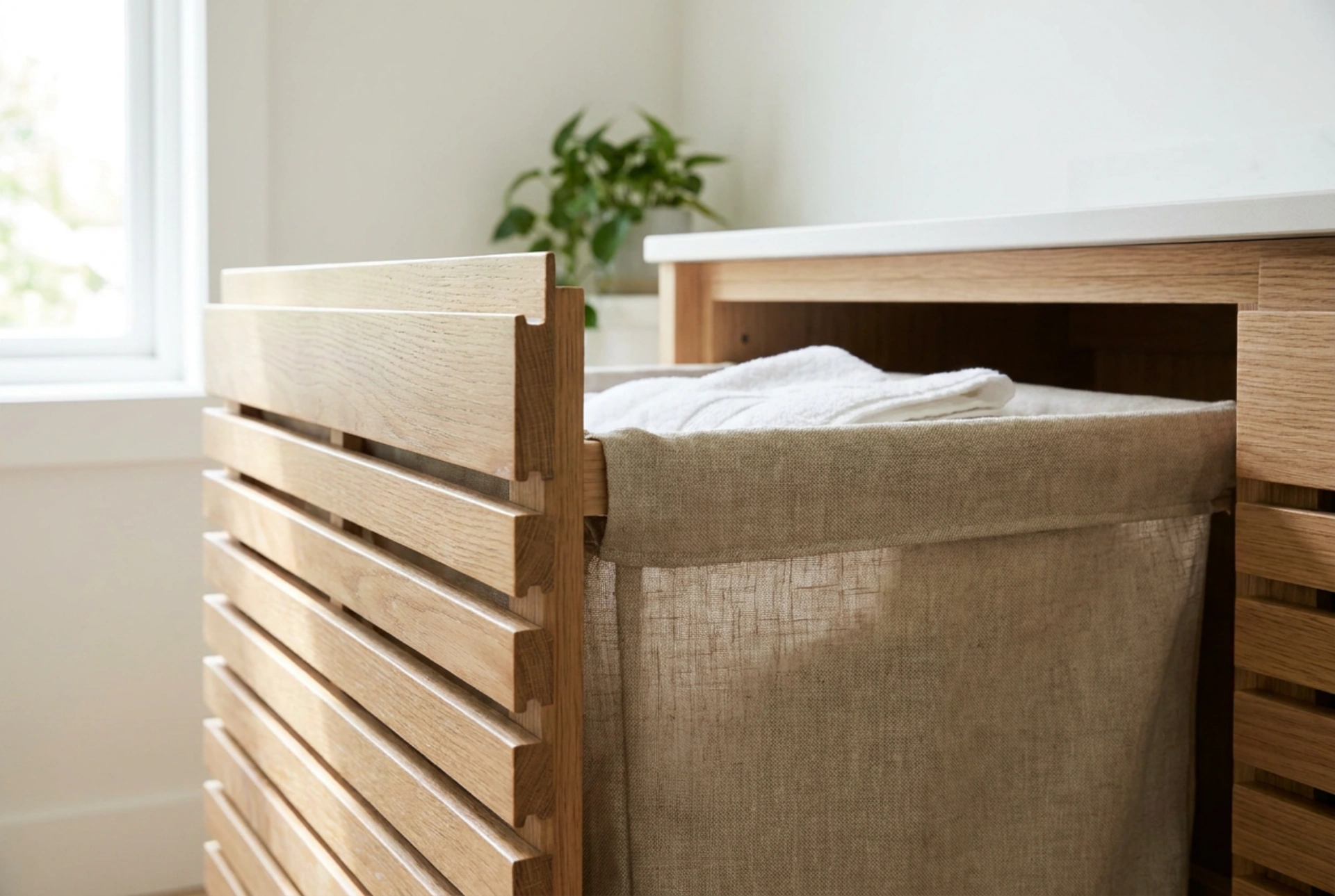
- Upper Ventilation: Design an open gap of at least 15 to 20 millimetres at the top of the cabinet front or integrate a slatted panel design. As the air inside absorbs moisture and warms up, it escapes through the top, pulling fresh air in from the bottom.
Slatted and Perforated Cabinet Fronts
Cabinet doors should not be solid. Slatted fronts, louvred doors, or decorative perforated grilles provide the necessary surface area for diffusion. For a minimalist aesthetic, CNC-milled geometric perforations in the cabinet door offer structural integrity while maintaining a high percentage of open area for unrestricted air molecule exchange.
Material Science: Selecting Breathable Internals
The structural design of the cabinet housing is only half of the equation; the container holding the laundry inside the drawer or pull-out mechanism must also be highly breathable.
Why Solid Plastic Fails
Solid plastic inserts or tubs act as absolute moisture barriers. They trap dampness at the bottom of the pile, forcing the bottom layer of clothing to sit in a saturated zone. This accelerates sour odours and mildew growth.
The Advantage of Wire Mesh and Natural Liners
Replace solid tubs with powder-coated steel wire baskets or open mesh frames. These structures offer nearly 360 degrees of exposure to circulating air. To prevent small items from falling through, line the wire baskets with breathable fabric liners.
- Linen and Hemp: These natural bast fibres are highly hygroscopic (capable of absorbing moisture without feeling wet) and possess a loose, breathable weave that allows rapid evaporation.
- Canvas Cotton: A durable alternative, provided it is unbleached and untreated with water-resistant synthetic coatings that block airflow.
Strategic Placement and Aerodynamic Habits
Where and how you position and use the built-in cabinet affects its long-term performance. Avoid installing built-in laundry units directly adjacent to high-humidity zones like open walk-in showers, unless the bathroom has a powerful active extraction system.
Furthermore, human habits play a critical role. Avoid compacting or pressing down the laundry inside the basket. Compacting forces air out of the fabric layers, creating dense, anaerobic pockets where moisture remains trapped. Instead, allow clothes to fall loosely into the basket, maintaining natural air gaps that work in tandem with the cabinet's convective airflow pathways.