

Securing sensitive papers in a lockable cabinet requires a systematic approach that balances physical preservation with rapid retrieval. Whether protecting financial records, property deeds, or personal identification, the physical structure of a locked storage unit demands specific organizational physics to prevent paper degradation and maximize space utility.
The Physics of Paper Preservation Inside Closed Cabinets
Before organizing files, it is essential to understand the microclimate of a sealed, lockable cabinet. Unlike open shelving, locked cabinets restrict airflow, which can trap ambient moisture and accelerate paper degradation. Cellulose fibers in paper are highly sensitive to relative humidity. High moisture levels (above 60%) promote fungal growth and mold, while excessive dryness (below 30%) causes fibers to become brittle.
To mitigate these risks, choose your cabinet material wisely. Metal cabinets offer superior fire resistance and do not off-gas organic acids, whereas wooden cabinets must be sealed with inert polyurethane to prevent acetic acid from yellowing the paper. Inside the cabinet, place silica gel packets (active desiccant) on each shelf to regulate moisture levels. Additionally, avoid placing the cabinet against exterior walls, where temperature fluctuations can cause condensation inside the locked compartment.
Spatial Architecture and Weight Distribution
Organizing a cabinet is an exercise in structural mechanics. Heavy lever-arch binders and thick folders must be placed on the lowest shelves to lower the cabinet’s center of gravity, preventing tipping hazards when doors are opened or drawers are extended.
Divide the cabinet into three distinct functional zones based on access frequency:
The Active Zone (Eye-Level):
This middle tier is reserved for documents requiring regular updates or retrieval, such as active contracts, monthly utility receipts, and current tax files. Keep these in lightweight, easily accessible suspension folders.The Archive Zone (Bottom Shelf):
This zone holds heavy binders of historical data, tax records from previous years, and documents that must be kept for legal compliance but are rarely accessed.The Secure Core (Top Shelf or Dedicated Lockbox):
The highest, least accessible shelf should house highly sensitive, irreplaceable items like birth certificates, passports, and property deeds, ideally stored within a secondary fire-resistant and waterproof pouch inside the locked cabinet.
Implementing a Mechanical Filing System
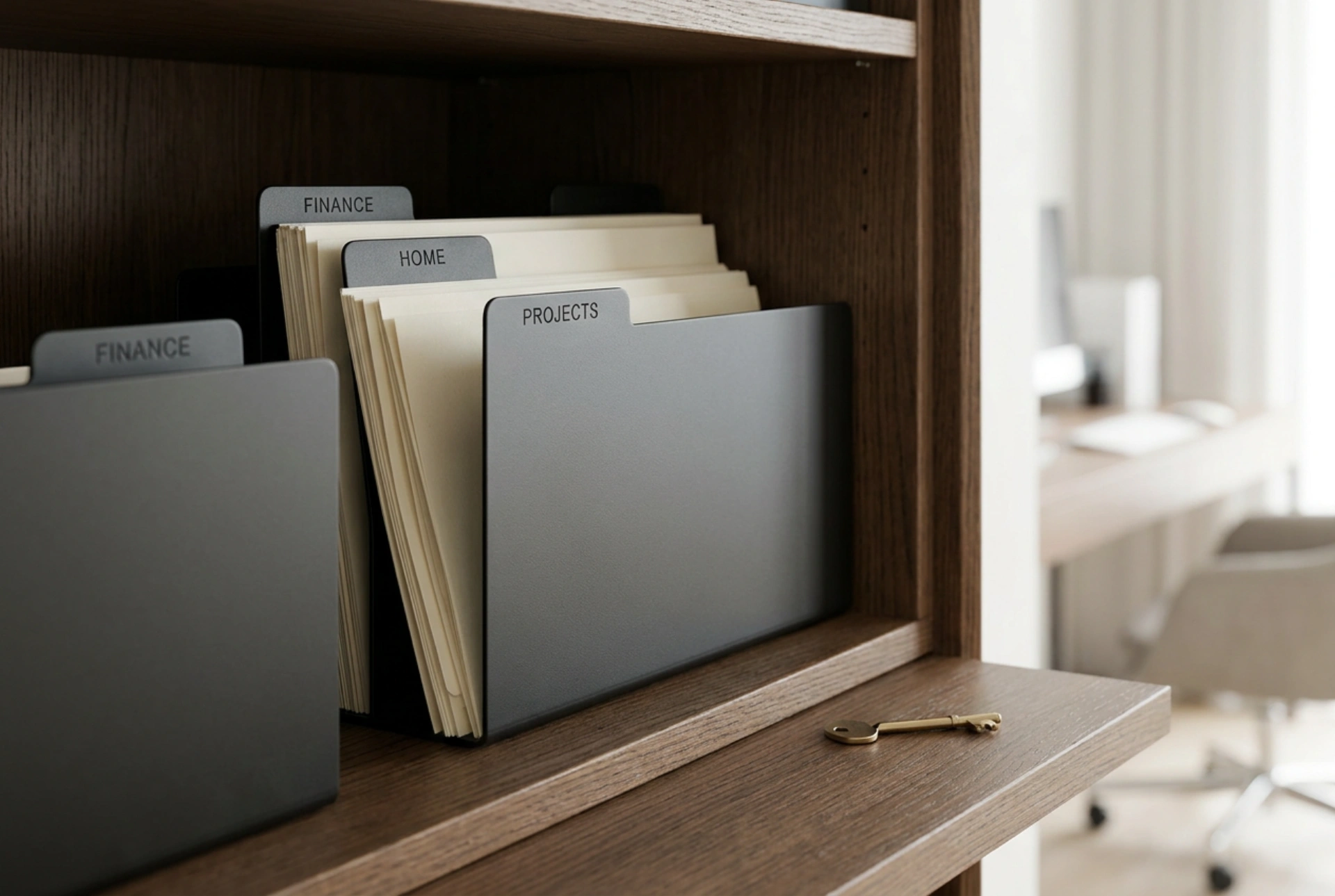
Efficiency relies on reducing the physical friction of finding a document. Stacking papers horizontally on top of one another creates a physical barrier to access, leading to disorganized piles. Instead, utilize a vertical filing system using hanging folders or heavy-duty dividers.
Categorize documents using a clear, consistent taxonomy. Divide your files into primary categories (e.g., Financial, Property, Medical, Identity) and assign each a specific color. Use matte-finish plastic tab inserts on the top of hanging folders to label subcategories. For maximum durability, write labels using pigment-based archival ink, which does not fade under light exposure or degrade when in contact with plastic sleeves. Within each folder, arrange documents chronologically with the newest document at the front, ensuring a logical timeline of events is always preserved.
Key Security and Access Protocols
A lockable cabinet is only as secure as its key management. Standard mechanical wafer-tumbler locks provide basic protection against unauthorized glances but can wear out over time. Lubricate the lock cylinder annually using a dry graphite lubricant; liquid oils or WD-40 should never be used, as they attract dust and clog the internal pins.
Keep a primary key in a secure, separate location, and store a duplicate key off-site or in a heavy-duty mechanical key safe. Avoid labeling the key with the cabinet's exact location; instead, use an anonymous geometric code. To maintain strict document control, attach a simple paper log to the inside of the cabinet door to track when sensitive folders are removed and returned.
Monthly Maintenance Checklist
An organized cabinet requires periodic physical auditing to prevent overcrowding, which bends paper and ruins folder tabs. Every six months, perform the following tasks:
- Check and regenerate silica gel packets by heating them gently if they have saturated.
- Purge expired utility bills or redundant drafts to free up physical space.
- Verify that no document folders are leaning at angles greater than 45 degrees, which can warp the spines of binders.
- Inspect the door hinges and tighten screws to ensure the locking mechanism aligns perfectly without grinding.