

Placing live culinary herbs within arm\'s reach transforms cooking efficiency while preserving the delicate volatile oils that give fresh plants their intense aroma.
The Biological Balance: Light Requirements versus Workspaces
To keep culinary herbs thriving, understanding their photosynthetic needs is critical. Mediterranean herbs such as rosemary, thyme, and oregano require at least six hours of bright, direct sunlight daily to synthesize the essential oils responsible for their pungent flavours. Conversely, soft-stemmed herbs like mint, coriander, and parsley prefer indirect or filtered light to prevent leaf scorch and rapid soil dehydration.
When planning your herb shelf, an east- or west-facing wall near a window is often the most biologically stable location. This positioning offers ample natural light without the extreme midday thermal radiation associated with southern exposure. Avoid placing shelves deep in dark corners; insufficient light causes plants to become leggy as they stretch toward the nearest light source, weakening their stems and reducing leaf production.
Thermal and Moisture Dynamics: Why the Stovetop is a Danger Zone
While mounting an herb shelf directly above the stovetop seems convenient for cooking, it is the worst possible environment for live plants. The cooking process releases steam, airborne grease, and intense convective heat. This combination creates a hostile microclimate that accelerates plant decay.
Rising steam increases local humidity to levels that encourage fungal pathogens, such as powdery mildew. At the same time, microscopic droplets of vaporised cooking fat settle on the leaves, clogging the stomata—the microscopic pores plants use for gas exchange and transpiration. Furthermore, direct heat from boiling pots raises the ambient temperature, causing the plants\' essential oils to volatilise prematurely, leaving you with tasteless herbs. For optimal preservation, keep the shelf at least 60 to 80 centimetres away from any direct heat source, such as cooktops, ovens, or toasters.
The Ergonomics of Prep Zones
Efficient kitchen design prioritises the flow of movement. The ideal placement for an herb shelf is adjacent to your primary food preparation area, typically the countertop space between the sink and the hob. This location minimises physical steps during cooking, allowing you to harvest fresh leaves directly into your prep bowls.
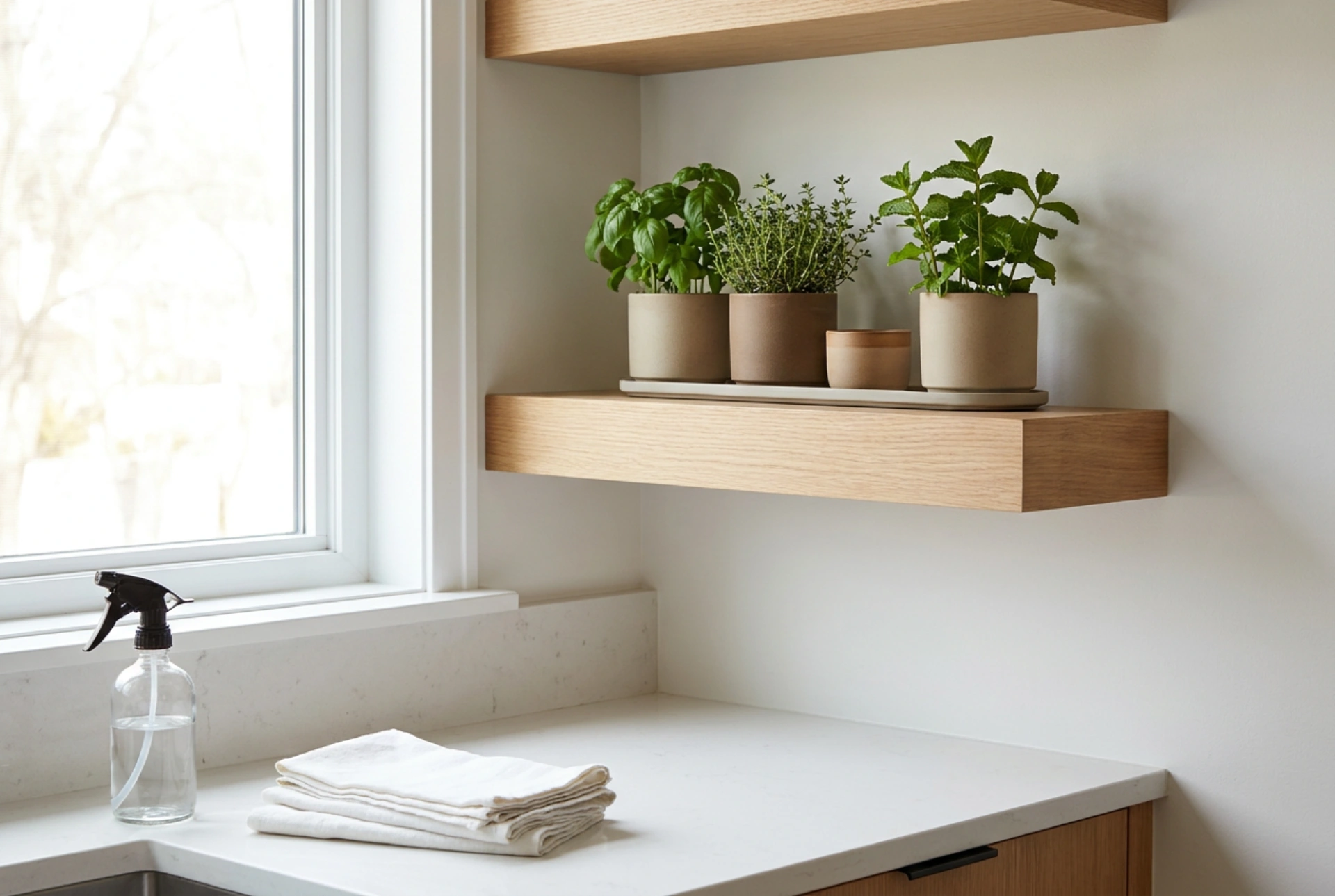
Position the shelf at eye level or slightly lower—approximately 30 to 45 centimetres above the countertop surface. This height keeps the plants within your natural line of sight, reminding you to water them, while keeping the work surface underneath completely clear for chopping boards and bowls. This vertical integration maximises small kitchen footprints without sacrificing functional prep space.
Material Science and Drainage Management
The physical structure of your herb shelf must withstand high moisture levels. Watering potted plants inevitably leads to minor spills and elevated humidity around the shelf itself. Untreated wood will warp, swell, and harbour mould over time. Instead, opt for shelves made from sealed hardwood (such as teak or oak finished with a water-resistant sealant), powder-coated steel, or tempered glass.
Additionally, weight distribution is a key physical factor. Damp soil, ceramic pots, and the shelf itself can easily exceed several kilograms. Ensure the shelf is secured into wall studs or using heavy-duty plasterboard anchors. To prevent water damage to your kitchen walls and countertops, always place herb pots in glazed ceramic saucers or non-porous outer planters that capture excess drainage water, preventing structural rot and keeping the prep area hygienic.