

Hanging towels on door-mounted racks often leads to annoying rattling, paint damage, and trapped moisture that degrades wood or laminate surfaces. Understanding the physical forces and air circulation principles at play allows you to mount these racks securely while protecting your door and ensuring rapid drying.
The Physics of Impact: Eliminating Door Rattling and Scratches
Over-the-door towel racks typically suffer from a mismatch between the hook width and the door thickness. Standard interior doors are usually 35mm to 40mm thick, whereas generic over-the-door hooks are often manufactured with a wider clearance of 45mm to 50mm to ensure they fit a wide variety of doors. This structural gap creates a fulcrum. Whenever the door is opened or closed, kinetic energy transfers to the rack, causing it to pivot and strike the door face.
To eliminate this mechanical movement and the resulting noise and abrasion, you must fill the void space with high-friction, energy-absorbing materials. Adhesive ethylene-vinyl acetate (EVA) foam strips or polyurethane silicone bumpers are ideal for this purpose. When applied to the inner side of the bracket hook, these materials compress slightly, creating a snug friction fit that prevents lateral slide and cushions vertical impact. Additionally, applying small felt pads to the lower contact points of the rack frame prevents the metal or plastic structure from swinging against the door face when towels are pulled off.
The Chemistry of Wood Decay: Why Damp Towels Damage Doors
A wet towel hanging directly against a door creates a microclimate of high relative humidity. Wooden doors, even those with paint or lacquer finishes, are hygroscopic, meaning they absorb moisture from the surrounding environment. When damp cotton remains in prolonged contact with the door surface, capillary action draws water molecules into the wood pores, micro-cracks in the paint, or seams in the laminate veneer.
Over time, this trapped moisture triggers several destructive chemical and biological processes. First, it causes the cellulose fibres in the wood to swell, leading to warping of the door panel. Second, the constant moisture breaks down the adhesive bonds in veneered doors, causing the outer layer to bubble and peel. Finally, this dark, stagnant interface provides the perfect breeding ground for mould spores, which digest the organic binders in the paint and wood, leaving permanent dark stains.
Creating a Thermal Chimney: The Importance of Airflow
To prevent moisture damage, you must facilitate rapid evaporation through convection. Liquid water in a wet towel evaporates into the surrounding air as water vapour. This process requires thermal energy and a constant supply of unsaturated air. If a towel hangs flat against a door, air cannot circulate behind it, creating a pocket of saturated air that halts further evaporation.
The solution lies in maintaining a physical offset. An effective over-the-door towel rack must feature extended spacer bars that hold the hanging rails at least 3 to 5 centimetres away from the door surface. This gap acts as a mini thermal chimney. As the damp towel cools the air immediately adjacent to it through evaporation, this cooler, denser air sinks, pulling drier room air down from the top and drawing it in from the sides. This continuous convective airflow ensures that both sides of the towel dry evenly and prevents moisture from condensing on the door's surface.
Step-by-Step Installation for Maximum Protection
To mount your over-the-door rack without risking structural or aesthetic damage, follow this precise sequence:
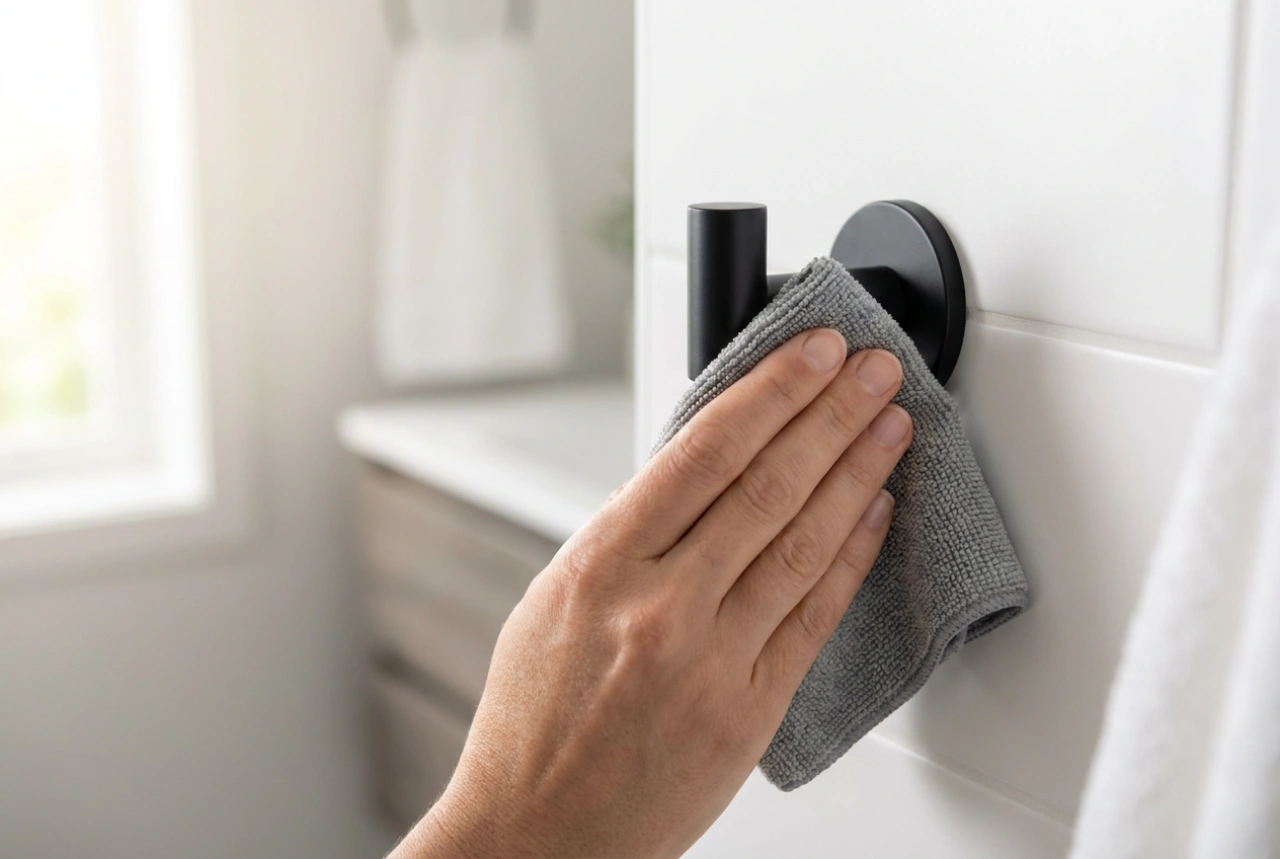
- Degrease the contact points: Clean the top edge and the face of the door where the rack will rest using isopropyl alcohol. This removes dust, sebum, and household oils, ensuring optimal adhesion for protective pads.
- Apply protective barriers: Cut strips of thin EVA foam or high-density felt and adhere them directly to the inside surfaces of the over-the-door hooks. If the rack has lower support bars, apply spherical silicone bumpers to the back of these bars where they meet the door face.
- Test the door clearance: Place the rack over the door and gently close it. Ensure the top hooks do not rub against the door frame. If the fit is too tight and causes friction against the frame, replace thick foam with thin, low-friction PTFE tape.
- Optimise towel placement: Spread towels out fully across the bars rather than bunching them together. Maximising the exposed surface area accelerates evaporation and reduces the total humidity load on the door interface.