

Setting up metal shelving in a basement requires more than just choosing a corner; it demands an understanding of basement microclimates, load physics, and material science to prevent structural failure and rust. Properly planning your storage layout ensures safety, maximizes space, and preserves your home supplies in optimal conditions.
Understanding Material Science: Galvanisation vs. Powder Coating
Basements are naturally high-humidity environments where relative humidity frequently exceeds sixty percent. Under these conditions, bare iron and steel rapidly undergo oxidation—a chemical reaction where iron, oxygen, and moisture combine to form hydrated iron(III) oxide, commonly known as rust. To prevent this, you must select metal shelving with appropriate surface treatments.
Galvanised steel shelves are coated with a thin layer of zinc. Zinc acts as a sacrificial anode; it oxidises more readily than the underlying steel, protecting the structural core even if the surface is scratched. This makes galvanised shelves highly resistant to dampness. Alternatively, powder-coated steel utilizes an electrostatic charge to apply a dry polymer powder, which is then cured under heat to form a hard, non-porous physical barrier. While highly durable, if a powder-coated surface is deeply chipped, moisture can penetrate beneath the layer, leading to hidden oxidation. For high-humidity basements, hot-dip galvanised metal provides superior long-term chemical defense.
The Physics of Load: Weight Distribution and Mechanics
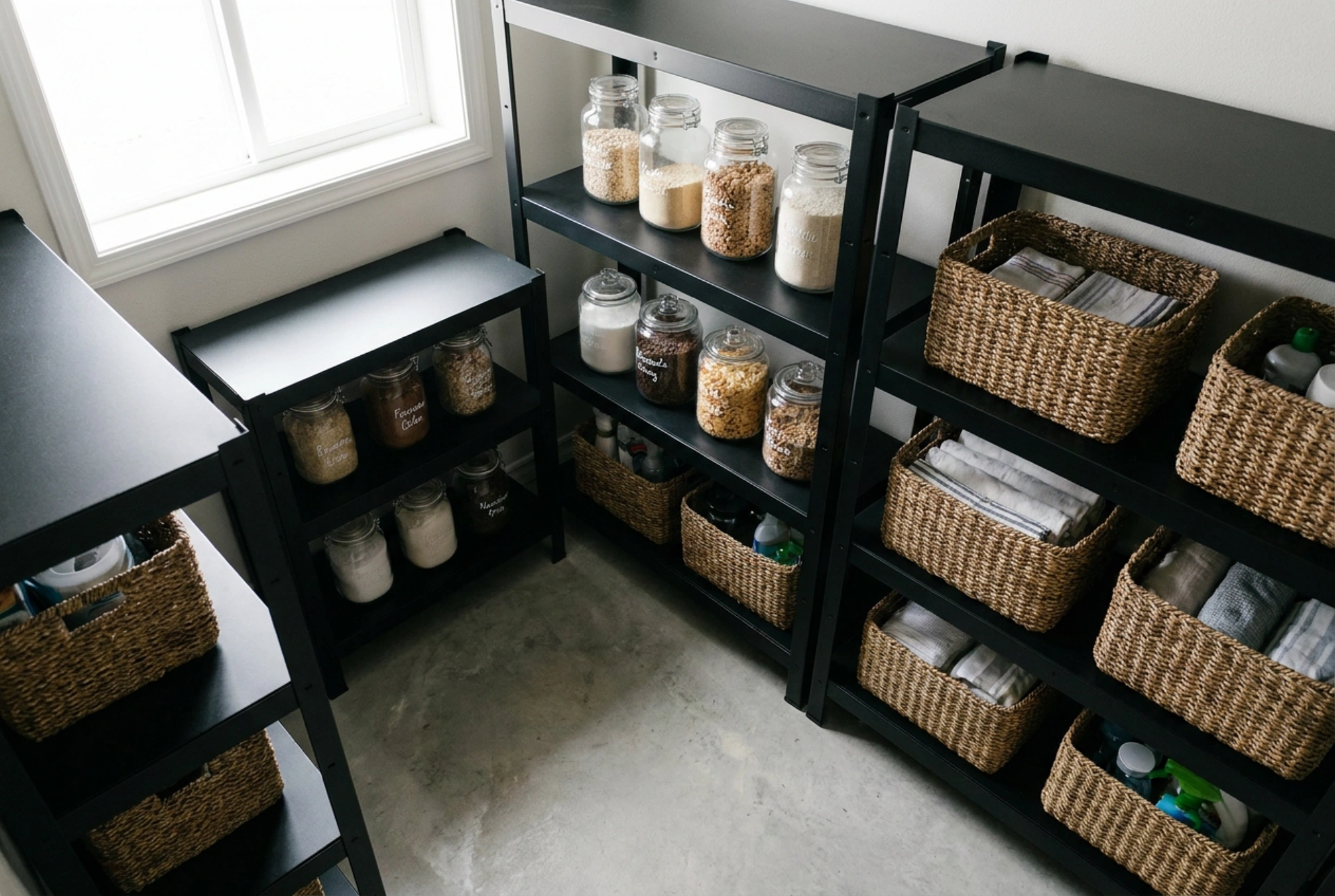
When organizing heavy home supplies, such as glass jars of preserves, canned goods, and emergency water storage, understanding structural mechanics is vital to prevent shelf deflection (sagging) and tipping. Every shelving unit has a maximum load capacity, which assumes an evenly distributed load across the surface.
To maintain a low center of gravity and ensure structural stability, always place the heaviest items on the lowest shelves. This minimizes the tipping moment of the unit. According to basic physics, the higher the mass is distributed, the easier it is for a lateral force to cause a rotational tipping force (torque) around the base. Furthermore, position heavier items closer to the vertical upright supports rather than the middle of the shelf span. This reduces the bending moment on the shelf panels, preventing permanent deformation of the metal.
Optimizing Airflow and Preventing Microclimates
Basement walls are often cooler than the ambient indoor air, creating a thermal boundary layer. When warm, humid air comes into contact with these cold walls, condensation occurs. Placing metal shelving directly against basement walls traps moisture, creating a stagnant microclimate that encourages mold spore germination and accelerates metal corrosion.
- The 5-Centimetre Rule: Always leave a gap of at least five to ten centimetres between the shelving unit and the basement walls to allow for natural thermal convection and airflow.
- Elevation: Keep the bottom shelf elevated at least fifteen centimetres off the concrete floor. Concrete is porous and absorbs moisture from the ground via capillary action, which can transfer directly to items stored too low.
- Perforated Shelves: Choose wire mesh or perforated metal shelves over solid sheet metal. Perforations facilitate vertical air circulation, reducing moisture buildup and temperature stratification.
Order of Operations for Installation
A stable installation begins with leveling. Basement floors are frequently sloped toward floor drains, meaning a standard shelving unit will not sit perpendicular to the ground. Use a spirit level to assess the slope. If the shelving does not feature adjustable levelling feet, use heavy-duty plastic or metal shims under the upright posts to distribute the load evenly across the floor surface.
Once levelled, secure the unit to the wall using appropriate anchoring hardware. Even a perfectly balanced shelf can tip if loaded unevenly. Tension anchors or sleeve anchors mounted into the concrete or brick wall provide the necessary tensile strength to resist pulling forces. Assemble the shelving system from the bottom up, securing the lowest horizontal beams first to establish a rigid foundation before climbing vertically.