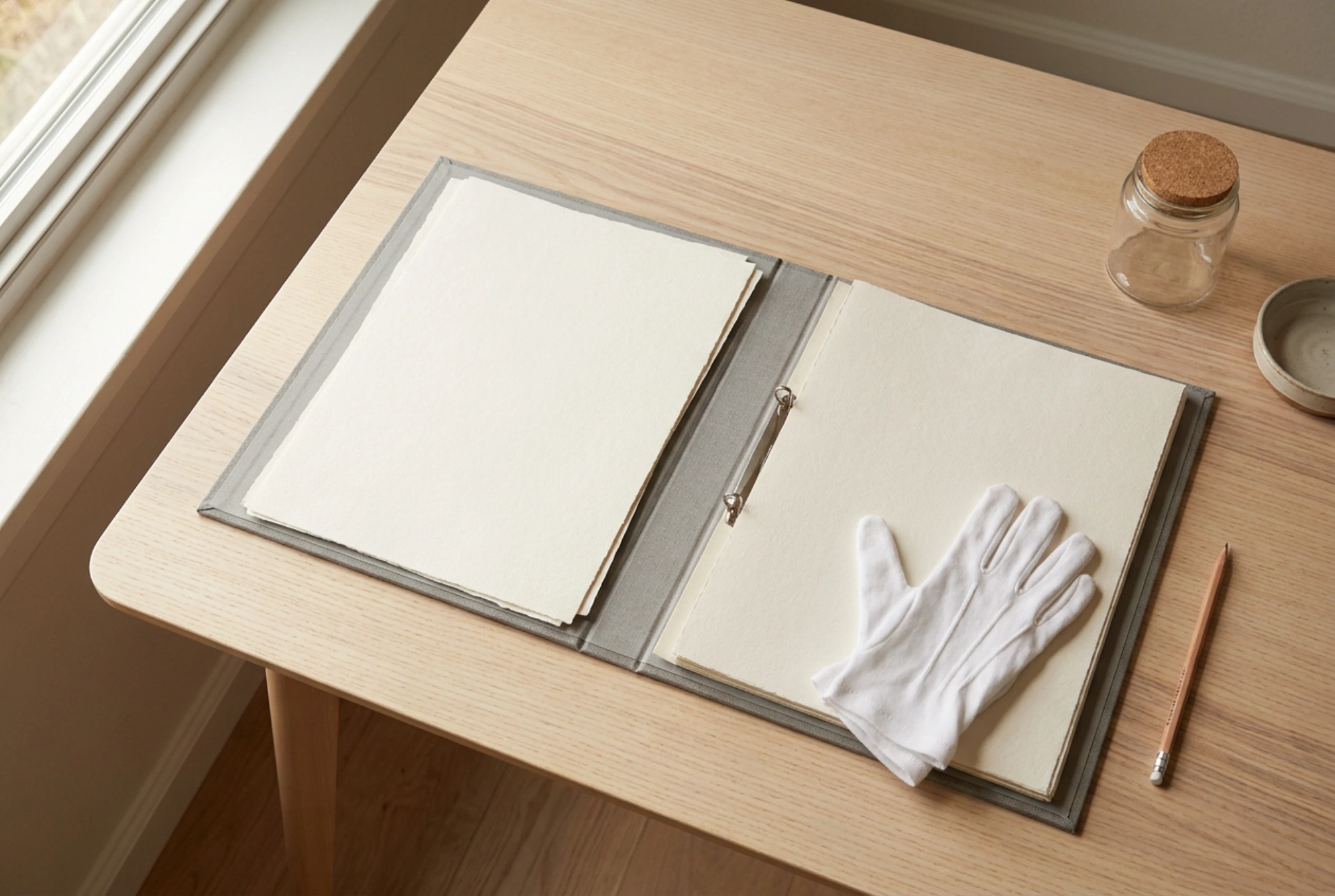


Large-format photographic prints require specialised physical support and chemical protection to prevent creasing, warping, and molecular degradation over time. Storing these delicate, expansive sheets in albums requires a precise understanding of paper tension, polymer safety, and mechanical stress distribution.
The Physics of Creasing and Material Tension
Large photographic prints are highly susceptible to deformation due to their surface-area-to-thickness ratio. Paper is a hygroscopic material, meaning it continuously absorbs and releases moisture from the surrounding air. In a photographic print, the paper base and the emulsion layer (typically gelatin or polymer-based) expand and contract at different rates when relative humidity fluctuates. This differential expansion creates internal mechanical shear, which manifests as curling or buckling.
When a curled print is forced flat inside an unsuitable album page, this tension is concentrated into localized creases. Furthermore, when pages are turned, larger sheets experience greater bending moments. Without rigid structural support, gravity acts on the unsupported areas of the print, causing the paper to sag, drape, and eventually crease permanently under its own weight.
Selecting Chemically Inert Materials
Preserving the structural integrity of large prints requires choosing the right album materials. Conventional adhesives and unstable plastics release volatile organic compounds (VOCs) that degrade both the paper substrate and the image emulsion.
- Inert Polymers: Only use sleeves made from uncoated polyester, polypropylene, or polyethylene. Polyester is the most rigid and optically clear, providing excellent structural support that prevents the print from flexing. Avoid polyvinyl chloride (PVC) at all costs; PVC degrades over time, releasing hydrochloric acid and plasticisers that turn prints yellow and make the emulsion sticky, leading to irreversible adhesion and creasing.
- Acid-Free, Lignin-Free Mounts: If mounting prints on paper pages, ensure the paper is alkaline-buffered (containing calcium carbonate) to neutralise ambient acids. However, for cyanotypes or albumen prints, unbuffered acid-free paper is required, as alkalinity can degrade these specific historic emulsions.
Insertion Techniques and Mechanical Support
The physical act of placing a large print into an album sleeve is a common point of failure where creasing occurs. To safely handle and insert large prints, specific physical protocols must be observed.
Handling and Friction Reduction
Always wear clean, lint-free cotton or nitrile gloves. Skin oils (sebum) contain fatty acids that transfer to the print, attracting moisture and dust, which weakens the paper fibres over time. To insert a large, flexible print into a tight polyester sleeve without bending the corners, use an auxiliary carrier sheet. Slide a rigid, acid-free card behind the print, slide both into the sleeve together, and then gently slide the carrier card out while holding the print in place. This redistributes the friction across the entire surface rather than concentrating pushing forces on the fragile edges of the print.
The Role of Photo Corners
Never glue large prints directly to album pages. Adhesives bond the print permanently to the backing, preventing the natural, micro-scale expansion and contraction of the paper fibres. When temperature or humidity shifts, the restricted paper will buckle and crease. Instead, use archival polyester photo corners. These secure the print at its outer limits while allowing the sheet to float and shift slightly within the mount, eliminating structural stress.
Album Orientation and Environmental Controls
The mechanical forces acting on an album during storage are highly dependent on its physical orientation and the surrounding climate.
Horizontal vs. Vertical Storage
While standard books are stored vertically, large-format albums benefit significantly from flat, horizontal storage. In a vertically stored album, gravity pulls downward on the large pages. Over time, the weight of the heavy prints causes the pages to sag within the binding, creating ripples at the bottom edges of the prints. Storing albums flat distributes gravitational pull evenly across the entire surface of the print, preventing sag-induced creasing.
Stabilising the Microclimate
To prevent the expansion cycles that lead to buckling, store albums in a controlled environment. Aim for a stable relative humidity between 30% and 50%, and temperatures below 20°C. Rapid fluctuations in these metrics are far more damaging than constant, slightly sub-optimal levels, as rapid transitions force the outer edges of the print to expand or contract before the core of the paper can adapt, resulting in severe edge-warping.