

Roasted coffee beans are highly sensitive organic structures that begin to degrade the moment they leave the roaster. Utilizing a vacuum canister alters the atmospheric conditions surrounding the beans, directly slowing down the chemical reactions responsible for stale flavours.
The Chemistry of Coffee Degradation
To understand why vacuum storage is effective, one must look at the lipid oxidation and loss of volatile compounds in roasted coffee. During roasting, lipids (fats) within the coffee beans migrate to the surface. When exposed to atmospheric oxygen, these lipids undergo auto-oxidation, breaking down into rancid-tasting aldehydes and ketones. Simultaneously, the highly volatile organic compounds (VOCs) that give coffee its distinct floral, fruity, or nutty aroma begin to escape into the surrounding air. This process, known as diffusion, is driven by a concentration gradient; the high concentration of volatiles within the bean naturally moves toward the lower concentration in the surrounding atmosphere. Without a barrier to limit this atmospheric exchange, coffee loses its complex flavour profile within days.
How Vacuum Systems Alter the Environment
A standard airtight container traps a significant volume of oxygen inside alongside the coffee beans. A vacuum canister, however, addresses this by removing a substantial portion of the air from the chamber. There are two primary mechanical designs for domestic vacuum canisters: displacement plungers and integrated vacuum pumps. Displacement plungers physically push the air out as they are pressed down, reducing the headspace volume to near zero. Integrated pump systems, whether manual or electric, extract air through a one-way valve, creating a low-pressure environment inside the vessel. By reducing the ambient pressure, the partial pressure of oxygen is drastically lowered. With fewer oxygen molecules available to collide with the lipid-coated surfaces of the beans, the rate of oxidation drops exponentially.
Managing Carbon Dioxide and Degassing
Freshly roasted coffee contains a significant amount of trapped carbon dioxide (CO2), a byproduct of the roasting process. Over the first few weeks post-roast, the beans naturally release this gas in a process called degassing. In a completely sealed, non-vacuum container, the buildup of CO2 increases the internal pressure, which can actually help slow down oxidation by displacing oxygen, but it does not stop VOC diffusion. A high-quality vacuum canister balances this dynamic. When you pull a vacuum, you encourage initial degassing, but the lack of oxygen prevents degradation. Many advanced vacuum canisters incorporate a one-way valve system that allows CO2 to escape without allowing oxygen back in. This maintains a stable, inert environment where the beans are surrounded primarily by their own released carbon dioxide rather than reactive oxygen.
Materials and Environmental Factors
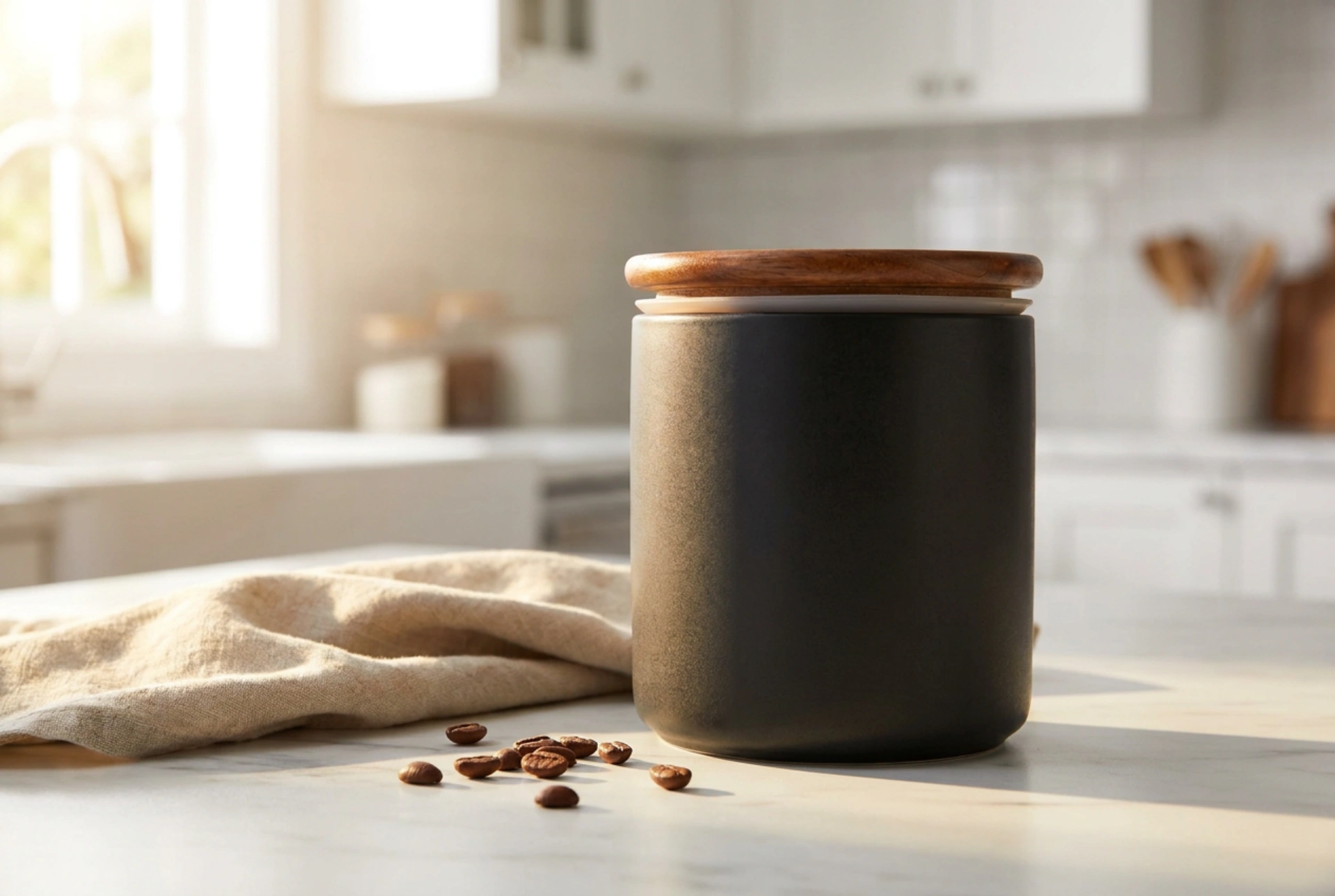
The efficacy of a vacuum canister is heavily influenced by its physical construction. Materials must be completely non-porous and chemically inert. Matte ceramics, stainless steel, and tinted borosilicate glass are ideal because they do not absorb oils or impart off-flavours. Furthermore, light exposure must be strictly controlled. Ultraviolet (UV) radiation acts as a catalyst for photo-oxidation, accelerating the breakdown of lipids even in low-oxygen environments. Therefore, opaque or heavily UV-shielded canisters are structurally superior to clear glass or plastic alternatives. Temperature also plays a critical role: reaction rates double with every ten-degree Celsius increase. Vacuum canisters should be stored in a cool, dark cupboard, away from heat sources like ovens, refrigerators, or direct sunlight.
A Systematic Storage Protocol
To maximise the lifespan of your coffee beans, implement this systematic approach to storage:
- Minimise headspace: If using a plunger-style canister, always press the seal directly onto the surface of the beans to eliminate dead air space.
- Pump consistently: Re-establish the vacuum seal every time you open the canister, as fresh oxygen is introduced during every extraction.
- Avoid thermal fluctuations: Keep the canister in a temperature-controlled environment; avoid placing it near windows, stoves, or cooling vents.
- Keep it clean: Periodically wipe down the inner walls and rubber gaskets of the canister with a dry microfibre cloth to remove residual coffee oils, which can oxidise over time and contaminate fresh batches.