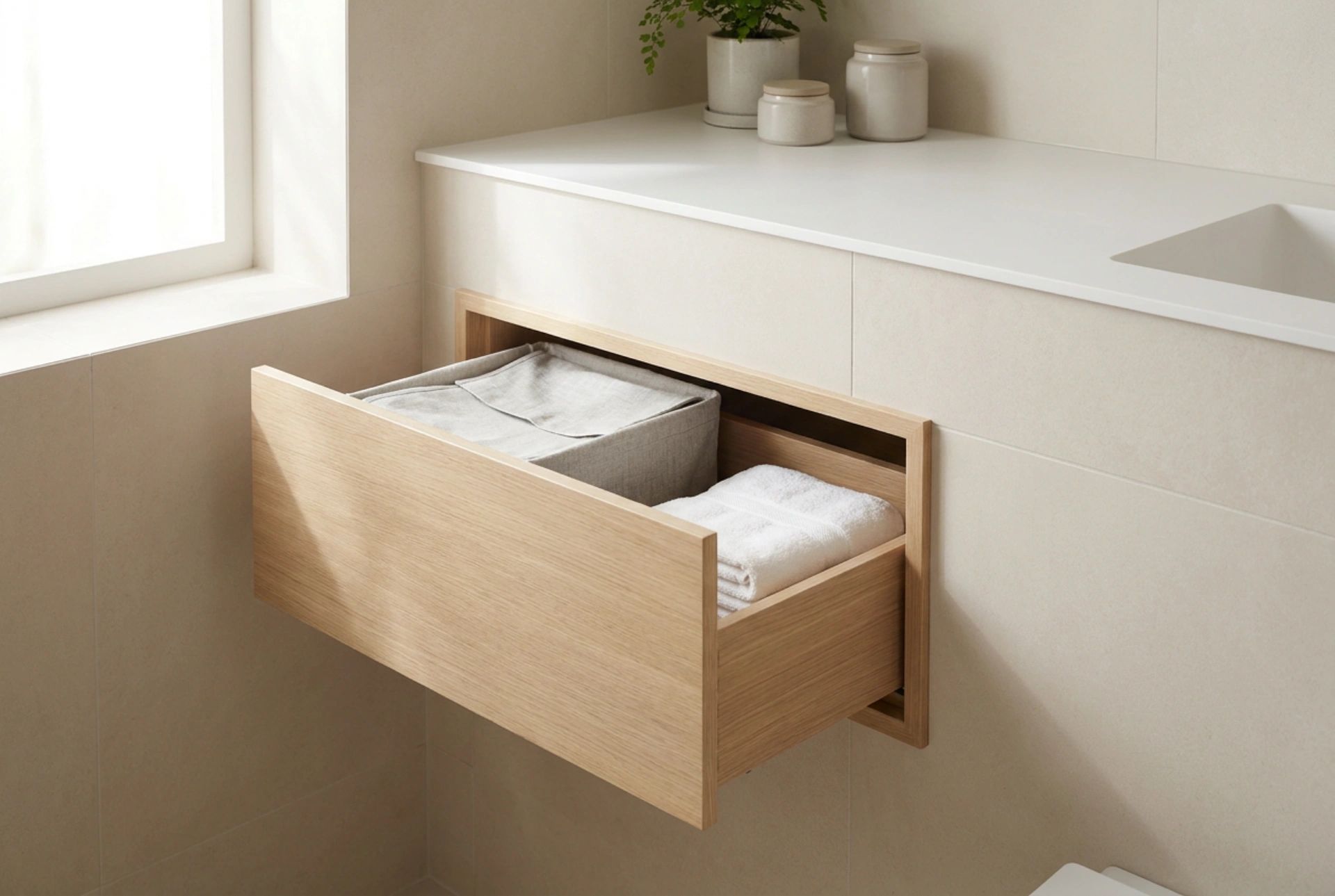


Integrating a laundry basket directly into your bathroom cabinetry is an excellent way to eliminate visual clutter, but executing this design successfully requires careful planning of ventilation, weight distribution, and material science. Without proper air circulation and moisture-resistant engineering, a hidden laundry compartment can quickly become a breeding ground for mold and structural damage.
Addressing Moisture: The Science of Air Circulation
Dirty laundry, particularly damp towels and gym wear, continuously releases moisture into its surrounding environment. When confined within a sealed wooden cabinet, this moisture elevates the relative humidity, creating a microclimate ideal for the proliferation of mold, mildew, and musty odors. To prevent this, your cabinet design must facilitate constant passive ventilation.
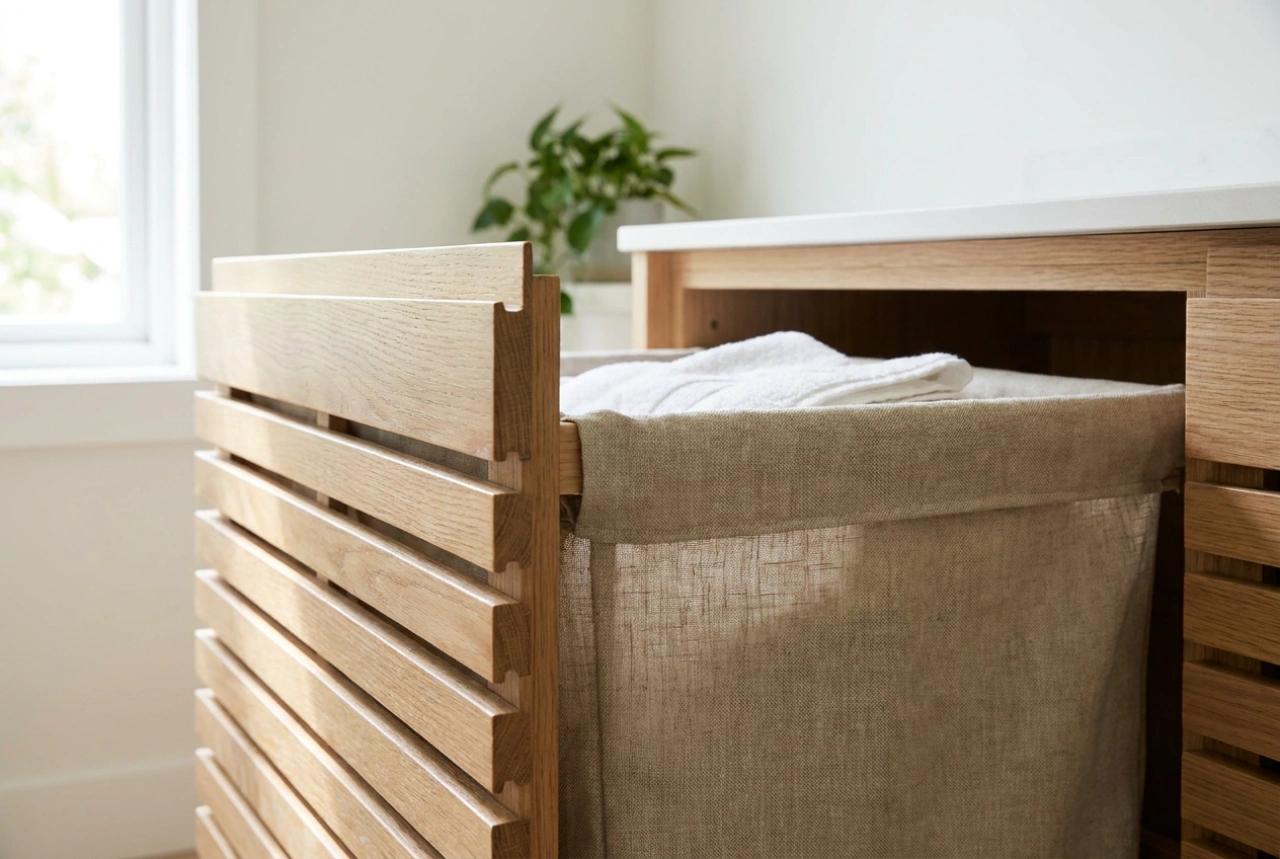
Airflow relies on temperature differentials and pressure gradients. To encourage natural convection, a laundry cabinet should have both an air intake and an exhaust. You can achieve this by incorporating a slatted or perforated cabinet front, or by leaving an intentional 20-millimetre gap at the top and bottom of the door. Inside the cabinet, avoid solid plastic tubs. Instead, opt for breathable wire mesh baskets, perforated steel containers, or removable canvas bags suspended on a frame. These materials allow air to circulate freely through the fabrics, accelerating the evaporation of residual moisture.
Choosing Materials That Withstand Steam and Humidity
Bathrooms are high-humidity zones subject to frequent temperature fluctuations. Standard furniture-grade particleboard will swell and delaminate when exposed to these conditions. When planning your custom cabinetry, the core materials and edge-binding techniques are critical to the longevity of the structure.
For the cabinet carcass, moisture-resistant MDF (often tinted green) or marine-grade plywood are the preferred substrates. If utilising melamine-faced boards, the type of edge banding applied is paramount. Standard EVA (Ethylene Vinyl Acetate) hot-melt adhesives can soften when exposed to steam and heat, leading to edge peeling. Specify polyurethane (PUR) adhesive bonding or laser edge banding. PUR adhesives undergo a chemical cross-linking reaction that creates an incredibly strong, waterproof barrier, preventing moisture from penetrating the wood fibres beneath.
Mechanisms, Load Distribution, and Usability
A full laundry basket is heavy; a week’s worth of cotton towels can easily weigh upwards of 10 to 15 kilograms. The physical strain placed on the cabinet hinges and runners during daily operation must be factored into your architectural plan. There are two primary mechanism designs: tilt-out fronts and pull-out drawers.
- Tilt-out (drop-down) mechanisms: These rotate on a bottom pivot hinge and are held at a specific opening angle by retaining brackets or gas struts. Because gravity pulls the weight outward as the door opens, heavy-duty bottom hinges and robust stays are mandatory to prevent the door from ripping out of its fixings over time.
- Pull-out drawer systems: This design mounts the laundry basket directly onto full-extension drawer runners. To handle the dynamic load of tossing and retrieving heavy garments, select heavy-duty, soft-close runners rated for at least 30 to 40 kilograms. Full-extension runners are vital, as they allow the basket to clear the countertop entirely, enabling easy vertical extraction of the laundry liner.
Calculating Volume and Internal Compartments
To determine the correct size of your laundry cabinet, you must calculate the required volume based on your household's washing machine capacity. A standard 7-kilogram washing machine corresponds to approximately 50 to 60 litres of dry laundry. Therefore, a single person or couple requires a minimum basket capacity of 60 litres, while a family of four will benefit from a dual-compartment system totalling 120 litres.
If space permits, planning a multi-compartment pull-out system is highly efficient. Separating darks, lights, and delicates at the point of disposal saves significant time and physical labour on washing day. Ensure the internal height of the cabinet accommodates the basket depth plus a 50-millimetre clearance at the top to prevent garments from catching on the cabinet framework as the drawer is opened or closed.