

Managing a chaotic collection of food containers often feels like solving an unstable geometric puzzle. Establishing a systematic, material-focused storage method restores order, maximises cabinet volume, and ensures every base quickly meets its matching lid.
The Geometry of Nesting: Grouping by Material and Shape
The primary rule of efficient container storage is nesting. However, nesting cannot be done indiscriminately. Grouping containers strictly by their material and geometric shape is essential for maintaining order and preventing physical damage. Glass and plastic behave very differently under physical compression.
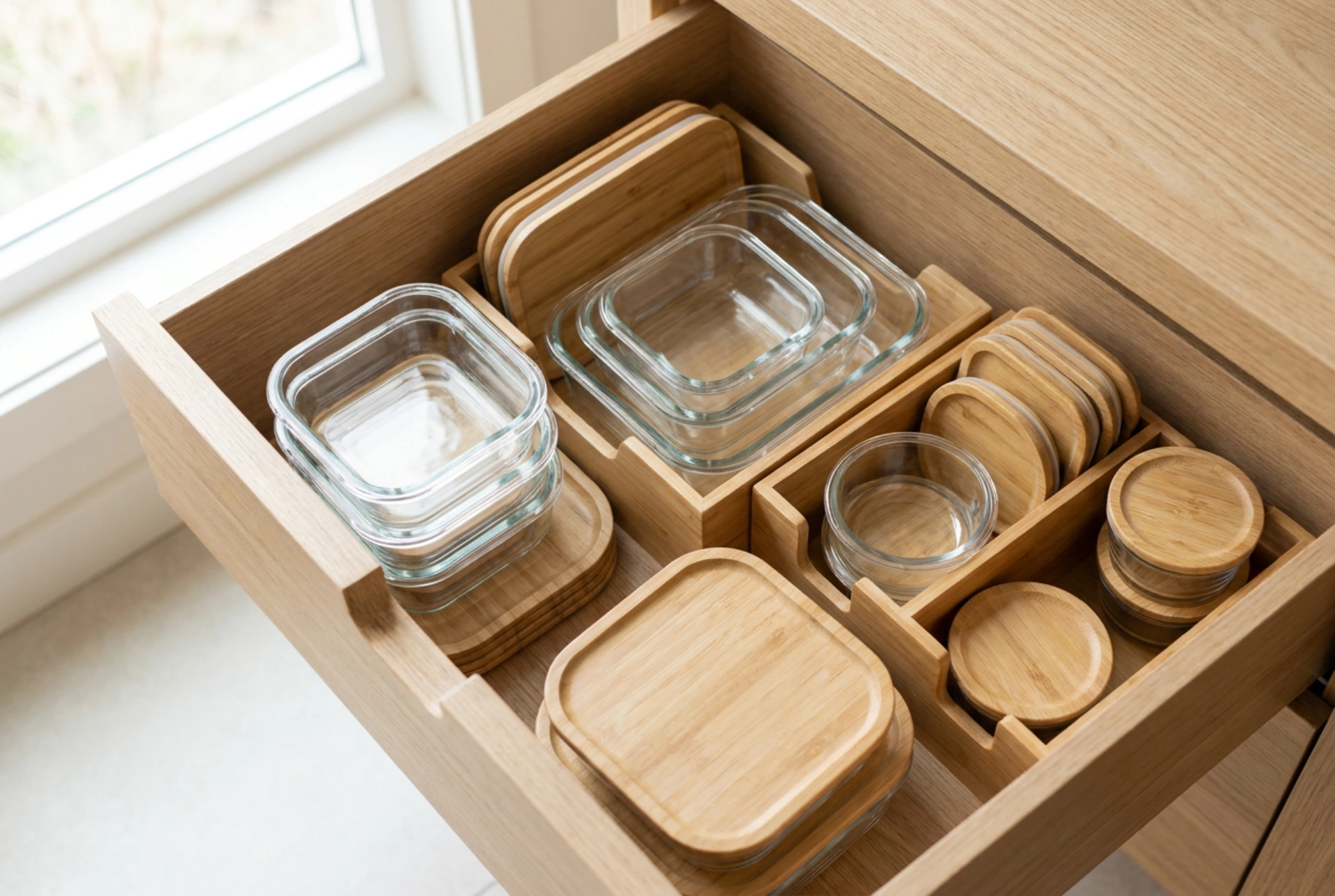
Tempered glass containers require precise sizing to avoid structural tension. Stacking glass bases of identical sizes directly inside one another can create a vacuum or cause micro-scratches that weaken the glass over time, making it prone to thermal shock. When nesting glass, always place a small buffer—such as a clean paper towel or a reusable silicone mat—between the layers to absorb friction. Plastic containers, being more flexible, nest easily but are prone to tipping if stacked too high. Group round containers within round ones, and rectangular shapes within rectangular ones. This alignment minimises dead space in the cabinet corners and prevents the stacks from tumbling.
The Danger of Sealed Storage
Never store containers with their lids sealed tightly shut. Even after thorough washing and drying, minute amounts of residual moisture can remain trapped. Sealing the container creates an anaerobic environment, which promotes the growth of microscopic mould spores and locks in stale food odours. Storing bases and lids separately allows constant air circulation, keeping the materials fresh and dry.
The Separation Principle: Decoupling Bases and Lids
The most common organisation mistake is attempting to store containers with their lids attached, which consumes up to three times more physical volume than necessary. The key to a streamlined cabinet is decoupling.
First, nest the empty bases together, starting with the largest at the bottom and working upwards to the smallest. Once the bases are compacted, turn your attention to the lids. Storing lids horizontally in a pile inevitably leads to sliding, clutter, and lost matches. Instead, utilise vertical space. By using tension-rod dividers, small wire racks, or dedicated wooden pegs inside a deep drawer or shelf, you can file lids vertically like vinyl records. Arrange them by size from front to back, ensuring instant accessibility. This vertical filing system allows you to slide out the exact lid you need without disrupting the entire cabinet.
The Chemistry of Maintenance: Preventing Warping and Odours
An organised system only works if the components remain functional. To maintain a stackable collection, you must preserve the physical integrity of the materials, especially plastics like polypropylene.
Polypropylene is highly susceptible to heat warping. When washed at extreme temperatures in a dishwasher, the high-heat drying cycle can subtly deform plastic lids. Even a millimetre of warping can prevent a lid from snapping securely onto its base or cause it to resist nesting. To prevent this, always place plastic components on the top rack of the dishwasher, furthest from the heating element, or wash them by hand in warm water. For stubborn odours absorbed by plastic's hydrophobic surface, create a paste of sodium bicarbonate and water. Apply it to the interior surfaces, let it sit for thirty minutes, and rinse. Sodium bicarbonate acts as a mild amphoteric compound that neutralises acidic and basic odour molecules, restoring the material to a neutral state.
Establishing a Sustainable Kitchen Workflow
To keep your cabinet structured over the long term, implement a simple rotation habit. When putting away clean containers, place them at the bottom of the nested stack or at the back of the lid file. This ensures even wear across your entire collection. Once every few months, conduct a rapid matching audit. Any base missing a lid, or any lid warped beyond utility, should be removed from the cabinet. Keeping only complete, functional pairs prevents the gradual accumulation of useless clutter and ensures your kitchen storage system remains highly efficient.