

Maintaining the deep, uniform appearance of an outdoor black mailbox requires understanding how environmental factors like UV radiation, airborne pollutants, and hard water minerals interact with powder-coated or painted metal. Regular improper cleaning can cause micro-scratches that diffuse light, making the surface look faded and grey instead of a crisp matte or satin black.
Understanding the Enemies of Black Outdoor Surfaces
Black outdoor fixtures absorb the full spectrum of visible light, which also means they absorb a significant amount of thermal energy from solar radiation. This elevated surface temperature accelerates chemical reactions, including photo-oxidation caused by ultraviolet (UV) rays. Over time, UV light breaks down the polymer binders in the paint or powder coating, leading to a phenomenon known as chalking, where loose pigment particles migrate to the surface as a whitish powder.
Additionally, rainwater and irrigation systems deposit dissolved minerals—mostly calcium carbonate and magnesium—onto the surface. As the water evaporates quickly due to the solar heating of the black metal, it leaves behind stubborn, white crystalline rings known as hard water spots. Simply wiping these dry deposits can grind the hard mineral crystals into the coating, creating permanent abrasions that permanently dull the finish.
Phase 1: Safe Decontamination and Washing
To clean a black mailbox without causing microscopic physical damage, you must use a lubrication-first approach. Never dry-dust or use abrasive scrubbers like nylon sponges. The ideal cleaner is a pH-neutral, non-ionic surfactant solution. Non-ionic surfactants lower the surface tension of water, allowing it to penetrate and lift organic dirt, soot, and pollen without chemically attacking the underlying metal or coating.
- Preparation: Gently flush the mailbox with clean, low-pressure water to wash away loose grit and dust particles.
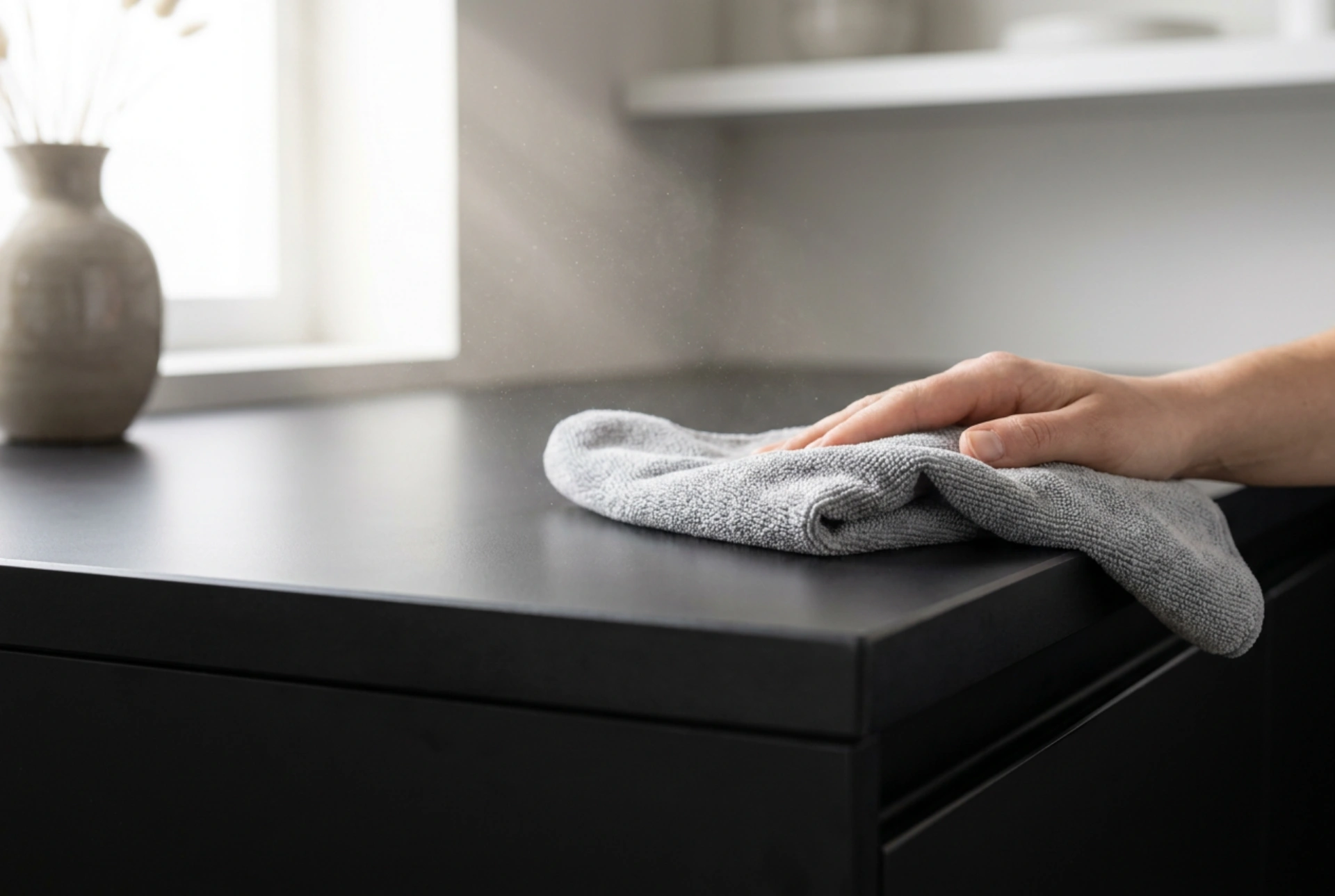
- Application: Mix a few drops of a neutral surfactant in lukewarm water. Use a high-density, soft microfiber cloth. Microfiber is crucial because its split-polyester fibers lift and trap particles inside the fabric structure, rather than dragging them across the metal surface.
- Technique: Wipe in straight, linear motions rather than circular patterns. If a particle does cause a micro-scratch, a straight line is far less visible to the human eye under direct sunlight than a circular swirl mark.
Phase 2: Neutralizing Mineral Deposits and Acid Rain Residue
If your black mailbox has developed dull, white water spots that do not wash away with a neutral surfactant, you are dealing with mineral scaling. Because these minerals are alkaline, they must be dissolved using a mild acid. Avoid strong industrial mineral acids which can corrode raw metal elements or strip the coating. Instead, use a highly diluted organic acid such as citric acid or food-grade white vinegar (acetic acid) diluted 1:1 with distilled water.
Apply the diluted acid solution to a microfiber cloth and lay it over the affected areas for two to three minutes. The acid chemically reacts with the calcium carbonate, converting it into water-soluble calcium acetate or calcium citrate, which can then be wiped away effortlessly. Once complete, rinse the surface thoroughly with distilled water to remove any residual acid, and dry immediately with a clean microfiber towel to prevent new mineral spots from forming.
Phase 3: Restoring Depth and Creating a Hydrophobic Barrier
Once the surface is chemically clean and dry, it requires protection to shield it from future UV degradation and moisture adhesion. This is achieved by applying a thin hydrophobic barrier. A hydrophobic layer forces water to bead up and roll off, taking atmospheric dust with it—a process known as the self-cleaning effect.
For matte and satin black finishes, avoid heavy petroleum-based waxes or oils, as they can create an uneven, greasy sheen and attract airborne dust. Instead, use a high-quality polymer sealant or a natural carnauba-based wax emulsion designed for matte surfaces. Apply a tiny amount with a soft foam applicator pad in a thin, even layer. Let it cure according to the physics of the carrier solvent (usually a few minutes until it hazes), then buff gently with a clean, dry microfiber cloth. This microscopic layer fills in microscopic voids in the coating, restoring the deep, rich black color by reducing light diffusion.