

Positioning wooden bookshelves without considering airflow and floor clearance transforms a home library into a permanent dust trap. Optimising the physical layout of these heavy structures is the key to maintaining clean floors and preserving wood surfaces with minimal effort.
The Physics of Dust and Airflow Around Wood
Dust consists of organic matter, skin flakes, and textile fibres that float on ambient thermal currents. Large wooden structures interrupt these currents, creating low-pressure zones where air stagnates and suspended particles settle. Furthermore, untreated or waxed wood can develop mild electrostatic charges, attracting fine particulate matter. When bookshelves are pushed flush against walls or sit directly on the floor, they eliminate air circulation, trapping humidity and dust in inaccessible crevices. Understanding this aerodynamic behaviour allows you to place furniture in a way that utilises natural room ventilation to keep dust moving toward filtration systems rather than settling under your shelves.
Ground Clearance and Vacuum Head Dynamics
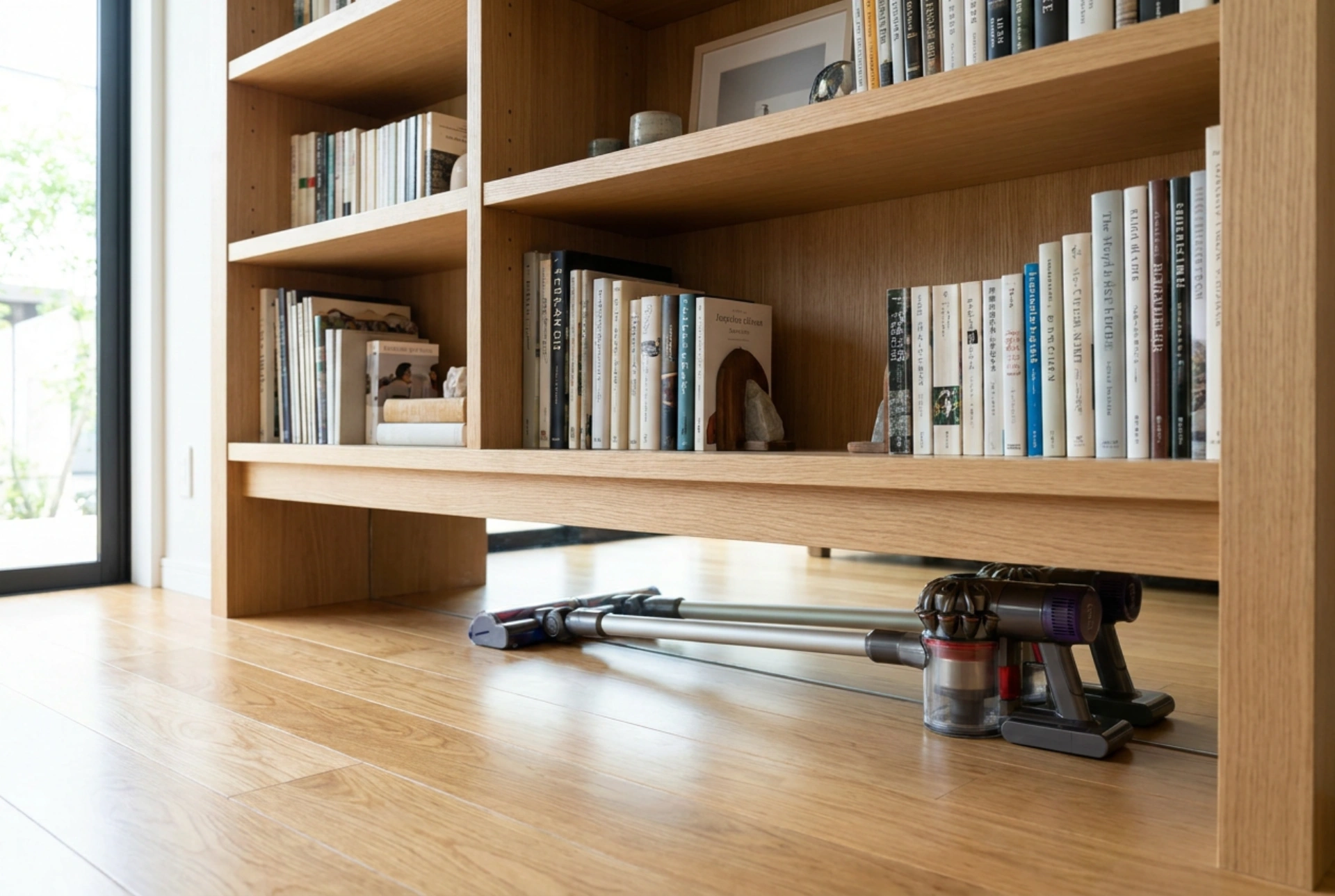
The standard plinth on many traditional bookshelves sits directly on the carpet or hardwood, sealing off a dead zone that accumulates dust through tiny gaps but cannot be reached by cleaning tools. To resolve this, choose bookshelves raised on legs with a minimum clearance of 15 centimetres, or ideally 20 centimetres. This height corresponds to the standard clearance profile of most vacuum cleaner heads and robotic vacuums. This clearance prevents the head of the vacuum from colliding with the base of the unit, which can cause micro-scratches on the wood finish over time. Elevating the unit also allows light and air to pass underneath, reducing the damp, dark conditions that encourage dust mites.
Optimal Wall Clearance and Thermal Currents
Placing a wooden bookshelf directly against an external wall creates a thermal bridge, leading to temperature differentials that cause condensation and attract dust. Maintain a gap of at least 3 to 5 centimetres between the back panel of the bookshelf and the wall. This gap facilitates a chimney effect, where warm air rises behind the unit, carrying dust upward and outward into the room's open air currents where it can be captured by air purifiers or easily vacuumed from the floor. Additionally, avoid placing wooden bookshelves directly adjacent to radiators or heating vents. The localized thermal convection currents will accelerate dust deposition on the wood grain and dry out the timber, leading to structural warping.
Material Science of Wood and Dust Interaction
Dry dusting with a traditional cloth often scratches the protective varnish of wooden shelves, as microscopic dust particles act as abrasives. When vacuuming around and on the shelves, use a soft dusting brush attachment made of natural bristles (such as horsehair). Natural bristles prevent static build-up, which otherwise causes dust to immediately adhere back to the shelf surface. For the wooden surfaces themselves, follow vacuuming with a slightly damp microfiber cloth. The capillary action of microfiber lifts dust without requiring chemical polishers, which can leave a sticky residue that binds future dust. Ensure the wood is dried immediately to prevent moisture from penetrating the wood grain and causing swelling.
A Checklist for a Clean-Efficient Layout
To streamline your cleaning routine, implement these physical adjustments to your shelving arrangement:
- Verify a 15-20 cm gap beneath the lowest shelf to allow unhindered vacuum wand access.
- Pull the shelving unit 5 cm away from the wall to establish a continuous vertical air channel.
- Avoid placing bookshelves in tight corners where dual-wall stagnation limits airflow.
- Ensure the bookshelf is perfectly level using shim pads, preventing vibrations that shake dust into floor gaps.
- Position the unit away from direct heat sources to prevent thermal dust precipitation.