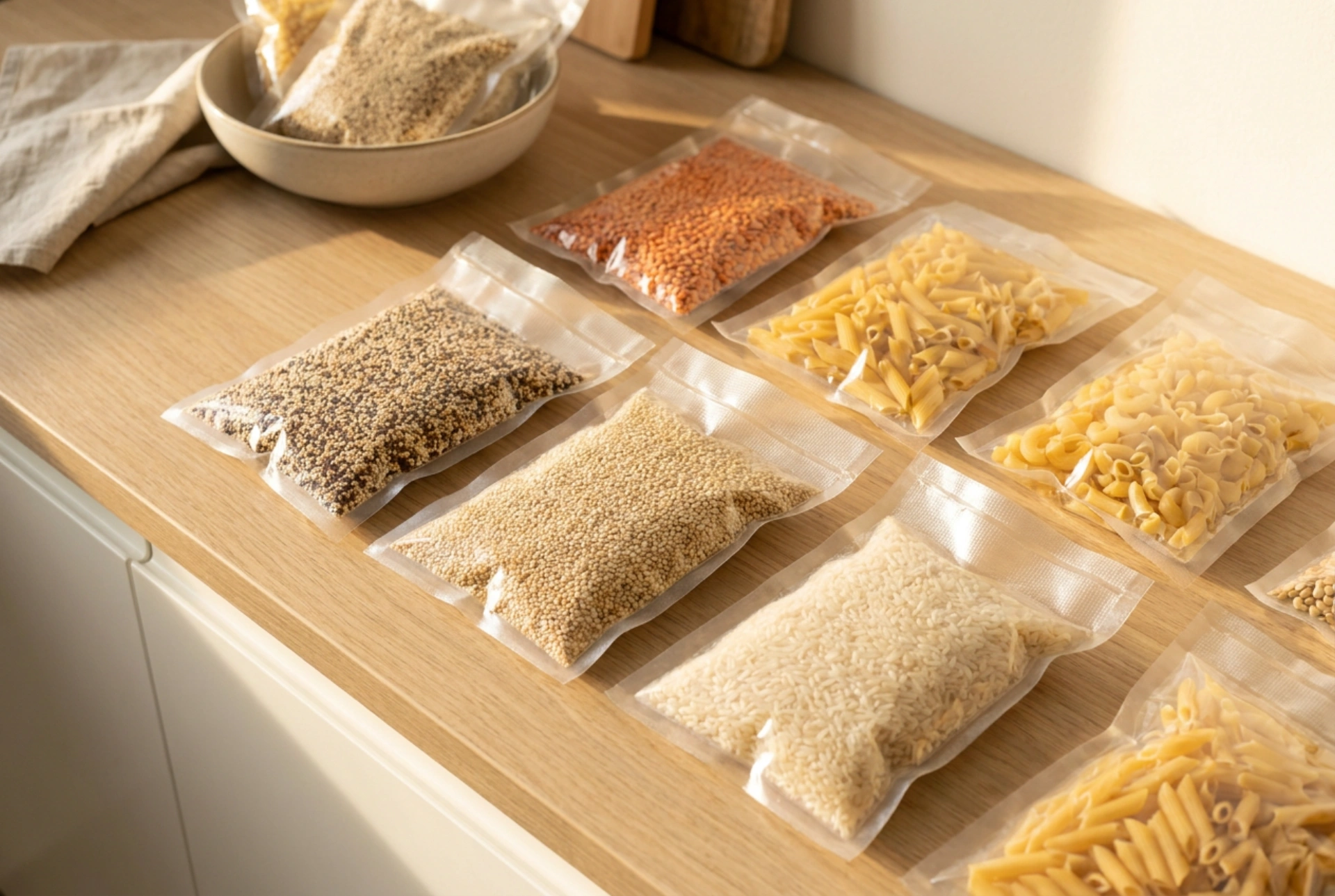


Achieving an airtight, hermetic seal on plastic storage bags relies on understanding polymer physics rather than relying on expensive machinery. Controlling temperature, pressure, and cooling time ensures a perfect barrier that protects dry goods from moisture and oxidation.
The Science of Polymer Fusion
To seal plastic bags effectively, we must understand the behavior of thermoplastics under heat. Most food-grade bags are made of polyethylene (PE) or polypropylene (PP). These polymers consist of long, tangled molecular chains. When cold, these chains are locked in a rigid structure. Applying heat raises the plastic past its glass transition temperature and close to its melting point. At this temperature, the polymer chains gain kinetic energy and begin to slide past one another.
When you press two heated layers together, these mobile polymer chains diffuse across the boundary interface, intertangling with the chains of the opposite layer. As the plastic cools, these chains lose energy and lock back into a solid state, forming a single, continuous phase. If the temperature is too low, the chains do not diffuse, leading to a weak joint that peels apart under tension. Conversely, if the temperature is too high, the polymers undergo thermal degradation, chain scission, and thinning, which makes the seal brittle and prone to tearing.
Selecting the Right Barrier Film
Not all plastic bags are suitable for long-term storage. Single-layer low-density polyethylene (LDPE) bags, common for short-term freezing, are highly permeable to oxygen over extended periods. For long-term food preservation, multilayer films are necessary. These typically combine a puncture-resistant outer layer (such as oriented polyamide or polyester), an oxygen-barrier middle layer (like ethylene vinyl alcohol or aluminium foil), and an inner sealing layer of food-grade linear low-density polyethylene (LLDPE).
When sealing multilayer bags like Mylar, the inner polyethylene layers melt and fuse together, while the high-melting-point outer polyester layer remains solid, acting as a support jacket that prevents the sealing tool from sticking to the film or melting through it entirely.
The Core Variables of Heat Sealing
A successful seal requires precise coordination of three physical variables: heat, pressure, and time. Adjusting these parameters according to the film thickness is essential for a reliable bond.
- Temperature: This must match the melting point of the inner sealing layer (typically between 120°C and 180°C for polyethylene). Thin films require lower temperatures, while thicker, laminated barrier foils require higher heat to penetrate the insulating outer layers.
- Pressure: Constant, even pressure forces the molten polymer chains into intimate contact. Insufficient pressure leaves microscopic voids where gases can pass. Excess pressure squeezes the molten plastic out of the sealing zone, leaving a thin, weak spot along the seam.
- Dwell Time: This is the duration of heat application. The heat must dwell long enough to penetrate the bag layers but not so long that it distorts the surrounding film. Typically, this ranges from 0.5 to 2.5 seconds.
Step-by-Step Sealing Technique
Begin by preparing the sealing zone. Any contamination, such as oil, moisture, or fine powder from flour and spices, will disrupt the polymer fusion and create micro-channels for air leakages. Wipe the inner neck of the bag with a dry, lint-free cloth before sealing.
Next, align the bag edges flatly without wrinkles. Wrinkles create thick spots where the heat cannot penetrate uniformly, leading to unsealed channels. When using a manual flat heating element or an impulse sealer, press down firmly and evenly across the entire width. Maintain this pressure for a brief cooling phase (1 to 2 seconds) after removing the heat source. This cooling period is crucial; it allows the polymer chains to recrystallize and gain tensile strength while still held flat. If tension is applied to a hot seal, the molten polymer will stretch and deform, destroying the airtight barrier.
Verifying Seal Integrity
A visual inspect is the first line of quality control. A perfect seal should appear uniform, flat, and slightly translucent without bubbles, charring, or excessive squeezing at the edges. For non-destructive testing, gently squeeze the sealed bag to check for slow air leaks. For absolute assurance, submerge a test bag in water and apply gentle pressure; a stream of bubbles indicates a compromised seal, requiring a calibration of temperature or pressure.