

Organising spices in a dedicated kitchen drawer instead of exposing them on countertops significantly accelerates cooking times while preserving the volatile oils essential for flavour. By understanding the physics of spice degradation and the ergonomics of motion, you can transform your culinary workflow into a highly efficient process.
Why Drawers Are Chemically Superior to Countertop Racks
Spices owe their distinct aromas and flavours to highly volatile organic compounds, such as piperine in black pepper, cinnamic aldehyde in cinnamon, and eugenol in cloves. These compounds are highly sensitive to environmental factors: light, heat, and oxygen. Storing spices on countertop racks exposes them to ultraviolet (UV) radiation and fluctuating heat from nearby cooking appliances, accelerating chemical breakdown through oxidation and thermal degradation.
A closed kitchen drawer acts as a thermal buffer and a complete barrier to UV light. By eliminating exposure to direct sunlight and minimising temperature swings, the structural integrity of the essential oils is preserved. Consequently, spices retain their potency for much longer, ensuring you achieve the desired taste profile with smaller quantities and without the frustration of using flat, inert ingredients.
The Ergonomics of Speed: Reducing Cognitive Load and Physical Motion
In professional kitchen ergonomics, speed is determined by the economy of movement and the reduction of cognitive search time. Hunting through a cluttered cabinet for a specific jar disrupts the cooking rhythm and can lead to overcooking delicate ingredients like garlic or fresh herbs already in the pan.
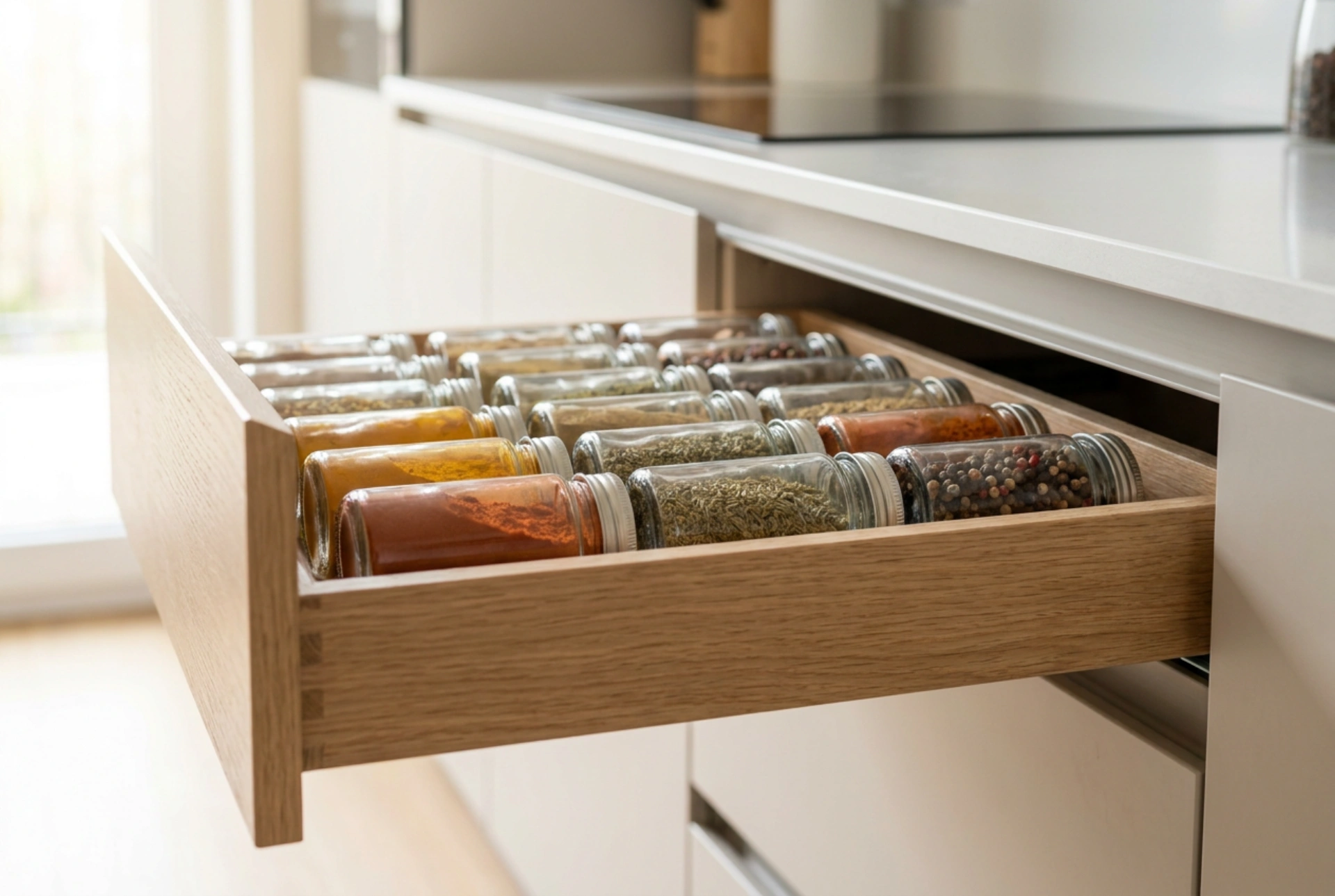
An angled drawer organiser solves this by laying jars flat or at a precise 45-degree angle. This orientation ensures that every label is immediately visible upon opening the drawer, eliminating the need to lift, rotate, or displace other jars. Furthermore, the physical reach-and-grasp motion is streamlined. Instead of reaching upward into an overhead cabinet—which strains the shoulder girdle and limits visibility—you simply pull the drawer open, view the entire collection in a single glance, and lift the desired jar vertically.
Decanting and Categorising for Maximum Workflow Efficiency
To maximise the efficiency of a drawer organiser, you must implement a systematic approach to decanting and categorisation. Follow this precise order of operations to set up your system:
- Standardise Container Geometry: Transfer spices from mismatched supermarket packaging into uniform glass jars. Round or hexagonal glass jars fit tightly together, preventing wasted space and sliding. Glass is non-porous and chemically inert, meaning it will not absorb strong aromatic oils like plastic containers do.
- Implement Airtight Seals: Ensure all jars feature silicone or rubber gaskets. This creates a physical barrier against ambient humidity, preventing hygroscopic ground spices (like onion and garlic powder) from clumping and hardening.
- Choose an Organisation Schema: Group your spices based on your cooking habits. The two most efficient methods are alphabetical sorting (ideal for large collections of over twenty spices) or culinary profile grouping (such as baking spices, savoury/herbal, and hot/chili-based).
Material Selection: Wood vs. Polymer Inserts
When selecting a drawer organiser, the material matters for both stability and hygiene. Molded acrylic or plastic inserts are highly durable, easy to wipe clean, and impervious to moisture. However, they can have low-friction surfaces, causing glass jars to slide and clatter when the drawer is opened quickly.
Wooden inserts, such as oak or bamboo, offer natural acoustic dampening and a higher coefficient of friction, keeping jars firmly in place. To maintain a wooden insert, avoid harsh chemical cleaners. Instead, wipe it down periodically with a slightly damp microfibre cloth and apply a food-safe mineral oil to prevent the wood from drying out or absorbing spilled spice oils.