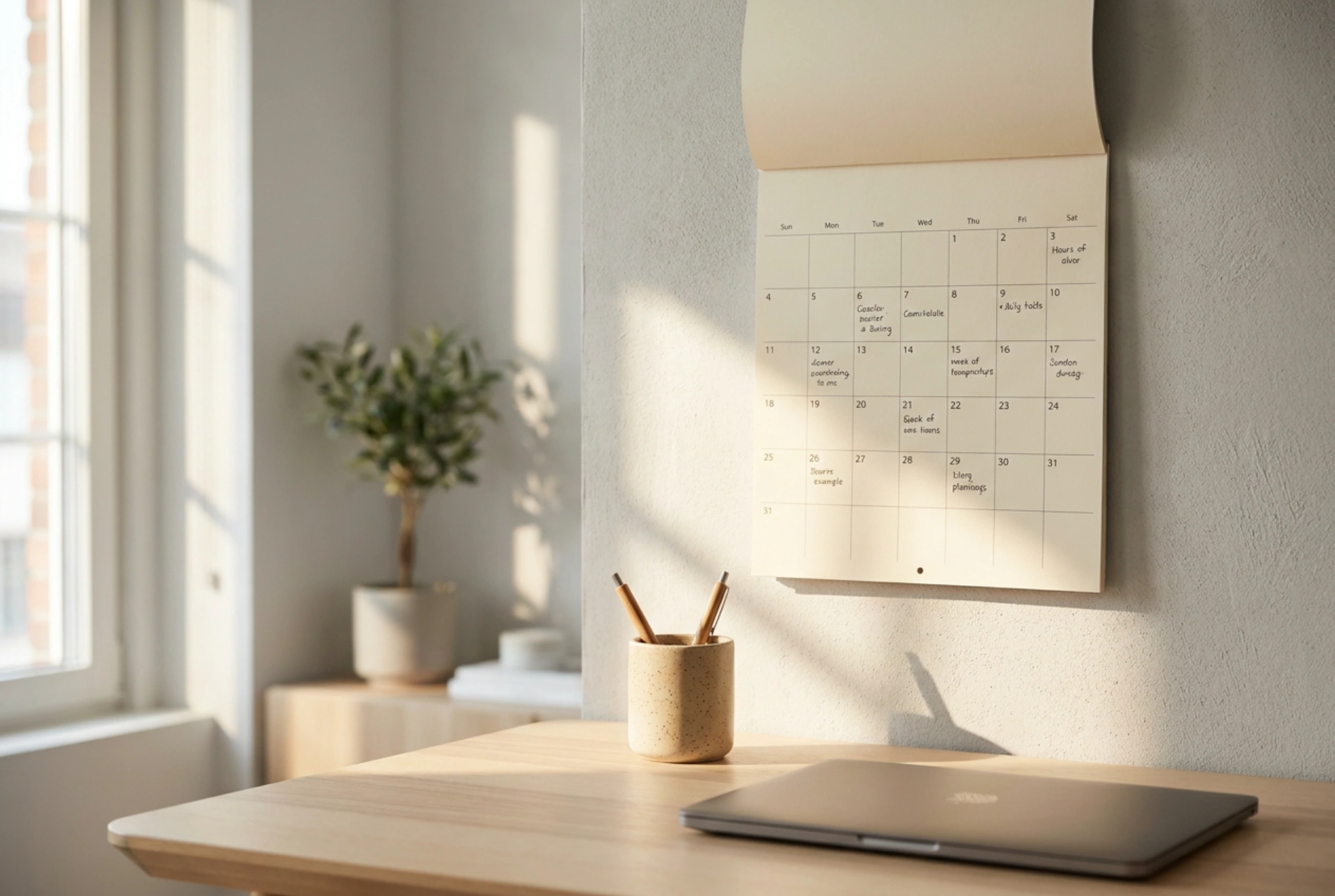


A three-month wall calendar is a highly effective analog tool that leverages spatial memory and continuous visual scanning to streamline household scheduling and deadline management. By presenting the past, present, and future in a single vertical field of view, it eliminates the cognitive friction of digital scrolling and page-flipping.
The Cognitive Science of Three-Panel Visualisation
The human brain is optimized for spatial awareness. When you look at a three-month calendar, you are not just reading dates; you are mapping time in physical space. This layout relies on three distinct zones of visibility: the top panel displays the previous month, the middle panel shows the current month, and the bottom panel previews the upcoming month. This spatial arrangement serves a critical cognitive function.
Having the previous month visible provides immediate historical context, allowing you to quickly verify when a recurring task was last completed without flipping backward. The current month serves as your active operations zone, where day-to-day deadlines reside. The upcoming month acts as an early warning system, preparing your subconscious for future commitments. This continuous visual exposure reduces anxiety associated with unexpected deadlines, as upcoming events slowly drift into your central focus rather than catching you by surprise.
Establishing a Visual Hierarchy and Color Code
To prevent a three-month calendar from becoming a chaotic mass of ink, you must establish a clear structural hierarchy using color and symbol systems. Because the viewing distance for a wall calendar is typically greater than that of a handheld planner, legibility and contrast are paramount.
- Use pigment-rich, fade-resistant markers: Select fine-point felt tip pens that offer high contrast against the paper. Avoid light highlighters or gel pens that reflect ambient light, making them difficult to read from an angle.
- Assign functional categories: Limit your color palette to three or four distinct hues. For example, use deep blue for critical financial deadlines (mortgages, utilities), green for home maintenance schedules (boiler servicing, gutter cleaning), and black for personal appointments.
- Incorporate the sliding date indicator: The red plastic window (aperture slide) must be moved daily. This simple mechanical action anchors your visual field, immediately orienting your eyes to the current day while leaving the surrounding dates in your peripheral vision.
Optimal Placement and Ergonomics of Analog Scheduling
The utility of a physical calendar depends heavily on its physical location. If a calendar is hidden behind a door or placed in a dimly lit hallway, it loses its passive information delivery capability. The calendar should be hung at eye level—approximately 1.5 to 1.7 meters from the floor—in a high-traffic area such as a home office, kitchen entry, or utility transition zone.
Ensure the area has adequate ambient light. Natural sidelight from a window or direct illumination from an overhead fixture prevents glare on the paper and plastic indicator. The physical act of standing in front of the calendar to write or move the slider creates a brief, mindful pause in your day, reinforcing commitment to the schedule in a way that dismissing a digital push notification cannot replicate.
The Monthly Rotation and Maintenance Routine
An analog system requires a disciplined maintenance routine to remain accurate. At the end of each month, the physical transition of the calendar panels must occur. This process depends on the design of your calendar (either tearing off the top sheet or sliding panels upward).
During this transition, perform a synchronization ritual: review the month that is being discarded, carry over any uncompleted long-term projects to the active or future panels, and pre-populate the new bottom panel with recurring seasonal tasks. Aligning this physical transition with the first day of the month ensures that your long-range planning remains seamless and uninterrupted.