

Selecting a school lunch box requires balancing physical ergonomics, material chemistry, and sanitisation practicality to ensure the container remains hygienic and easy to pack daily.
The Material Science: Choosing the Right Substrate
The choice of material determines how easily a lunch box releases grease and resists odours. The most common materials are polypropylene (PP), Tritan copolyester, and stainless steel, each possessing distinct chemical and physical properties.
- Polypropylene (PP): Lightweight and durable, this polymer is highly heat-resistant, making it dishwasher safe. However, as a non-polar plastic, it has a high affinity for hydrophobic substances, meaning oils and fats easily adhere to its surface and require strong surfactants to emulsify and remove.
- Tritan: This modern copolyester offers glass-like clarity and high impact resistance. It resists staining and odour retention better than standard polypropylene because its molecular structure is denser, reducing the microscopic surface porosity where organic molecules can lodge.
- Stainless Steel (Grade 304): Naturally non-porous and highly hygienic, stainless steel does not absorb organic compounds, fats, or pigments. While it is incredibly easy to sanitise and extremely durable, it lacks elasticity, meaning it requires secondary materials like silicone gaskets to achieve a hermetic, leakproof seal.
Geometric Design and the Physics of Cleaning
A lunch box's physical geometry directly dictates how easily it can be cleaned. From a mechanical cleaning perspective, the primary enemy is the tight corner. Sharp 90-degree angles create dead zones where sponge fibres cannot make contact, and surface tension prevents water from circulating effectively. Look for containers with rounded internal corners—ideally with a radius of curvature of at least 5 millimetres—which allow cleaning tools to sweep away food residues effortlessly.
Sealing mechanisms are another critical hygiene point. Many leakproof lunch boxes use silicone gaskets. While silicone provides an excellent hermetic seal, capillary action can draw liquids into the micro-gap between the gasket and the plastic lid. If the gasket is permanently co-molded, check for seamless integration. If it is removable, it must be easily extracted for deep cleaning to prevent anaerobic bacteria and mould from proliferating in the trapped moisture.
Spatial Ergonomics: Maximising Volume and Packing Efficiency
Efficient packing is a matter of geometry and weight distribution. Rectangular containers are mathematically superior to round ones for school bags, as they align with the flat surfaces of textbooks and laptops, eliminating wasted negative space. When selecting a box, consider the ratio of internal volume to external footprint.
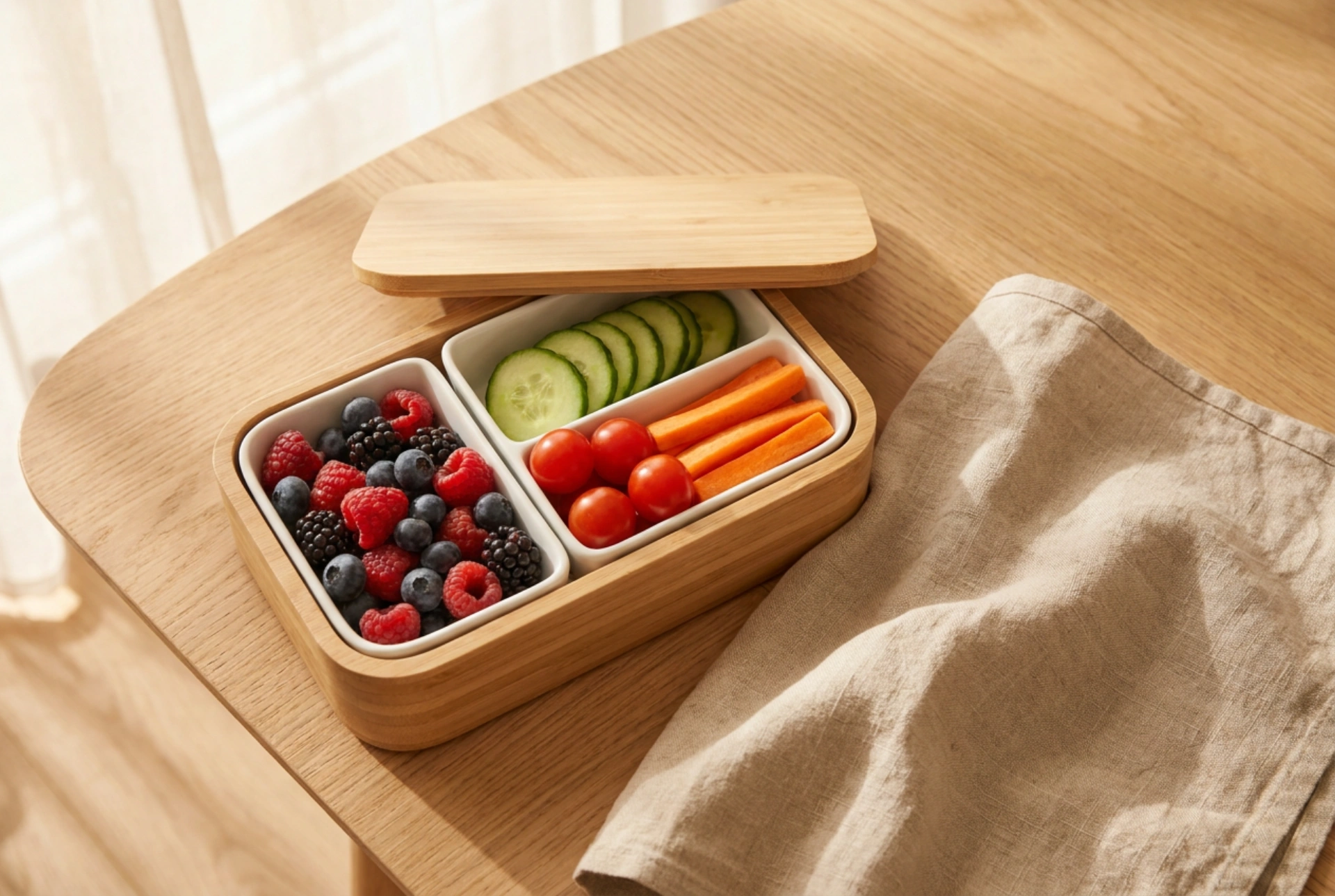
Internal compartments (bento-style) keep foods separated, preventing moisture migration—such as sandwich bread absorbing humidity from sliced vegetables. However, fixed compartments reduce flexibility. A modular system with removable, tightly fitting sub-containers provides the best of both worlds: it allows you to customise the internal layout based on the menu while simplifying the washing process, as you only wash the compartments you actually used.
The Chemistry of Effective Sanitisation
Daily washing of lunch boxes often requires more than just a quick rinse. Understanding the chemical reactions at play can simplify the maintenance routine. To remove stubborn greasy films from plastic, wash with hot water (above 45°C) to melt the fats, allowing the surfactants in dishwashing liquid to surround and suspend the oil droplets in the water phase.
For persistent odours caused by volatile organic compounds, utilize simple household chemistry. Acidic odours (often from fruit or dairy) can be neutralised using a paste of sodium bicarbonate (a mild alkali), which chemically bonds with the odour molecules to neutralise them. Conversely, alkaline residues can be broken down with a rinse of dilute acetic acid (white vinegar), which also helps dissolve hard water mineral deposits that can dull stainless steel and plastic surfaces.