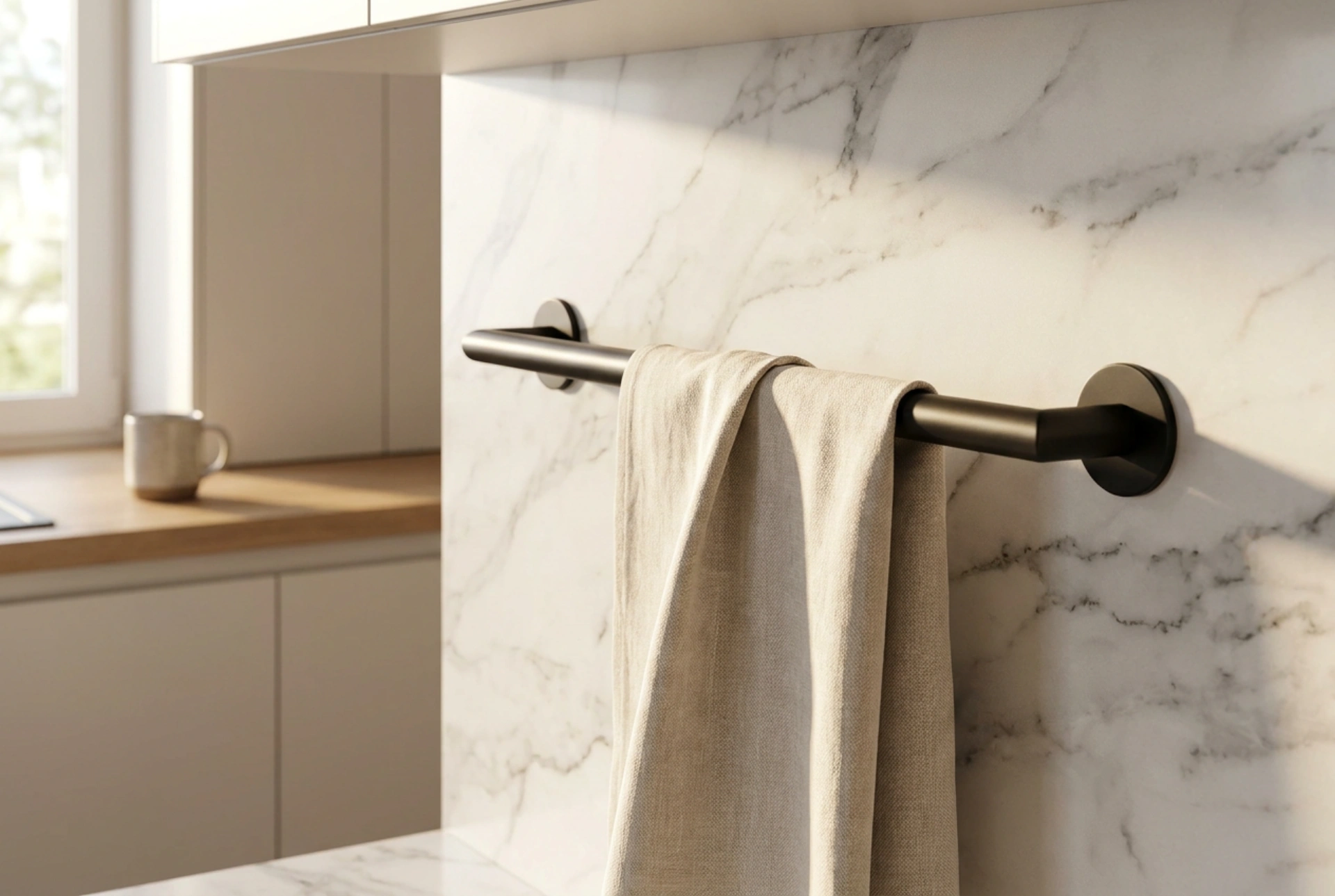


Positioning your kitchen towel rail close to your active workspace is essential for maintaining both culinary efficiency and kitchen hygiene. Placing it within arm's reach prevents water drips across the floor and ensures immediate access during active cooking phases.
The Ergonomics of Towel Placement
Kitchen efficiency relies heavily on the principles of motion economy. When preparing food, the hands must be washed and dried repeatedly. An optimally placed towel rail should reside within your primary zone of reach—the area you can access without bending your torso or taking a step. Typically, this is within a 35 to 45 cm radius from your main prep station or sink. Mounting the rail just below the countertop edge (approximately 80 to 90 cm from the floor) matches the natural resting height of your hands, minimising muscle strain over extended cooking sessions. Furthermore, keeping the towel near the sink reduces the physical transit of wet hands, which limits water dripping onto floorboards, preventing slip hazards and protecting sensitive timber or laminate flooring from moisture damage.
Material Science and Mounting Techniques
The method you choose to secure your towel rail depends entirely on the substrate of your kitchen wall or cabinetry. Different materials require specific mechanical or chemical fastening solutions to withstand the constant downward shear forces applied when pulling a towel.
- Tile and Marble Backsplashes: To avoid damaging delicate natural stone or glazed ceramic, adhesive mounting is preferred. High-density acrylic foam tapes or polyurethane-based construction adhesives provide exceptional shear resistance. These adhesives rely on intermolecular forces (van der Waals forces) to bond with the non-porous surface without drilling. If drilling is unavoidable, diamond-tipped masonry drill bits must be used at low rotational speeds with water cooling to prevent thermal shock and subsequent cracking.
- Wooden Cabinetry: Wood can handle mechanical fasteners easily, but depth is critical. Use short, coarse-threaded wood screws that do not penetrate the interior of the cabinet door. Pilot holes drilled to 70% of the screw’s core diameter will prevent the wood from splitting along the grain.
- Metallic Surfaces: Neodymium magnetic mounts are ideal for the sides of refrigerators or steel panels. These rare-earth magnets offer high pull force in a compact size, allowing for easy relocation as your workflow changes. However, avoid placing them on high-heat zones like oven sides, as thermal energy can demagnetise the material over time.
The Physics of Drying: Airflow and Moisture Control
A kitchen towel is a breeding ground for bacteria if it remains damp. The science of evaporation dictates that moisture removal is accelerated by increased surface area, higher ambient temperatures, and continuous airflow. Hanging a towel flat across a horizontal rail exposes a larger surface area to the air compared to hanging it from a single hook, which bunches the fabric. This bunching traps moisture in micro-pockets, slowing down evaporation and encouraging anaerobic bacterial growth. For optimal hygiene, ensure the rail is positioned at least 5 cm away from the wall or cabinet face. This gap allows convective air currents to rise behind the fabric, accelerating the drying process. Additionally, avoid enclosing wet towels inside under-sink cupboards, where restricted ventilation leads to stale air and musty odours.
Choosing the Right Location Based on Workflow
Analyse your daily routine to determine the perfect coordinates for your rail. If your workflow centres around a kitchen island, consider mounting a minimalist rail on the side panel facing the prep area. For standard linear or L-shaped kitchens, the space directly to the left or right of the sink is structurally and functionally ideal. If space is premium, utilising the dead space on the front of an under-sink dummy drawer panel keeps the towel out of sight but highly accessible. By matching the mechanical properties of your mounts to the physical demands of your kitchen environment, you ensure a durable, hygienic, and highly ergonomic setup.