

Hanging towels on standard hooks often leads to trapped moisture, musty odours, and rapid bacterial growth due to severely restricted airflow. Transitioning to a ladder towel rack solves this by utilising basic thermodynamics and surface-area physics to accelerate the drying process.
The Thermodynamics of Evaporative Drying
To understand why towels dry slowly, one must examine the boundary layer of air surrounding wet cotton fibres. Water molecules escape the fabric through evaporation, a process requiring ambient heat and continuous air movement. In a stagnant environment, a highly humid boundary layer forms directly over the wet textile, slowing down further evaporation. A ladder towel rack excels by elevating the textile and placing it in a plane where ambient bathroom air can circulate freely across both sides of the weave, maintaining a steep moisture concentration gradient from the fabric to the room.
Surface Area Exposure: Hook vs. Ladder
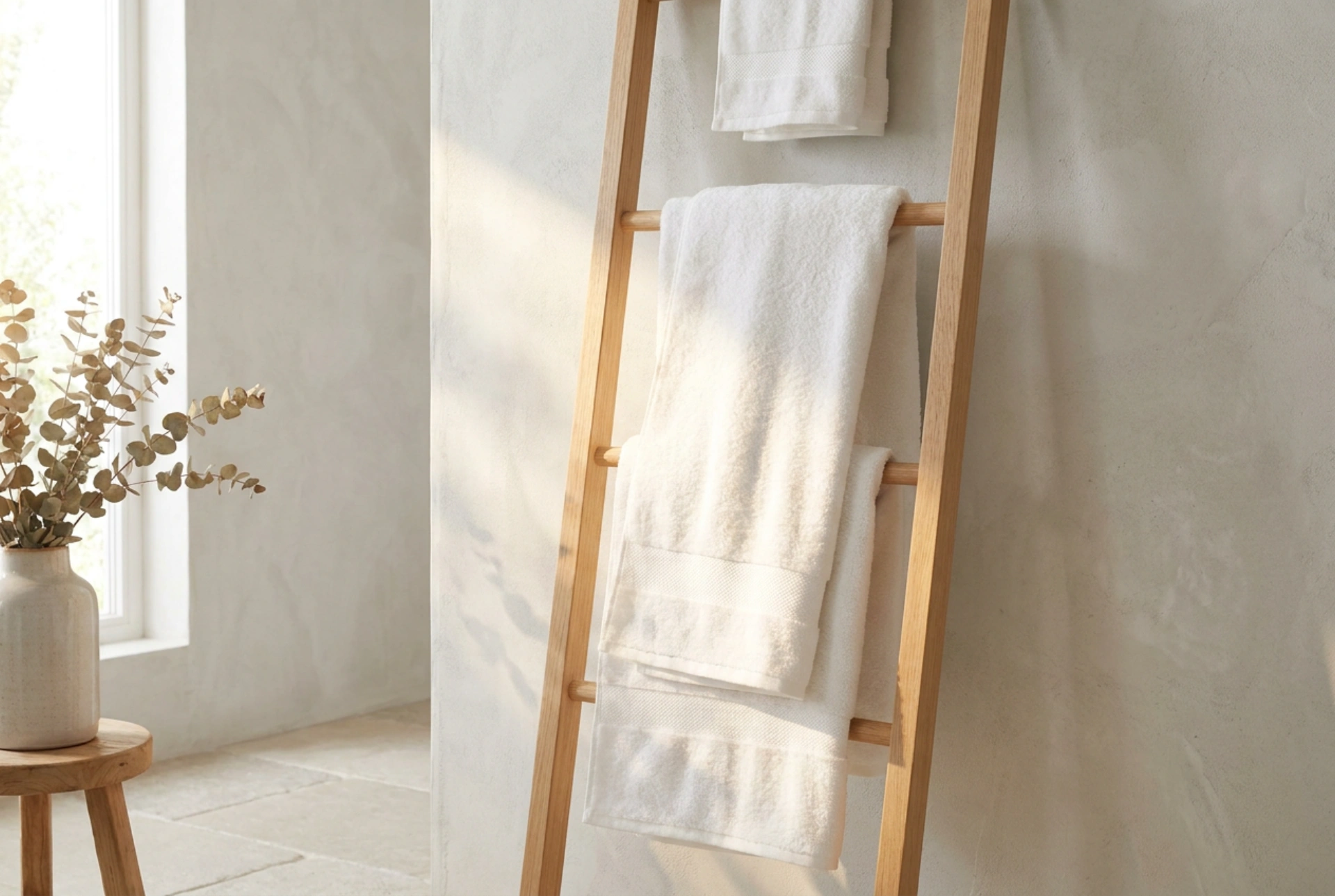
When a towel is hung on a single peg or hook, the fabric bunches together, folding over itself. This drastically reduces the exposed surface area. The inner layers of the folds remain shielded from moving air, creating pockets of high humidity and low oxygen which are prime environments for musty smells to develop. In contrast, draping a towel flat over a horizontal rung of a ladder rack maximises its exposed surface area. By ensuring the fabric remains flat, water molecules evaporate uniformly across the entire plane of the textile, preventing damp spots and reducing drying times by up to fifty percent.
Harnessing Natural Convection and the Stack Effect
The spatial arrangement of a ladder rack leverages natural convection currents within a room. As wet towels dry, they cool the air immediately surrounding them through the latent heat of vaporisation. This cooled, heavier air falls, creating a gentle, micro-convection loop. Because a ladder rack holds towels vertically offset from one another, it facilitates this natural downward pull of cooler air and the upward drift of warmer ambient air. Placing the ladder near a passive heat source or ventilation inlet amplifies this stack effect, ensuring continuous, energy-free air movement through the drying towels.
Material Science and Wall Protection
The physical design of a leaning ladder rack also plays a crucial role in preventing moisture transfer to bathroom structures. Lean-to designs naturally create a protective distance between the damp towels and the wall behind them. This physical gap prevents capillary action from transferring moisture to plaster or paintwork, which could otherwise lead to structural mould. When selecting a ladder rack, material science dictates choosing non-porous or sealed surfaces. Powder-coated steel or highly sealed hardwoods like bamboo or teak treated with hydrophobic polyurethane prevent the rack itself from absorbing moisture, ensuring all evaporated water is directed solely into the room's ventilation system.