

Preheating a vacuum flask before filling it prevents immediate thermal transfer, ensuring your hot beverage stays at its optimal temperature for hours. By understanding the thermodynamics of heat transfer, you can easily optimize the thermal efficiency of any double-walled insulated vessel.
The Physics of Vacuum Flask Insulation
To understand why preparation is necessary, it helps to understand how an insulated flask works. Most high-quality thermal bottles utilize a double-walled construction made of stainless steel or glass. During manufacturing, the air between these two walls is evacuated to create a near-perfect vacuum. Because vacuum contains no matter, it eliminates two primary methods of heat transfer: conduction (molecular collision) and convection (fluid movement). Heat cannot travel through empty space.
However, heat can still escape through thermal radiation (infrared waves) and through the neck and lid of the flask, where the inner and outer walls meet. The stopper or lid, usually made of dense plastic and silicone gaskets, represents the weakest thermodynamic link. Over time, heat slowly migrates upward and radiates outward. Our goal is to minimize this rate of transfer from the moment the hot liquid enters the flask.
Why Preheating is Essential: The Heat Sink Effect
When you pour a hot liquid into a cold flask, a thermodynamic process called thermal equilibrium begins instantly. Heat energy naturally flows from the hotter substance (the liquid) to the cooler substance (the inner wall of the flask). Stainless steel has high thermal conductivity, meaning it absorbs and transfers heat rapidly.
If the inner steel wall is at room temperature (around 20°C) and you pour in hot coffee at 90°C, the cold steel acts as a "heat sink." It will immediately absorb thermal energy from the liquid until both the steel wall and the liquid reach the same temperature. This initial temperature drop can be as high as 5°C to 10°C within the first few minutes, significantly reducing the starting temperature of your beverage and shortening the duration it remains hot.
The Standard Preheating Protocol
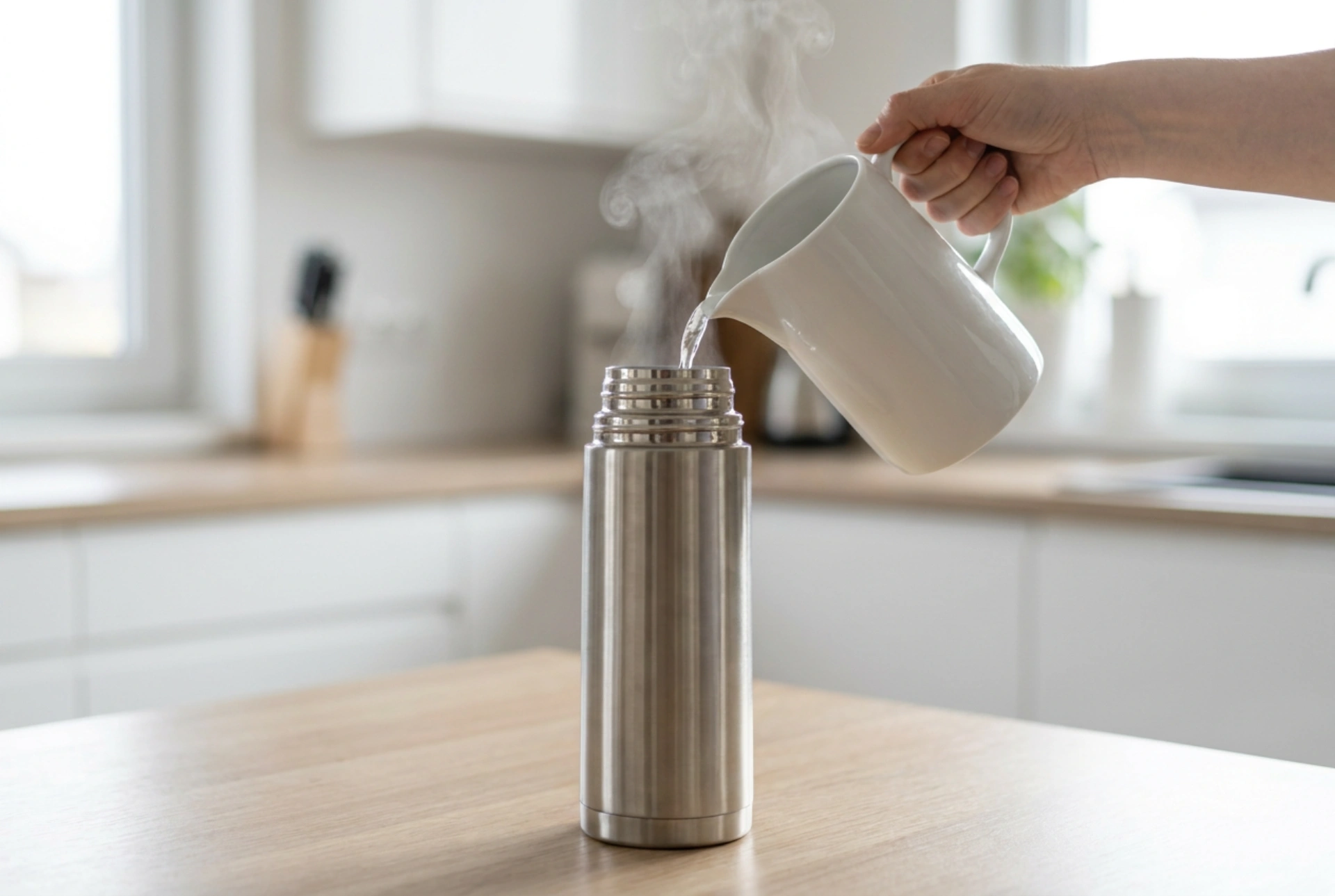
To prevent this initial temperature drop, you must prime the inner wall by raising its temperature to match the beverage. This is achieved through a simple hot-water preheating technique:
- Boil the water: Heat fresh water to a rolling boil (approx. 100°C). Using lukewarm tap water is ineffective, as it will not raise the steel's temperature sufficiently.
- Fill and seal: Pour the boiling water into the flask, filling it to about 90% capacity. Seal the lid tightly. Closing the lid is crucial because it traps the rising steam, preheating the upper neck and the stopper assembly.
- Wait for thermal absorption: Allow the water to sit in the sealed flask for 5 to 10 minutes. During this time, the inner steel wall absorbs the thermal energy, reaching a high state of thermal equilibrium.
- Empty immediately before filling: Unscrew the lid and discard the priming water right before you are ready to pour in your actual beverage. Do not let the flask stand open, as it will quickly lose heat to the ambient air.
Optimizing the Filling Process
Once the flask is primed, the way you fill and seal it determines how long it will retain its heat. Follow these thermal principles:
First, minimize the air gap. Air is a poor conductor of heat, but the air space inside a partially filled flask will expand and contract, promoting convective heat loss. Fill the flask to just below the neck or the fill line indicated by the manufacturer. Leaving too much empty space accelerates cooling, while overfilling can compress the gasket and cause leaks or damage the stopper.
Second, ensure the liquid is at its maximum safe temperature before pouring. If you are brewing coffee or tea, do it immediately before filling. Every transfer between vessels (e.g., from pot to mug to flask) cools the liquid by several degrees due to evaporation and surface contact.
Maintaining Seal Integrity and Thermal Performance
The efficiency of a vacuum flask is heavily dependent on the integrity of its physical components. Over time, silicone gaskets can degrade, harden, or accumulate microscopic mineral scale from water. When a gasket loses its elasticity, micro-gaps form, allowing steam—and therefore heat energy—to escape through convection.
Clean the gaskets regularly by soaking them in a warm solution of sodium bicarbonate (baking soda) or oxygen bleach to remove organic residues without damaging the polymer structure. Check the vacuum seal periodically: if the outer wall of your flask becomes warm to the touch when filled with hot liquid, the vacuum seal between the walls has failed, and the flask will no longer function effectively.