

Managing dirty laundry efficiently relies on spatial ergonomics, material science, and moisture control. Integrating built-in sorting baskets directly into utility cabinetry streamlines the washing process, preserves fabric integrity, and maintains household hygiene by concealing soiled textiles in dedicated, ventilated compartments.
The Physics of Laundry Storage: Ventilation and Moisture Control
Soiled textiles carry residual moisture from sweat, environmental humidity, and wet cleaning. When damp fabrics are confined in unventilated, dark spaces, they create an optimal microclimate for anaerobic bacteria and fungal spores to thrive. Fungi, such as mold and mildew, break down natural organic fibers like cotton, linen, and wool, causing irreversible structural damage and persistent musty odors.
To prevent microbial growth, built-in laundry cabinets must prioritize airflow. Static air must be replaced with passive ventilation through several design techniques:
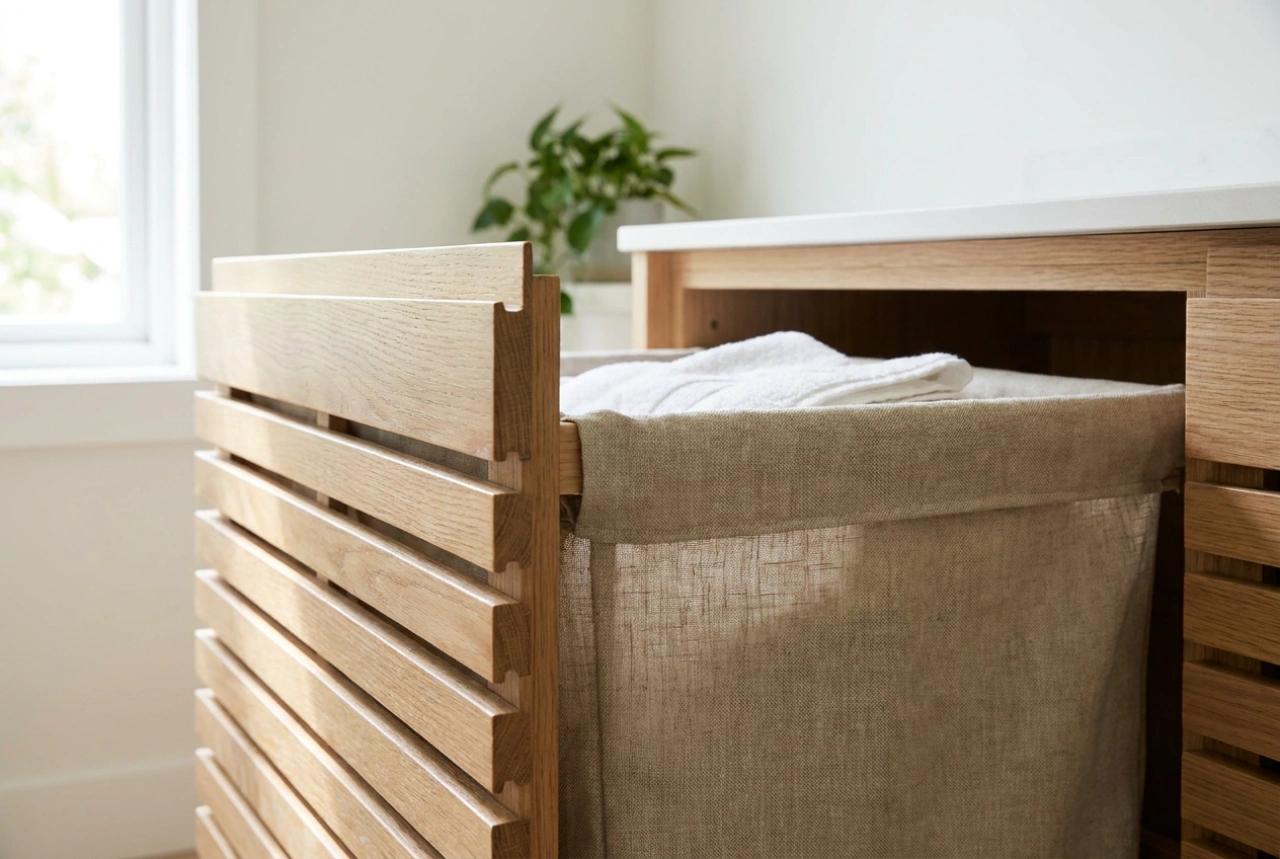
- Slatted Cabinet Fronts: Permeable doors allow continuous air exchange, balancing the internal humidity with the ambient room temperature.
- Perforated Basket Materials: Internal bins made from mesh, wire, or perforated polymers ensure that air can circulate vertically and horizontally through the piled fabric.
- Ventilation Grilles: Installing discrete intake grilles at the base of the cabinet and exhaust vents at the top utilizes the chimney effect, drawing cooler air in from the floor to expel warm, damp air.
Ergonomic Mechanics: Tilt-Out vs. Pull-Out Systems
Accessing stored laundry requires hardware that minimizes physical strain. Designing an ergonomic built-in system involves choosing the right mechanism for your daily workflow, focusing on reach, load capacity, and motion design.
Pull-Out Drawer Systems
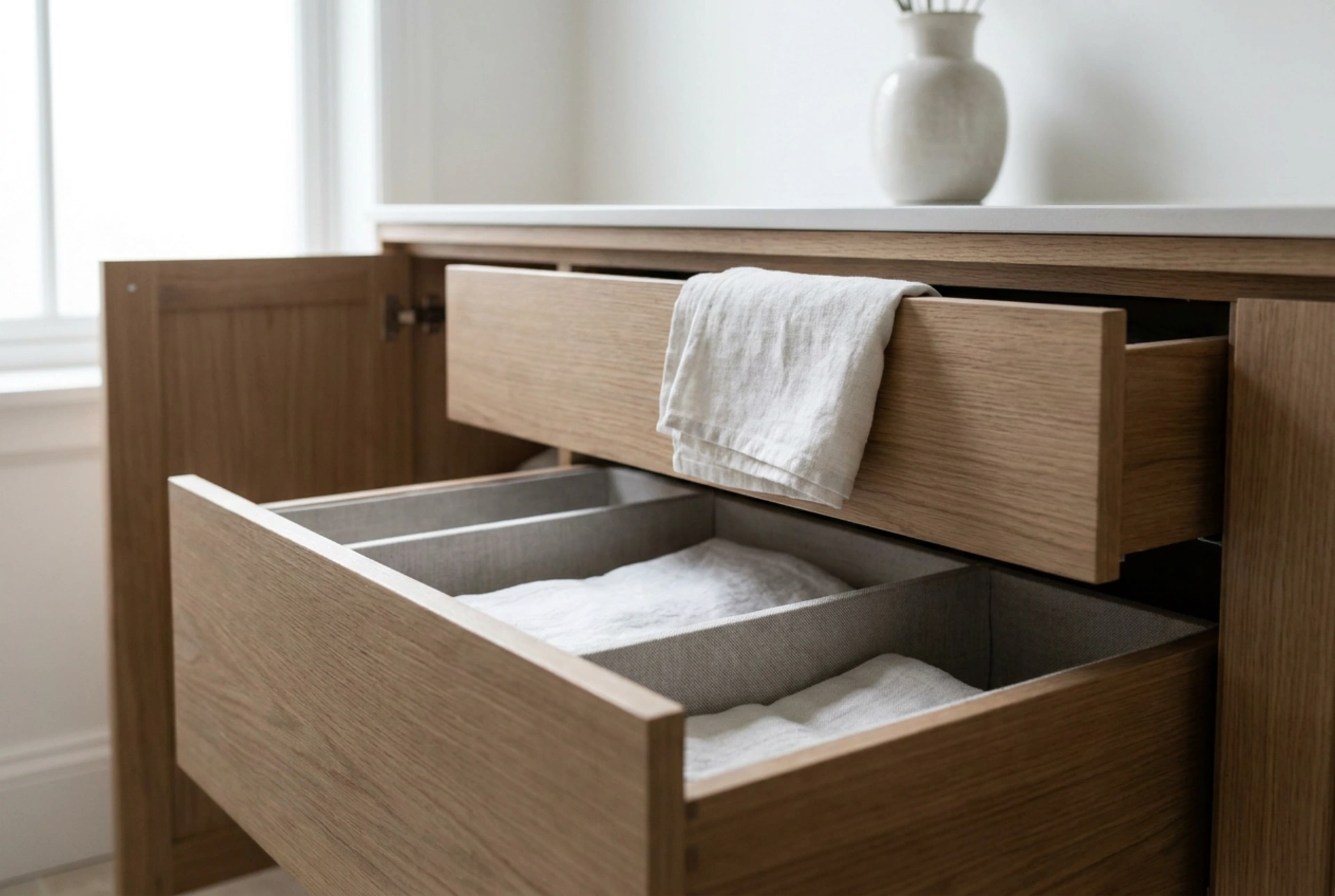
Pull-out laundry baskets operate on heavy-duty, full-extension ball-bearing runners. Mounted directly to the cabinet carcass, these runners allow the user to pull the entire sorting system forward, providing clear, top-down access to multiple compartments at once. This system is highly efficient for sorting because it allows you to separate garments into distinct bins without multiple movements. Soft-close dampening mechanisms are essential here to absorb the kinetic energy of heavy, fully loaded bins, preventing wear on the cabinet joints.
Tilt-Out Flap Systems
Tilt-out systems use bottom-hinged doors equipped with restraining brackets or gas struts that limit the opening angle to around 30 degrees. This mechanism is ideal for narrow spaces where a deep drawer cannot extend. However, tilt-out systems require manual lifting of the basket for emptying, making them less suitable for large-capacity households compared to sliding drawers.
Material Science: Selecting Moisture-Resistant Components
The interior of a laundry cabinet is a high-humidity zone. Choosing materials that resist corrosion, warping, and bacterial colonization is critical to the longevity of the installation.
- High-Density Polyethylene (HDPE) and Polypropylene (PP): These polymers are non-porous, hydrophobic, and chemically inert. They do not absorb moisture or organic odors, can be easily wiped clean with mild sanitizing agents, and resist cracking under mechanical stress.
- Powder-Coated Steel and Aluminium: For wire baskets, metals must be protected from oxidation. Electrostatic powder coating provides a continuous, non-porous barrier that prevents moisture from reaching the underlying steel or aluminium, eliminating the risk of rust transferring to your garments.
- Washable Technical Textiles: Removable inner bags made from tightly woven polyester canvas are highly durable, breathable, and machine-washable. This allows the liner itself to be laundered periodically to prevent odor accumulation.
Optimising the Pre-Sorting Workflow
The primary benefit of a multi-compartment built-in system is the ability to sort laundry at the point of disposal rather than at the machine. Grouping textiles prior to wash day prevents delicate fabrics from friction damage caused by heavy denim or metal zippers, and eliminates the risk of color bleeding.
A highly functional three-compartment configuration separates laundry into light colors, dark colors, and high-temperature fabrics (such as towels, bedding, and underwear). By aligning the capacity of each built-in compartment with the optimal load size of your washing machine, a full bin serves as a visual indicator that it is time to run a cycle, optimizing water and energy efficiency.