

Maximising wardrobe capacity relies on a simple principle of physics: reducing the volume of air trapped between fabric fibres while standardising the dimensions of your garments. Using a rigid folding board or a flat, firm surface allows you to apply uniform mechanical pressure, creating crisp, identical folds that eliminate wasted space and keep fabrics wrinkle-free.
The Physics of Folding: Air Displacement and Fiber Tension
To understand why structured folding saves so much space, one must look at the microscopic structure of textiles. Woven and knitted fabrics are composed of interlaced yarns that naturally trap pockets of air. When clothes are thrown into a drawer loosely, this trapped air accounts for up to seventy per cent of the total volume occupied by the garment. Folding acts as a mechanical compression method, forcing this air out of the weave.
Furthermore, textile fibres like cotton, linen, and wool possess elastic and plastic properties. When you fold a garment using a solid board or template, you guide the fabric along precise geometric lines. Applying pressure along these boundaries creates a localised stretch in the outer fibres of the fold and compression in the inner fibres. This balance of tension helps the garment hold its shape without collapsing under its own weight, allowing for vertical filing rather than traditional horizontal stacking.
The Role of the Folding Board and Surface Friction
Attempting to fold clothes on a soft mattress or an uneven couch absorbs the force you apply, resulting in loose, inconsistent folds. A rigid folding board—whether a dedicated plastic guide or a stiff piece of cardboard—provides a hard, non-yielding surface. This allows you to exert controlled downward pressure to lock the creases in place.
Surface friction is equally important. A clean, smooth wooden or laminate surface offers just enough resistance to keep the fabric flat while you smooth out wrinkles, but not so much that it pulls the garment out of alignment. Before you begin, ensure the surface is dry and free of static charge, which can cause synthetic fabrics like polyester to cling and warp during the process.
Step-by-Step Folding Guide for Tops and Knits
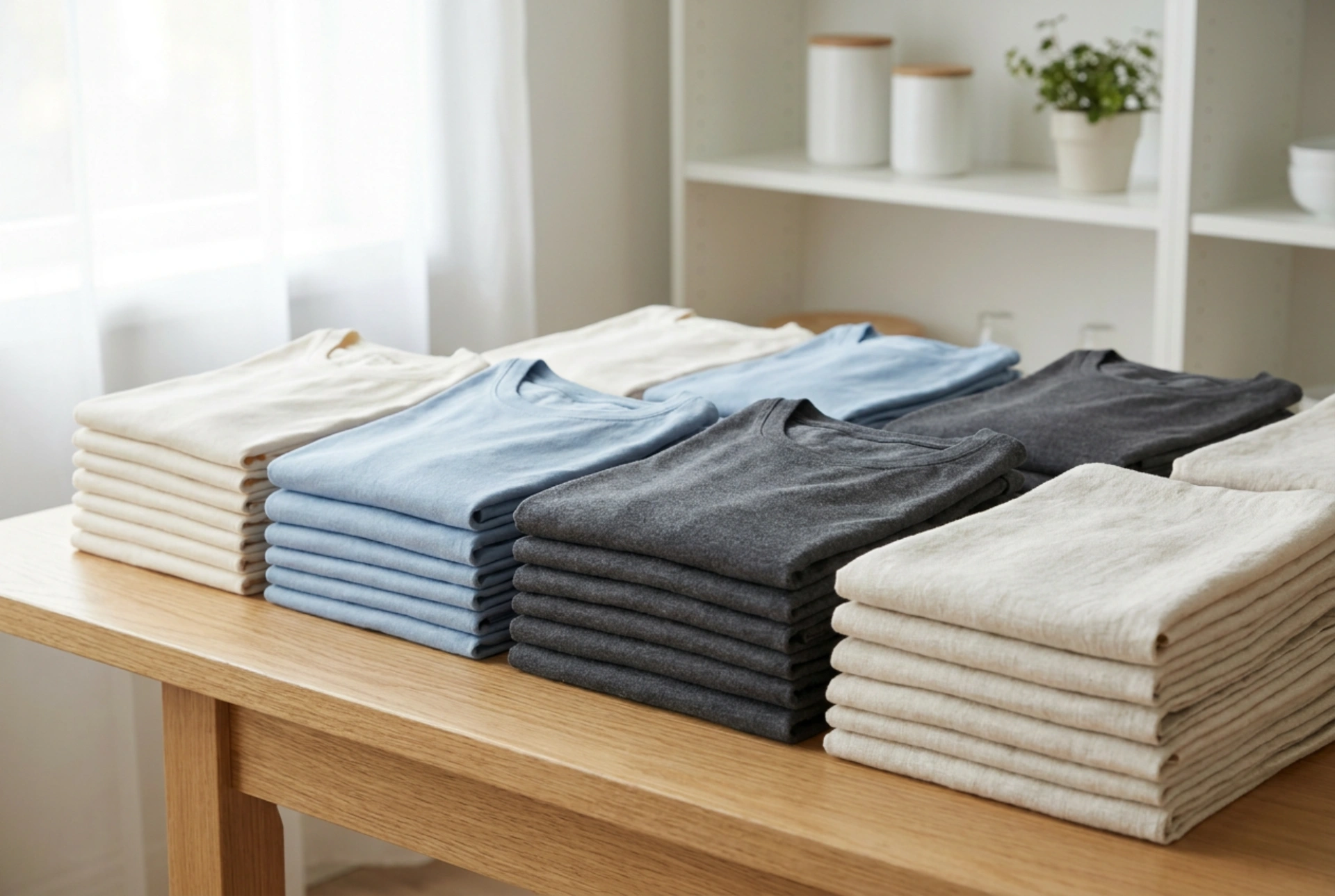
Standardising the width of your folded clothes is the key to filling drawers without leaving empty pockets of space. A folding board acts as a physical template to ensure every item matches this exact width.
- Positioning: Place the garment face down on the flat surface. Smooth it from the centre outward using the palms of your hands to expel trapped air and align the seams.
- Placing the Template: Align the top edge of your folding board with the collar of the shirt, ensuring it is perfectly centred.
- Folding the Sides: Fold one side of the shirt over the board, aligning the sleeve. For long sleeves, fold the sleeve back down parallel to the edge of the board to prevent bulk. Repeat this process on the opposite side to form a neat rectangle.
- The Bottom Fold: Fold the bottom hem upward to meet the collar. Depending on the depth of your drawers, you can fold it once more in half or thirds to achieve a self-supporting rectangle that can stand vertically.
- Removing the Board: Gently slide the folding template out from the top of the garment, holding the folded edges to maintain tension.
Filing vs. Stacking: The Vertical Storage Revolution
Traditional horizontal stacking is structurally flawed: the weight of the upper garments compresses the bottom items, causing deep creases and making it difficult to retrieve a single piece without disrupting the entire pile. Filing garments vertically—similar to files in a filing cabinet—distributes the weight evenly and keeps every item visible.
To achieve a self-supporting vertical fold, the final step of your folding process must create a stable base. By folding the garment into thirds rather than halves, you create a thicker, more rigid foundation. When placed in the drawer, the friction between adjacent garments supports them, preventing them from sliding down or unfolding when one item is removed.
Avoiding Material Fatigue and Creases
While tight folding saves space, over-compression can damage textile fibres. Natural fibres like wool and silk can undergo viscoelastic deformation if folded too tightly for extended periods. This means the fibres lose their ability to spring back to their original shape, resulting in stubborn creases that require steam or heat to relax.
To prevent this material fatigue, fold delicate or heavy knits slightly looser than cotton t-shirts. Avoid stacking heavy items on top of folded delicate fabrics. Ensure that clothes are completely cool and dry before folding; warmth and residual moisture set creases into the fabric matrix, neutralising the benefits of your precise folding routine.