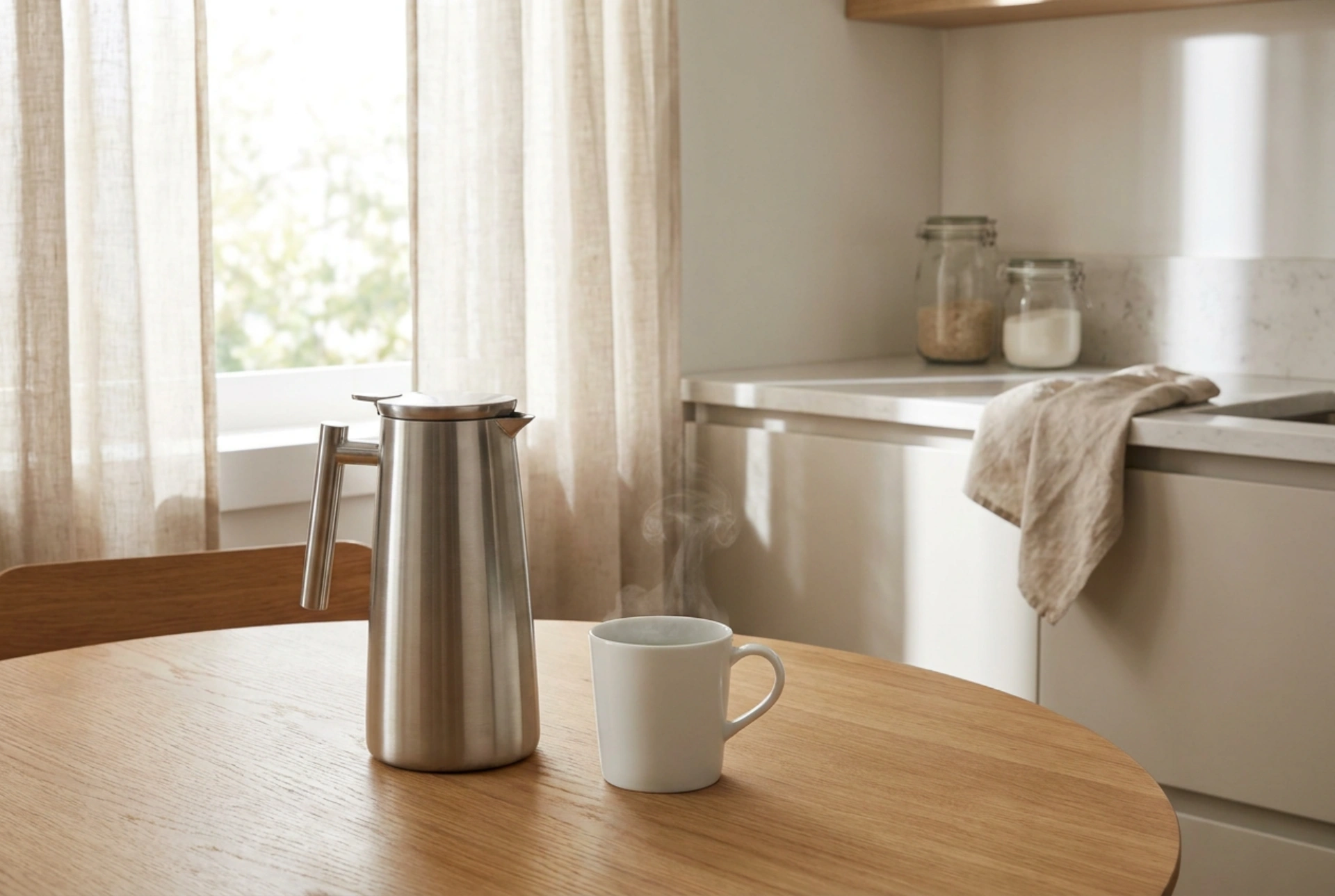


Using a thermal bottle to keep tea warm for children requires a precise balance between thermal physics and physiological safety. To prevent accidental scalding and preserve the material integrity of the flask, parents must understand heat transfer mechanisms and the biological risks of prolonged warm storage.
The Science of Thermal Retention: How Double-Wall Vacuum Works
A high-quality kids' thermos relies on double-wall vacuum insulation, typically constructed from food-grade stainless steel (commonly 304 or 18/8 stainless steel). This alloy contains 18% chromium and 8% nickel, providing high corrosion resistance. The insulation mechanism is purely mechanical: a vacuum is pulled between the inner and outer walls during manufacturing. Because a vacuum contains virtually no matter, heat transfer via conduction (direct physical contact) and convection (fluid movement) is physically impossible across this gap.
However, heat can still escape through infrared radiation. High-quality thermoses mitigate this by applying a reflective metallic coating (such as copper plating) to the outer face of the inner wall, reflecting radiant heat back into the liquid. The weak point of any thermal container is the lid, where conduction occurs through the plastic or silicone stopper. This is why proper sealing and stopper maintenance are critical to thermal efficiency.
The Danger of Overheating: Pressure and Scalding Risks
Pouring boiling water (100°C) directly into a thermos and sealing it immediately is a common mistake that poses significant physical hazards. When boiling liquid is sealed inside an airtight container, the air trapped in the headspace above the liquid rapidly heats up and expands. Additionally, the water vapor pressure increases. When a child opens the lid, this built-up pressure can cause a sudden release of steam or hot liquid, resulting in severe burns to the face or hands.
Furthermore, children's mucous membranes are highly sensitive. While adults typically enjoy beverages at temperatures around 60°C, the safe drinking temperature for children is significantly lower, ideally between 38°C and 45°C. Filling a high-performance thermos with boiling water means the beverage will remain at scalding temperatures for up to 12 hours. Therefore, the tea must be brewed, cooled to a safe drinking temperature, and only then poured into the thermal flask.
Bacterial Kinetics: The Risk of Sweetened Teas
The internal environment of a warm thermos is highly conducive to microbial proliferation. Bacteria, particularly pathogens like Bacillus cereus or Escherichia coli, thrive in the "danger zone" between 4°C and 60°C. If tea is sweetened with honey, sugar, or juices, it provides a rich carbohydrate substrate for bacterial fermentation.
Adding milk or dairy alternatives increases this risk exponentially. The proteins and fats in milk degrade quickly at warm temperatures, leading to rapid bacterial growth and gas production, which can ruin the beverage and cause gastrointestinal distress. If you must sweeten your child's tea, do so immediately before consumption, or ensure the thermos is thoroughly sanitized before and after use. Ideally, keep the beverage unsweetened and dairy-free inside the flask.
Protecting the Passivation Layer: Cleaning Chemistry
The corrosion resistance of stainless steel is not inherent throughout the metal; it relies on a microscopic, self-healing surface layer of chromium oxide, known as the passivation layer. Harsh chemical agents can strip this layer, leading to pitting corrosion and the leaching of metal ions into the beverage.
Never use chlorine-based detergents or bleach to clean a thermos. Chlorine ions actively attack and destroy chromium oxide. Instead, use mild surfactants (standard dish soap) or oxygen-based bleaching agents (sodium percarbonate) dissolved in warm water to lift organic tea stains. A mixture of baking soda (sodium bicarbonate) and warm water can also neutralize acidic odors and gently lift residues without mechanical scratching, which can harbor bacteria.
The Safe Filling Protocol
- Thermal Equilibrium: To maximize cold or heat retention, pre-condition the flask. Fill it with warm water for 2 minutes, discard the water, and then pour in the prepared tea. This prevents the bottle walls from drawing heat out of the beverage.
- Temperature Control: Ensure the tea is at a safe drinking temperature (under 45°C) before pouring it into the thermos. Never fill with boiling liquid.
- Headspace Allowance: Always leave at least 2 centimeters of space below the stopper thread. This prevents liquid displacement when inserting the lid and reduces pressure accumulation.
- Immediate Inspection: Ensure the silicone gasket is seated correctly in its groove to prevent leaks that could cause contact burns in a school bag.