

Damp towels are highly susceptible to bacterial growth and musty odors when moisture remains trapped within their dense fibers. Maximizing the drying efficiency of a standalone or wall-mounted towel rack relies on fundamental principles of thermodynamics, convection, and capillary action rather than mere aesthetics.
The Science of Evaporation and Airflow in Wet Textiles
When a towel is wet, water molecules are bound to the cotton or microfiber threads through capillary action. For drying to occur, these water molecules must transition from a liquid to a gaseous state—a process called evaporation. Evaporation relies heavily on the boundary layer of air directly surrounding the fabric. If the air around the towel remains stagnant, it quickly becomes saturated with moisture, halting the evaporation process. Continuous airflow is required to sweep this humid boundary layer away, replacing it with drier ambient air that can absorb more water vapor.
Natural convection plays a vital role here. As wet towels dry, they cool the air immediately surrounding them due to the latent heat of vaporization. This cooler, denser air sinks, while warmer, drier air rises to take its place. To facilitate this passive convective cycle, a towel rack must be positioned to allow unobstructed air movement both below and behind the hanging textiles.
Strategic Room Placement: Avoiding Dead Zones
The location of your towel rack within the bathroom layout directly dictates its drying performance. Placing a rack in a structural corner, behind an open door, or squeezed tightly between a vanity and a shower enclosure creates a dead zone where air stagnates. To prevent this, consider the following spatial guidelines:
- Proximity to Ventilation: Position the rack in the path of natural air currents, ideally between the primary air source (such as a door gap or window) and the mechanical exhaust fan. This ensures a constant, low-velocity stream of air passes over the towels.
- Wall Clearance: If using a wall-adjacent rack, ensure there is a minimum gap of 10 to 15 centimeters between the rails and the wall surface. A rack flushed too close to the wall prevents air from circulating behind the towel, trapping moisture against the vertical surface and potentially leading to localized mold growth.
- Elevation: Elevating the bottom rail at least 50 centimeters off the floor allows the descending cool, damp air to escape downward, drawing fresher air through the top of the rack.
Hanging Techniques and Rack Geometry
The physical arrangement of towels on the rack is just as important as the rack's location. Standard multi-bar racks often suffer from overcrowding, which severely restricts airflow. Utilizing these structural strategies will significantly reduce drying times:
The Chimney Effect
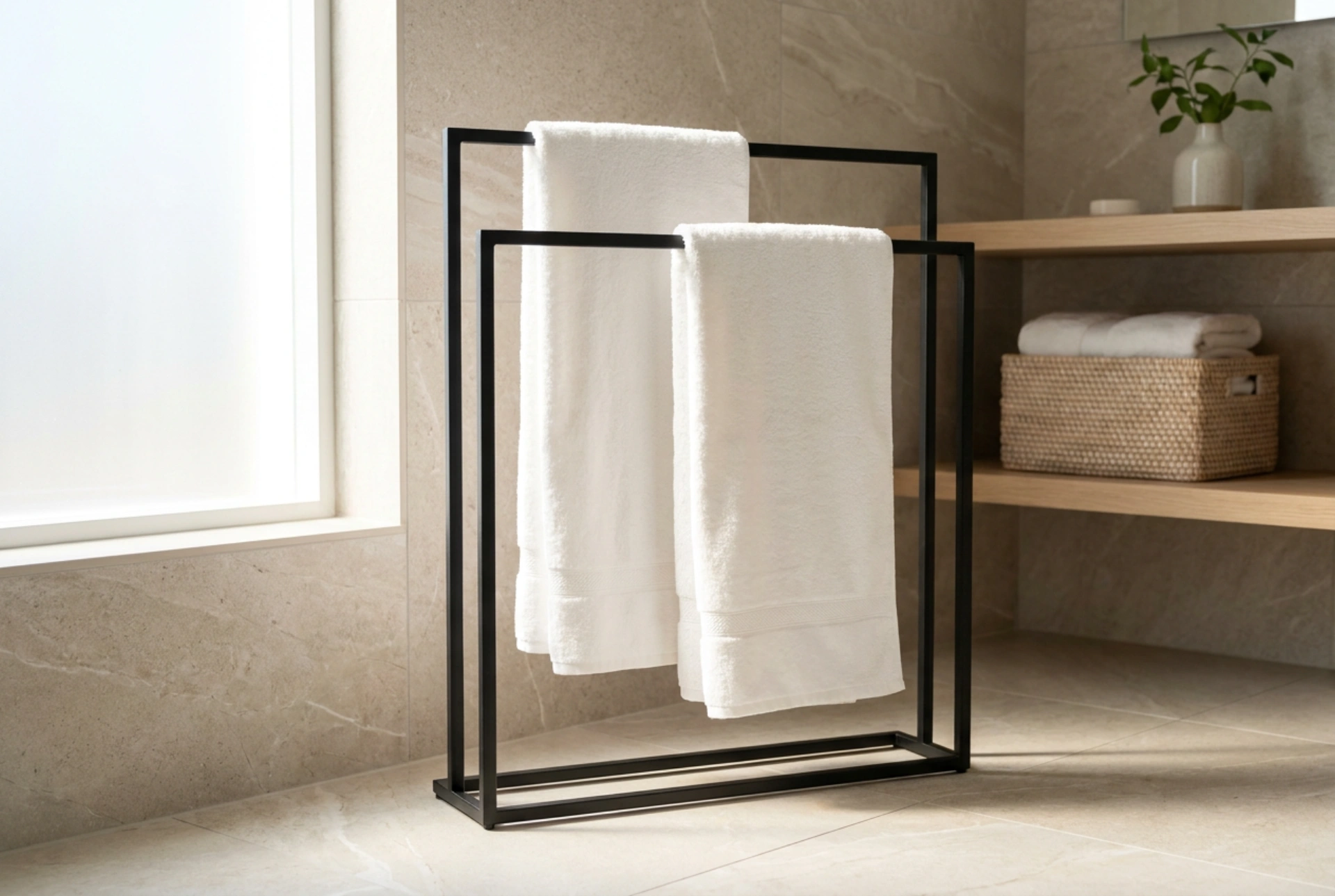
When hanging a towel, avoid folding it horizontally multiple times. Each fold doubles the thickness of the fabric layer, trapping moisture within the core and restricting air access. Instead, drape the towel loosely and flatly across the bar. If space permits, drape a single towel over two parallel bars. This horizontal spacing creates a chimney effect, where air can flow upward through the gap between the two hanging sections of the same towel, doubling the active evaporation surface area.
Optimizing Rail Separation
When choosing or positioning a multi-tiered rack, ensure there is at least 8 to 10 centimeters of horizontal clearance between the individual rails. Vertical overlapping of towels should be minimized; if a wet towel hangs directly over another, the moisture dripping or evaporating from the upper textile will saturate the lower one, stalling the drying cycle for both.
Maintaining Room Dynamics for Faster Drying
Air circulation alone cannot dry towels if the ambient bathroom air is already saturated. The air's capacity to hold water vapor increases exponentially with temperature. Maintaining a stable bathroom temperature between 18 degrees and 22 degrees Celsius ensures efficient moisture absorption. After a shower, running the exhaust fan for at least 20 minutes is essential to lower the relative humidity below 60 percent, restoring the air's natural capacity to draw moisture out of the towel fibers.