

Integrating a built-in laundry basket into a small bathroom requires a precise balance of spatial ergonomics, material science, and mechanical ventilation to prevent moisture retention and structural damage. By understanding how air moves and how materials respond to high humidity, you can design a functional system that saves floor space while keeping damp garments fresh.
Spatial Ergonomics and Mechanical Systems
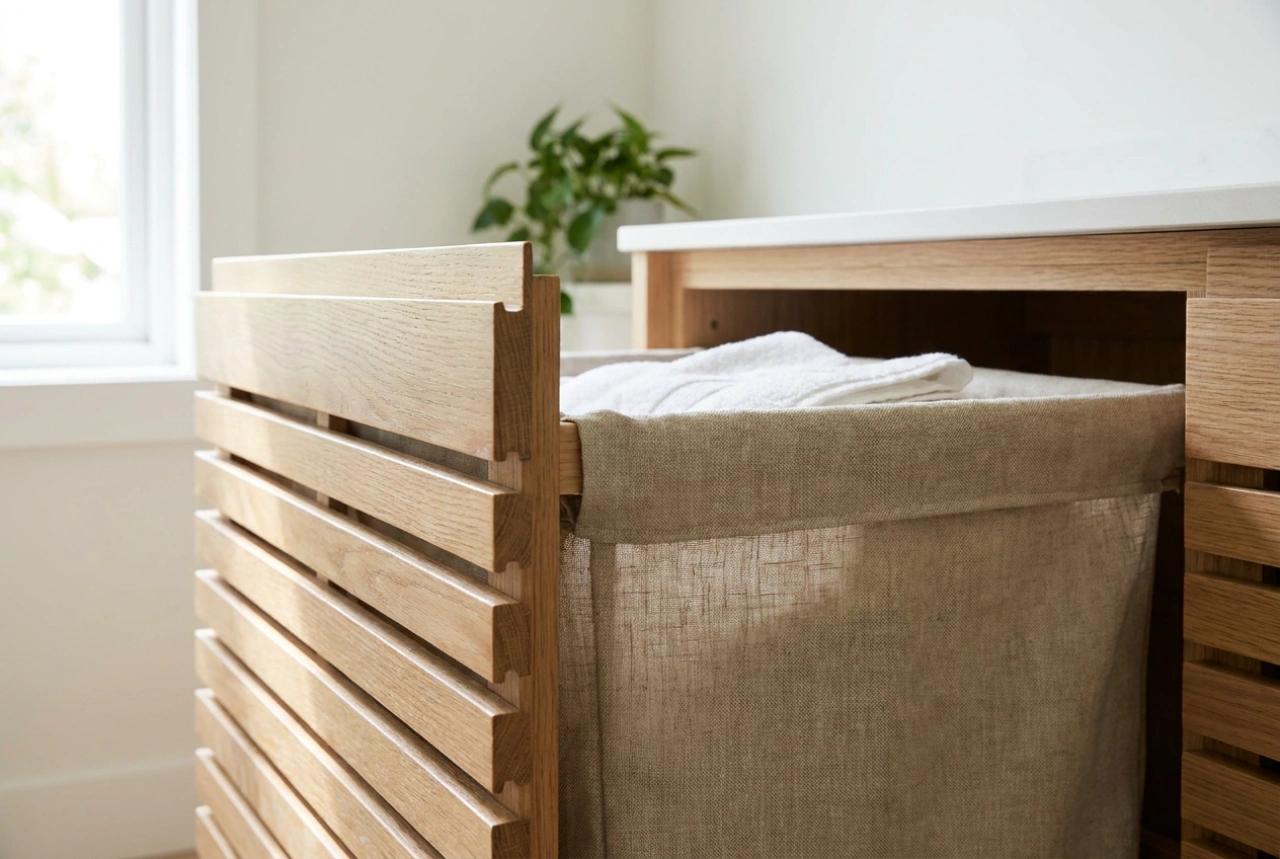
In a restricted bathroom layout, every centimetre of clearance counts. When planning a built-in laundry collector, you must choose between two primary mechanical operations: a front-tilt cabinet or a full-extension pull-out drawer. Each system exerts different physical stresses on the cabinet carcass and requires specific clearance parameters.
- Tilt-out mechanisms: These systems pivot on bottom-mounted hinges, rotating the basket outward at an angle (typically 30 to 45 degrees). They require minimal front clearance, making them ideal for narrow walkways. However, they rely on robust limit-stops or chain-stays to prevent the door from overextending and damaging the floor or hinges under a heavy load.
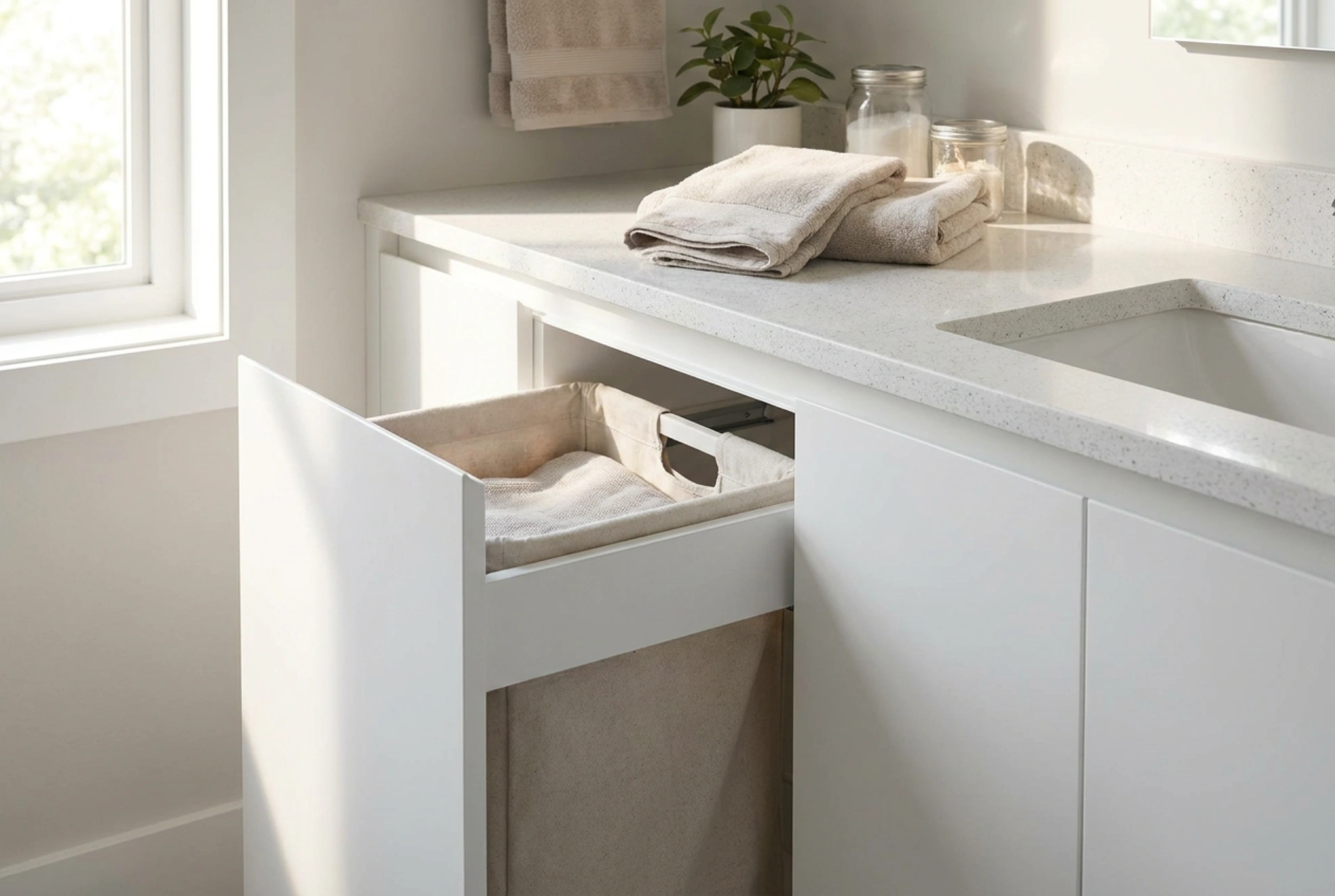
- Full-extension pull-out drawers: This design mounts the laundry bin directly onto heavy-duty runner slides. This allows you to pull the basket completely clear of the cabinet cavity for easy top-loading. This system requires deep front clearance equal to the depth of the cabinet plus the length of the slides. It offers superior weight distribution but demands precise leveling during installation.
For small spaces, a standard 400 mm or 500 mm cabinet width is usually optimal. To ensure mechanical longevity, always select runner systems with a static load rating of at least 30 kg to accommodate the weight of compacted, damp laundry without bending or causing friction in the bearings.
Material Selection: Combating Bathroom Humidity
Bathrooms are high-humidity environments, and storing dirty, damp clothes inside a closed cabinet creates a microclimate prone to microbial growth. The choice of materials for both the cabinet housing and the inner basket is critical to prevent rot, warping, and mold.
Standard chipboard will absorb atmospheric moisture, swell, and eventually disintegrate. Instead, specify moisture-resistant MDF (MR MDF) or marine-grade plywood for the outer cabinet structure. All exposed edges of these boards must be sealed with polyurethane adhesive or heavy-duty PVC edge banding to prevent water vapor from penetrating the core.
The interior basket itself must be non-porous and easy to sanitize. Avoid natural wicker or untreated solid wood, as these materials absorb moisture and harbor fungal spores. Instead, opt for:
- Powder-coated steel wire: Provides maximum air circulation and does not absorb odours, though the protective coating must remain intact to prevent oxidation (rust).
- Perforated high-density polyethylene (HDPE): Light, chemically inert, highly resistant to moisture, and easy to wipe down with mild disinfectants.
The Physics of Airflow: Preventing Musty Odours
Without adequate air circulation, damp textiles undergo anaerobic bacterial decomposition, producing unpleasant volatile organic compounds (musty smells). To prevent this, your built-in laundry cabinet must facilitate passive air exchange.
Airflow can be optimized by exploiting the stack effect (buoyancy-driven ventilation). As warm, moist air inside the bathroom rises, cooler air is drawn in. By incorporating ventilation inlets at the bottom of the cabinet door (such as a recessed plinth grille) and outlets at the top (such as a gap beneath the countertop or decorative perforations in the door panel), you create a continuous, passive air current through the laundry basket. This continuous air movement accelerates the evaporation of moisture from damp towels and gym wear, significantly reducing the risk of mildew development before the washing cycle begins.
Installation and Structural Alignment
The physical stability of your built-in system relies on correct load distribution. A fully loaded laundry basket can weigh up to 15 kg. When this weight is pulled out or tilted forward, it shifts the center of gravity of the entire cabinet unit.
To prevent tipping or cabinet deformation, the housing unit must be securely anchored to the wall studs using heavy-duty bracket fasteners. If mounting to a lightweight plasterboard wall, ensure you anchor into the underlying metal or timber studs, or use heavy-duty hollow-wall anchors. Furthermore, the drawer runners or tilt hinges must be perfectly leveled using a spirit level during installation. Even a minor 1-degree misalignment will cause uneven wear on the bearings, leading to sliding resistance, noise, and premature hardware failure.