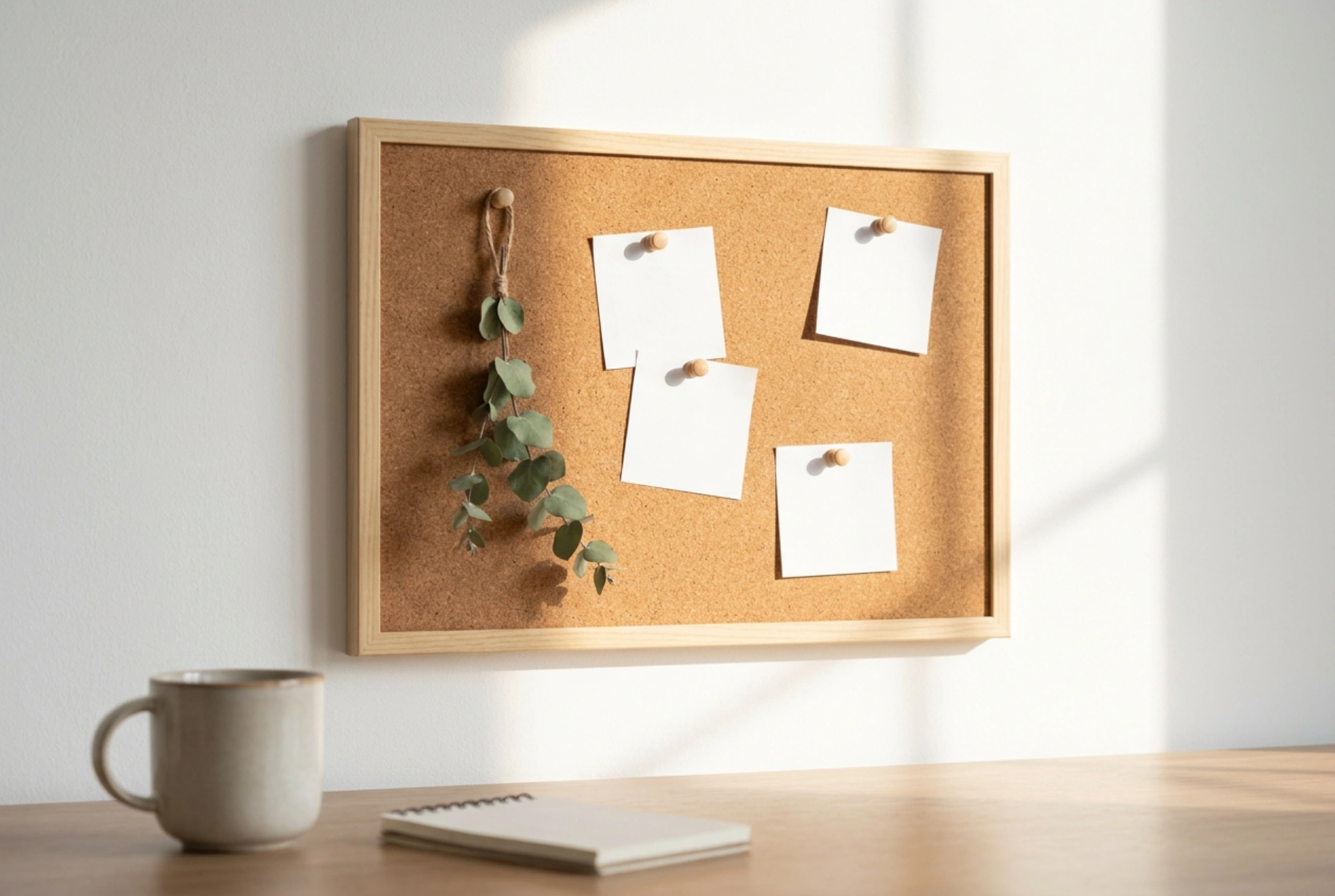


Spatial organisation relies on physical placement to anchor daily memory and coordinate household activities. A wall-mounted corkboard serves as an analogue processing unit, using visual hierarchy to reduce cognitive load and streamline family communication.
The Material Physics of Cork Boards
Cork is harvested from the outer bark of the cork oak (Quercus suber). At a microscopic level, cork consists of a tight honeycomb structure of dead cells filled with an air-like gas. These cell walls are primarily composed of suberin, a fatty acid substance that makes the material highly elastic, hydrophobic, and resilient. When you insert a pushpin, the surrounding cells compress rather than tear. Once the pin is removed, the elastic memory of the suberin-rich cell walls causes them to expand back to their original shape, sealing the entry point. To preserve this self-healing property, select fine-gauge steel pins with a shank diameter under 1 millimetre. Thick plastic tacks can permanently rupture the cell walls, leading to structural crumbling over time.
Designing a Visual Information Architecture
An unorganised board quickly becomes visual noise. To prevent this, apply the principles of spatial layout based on cognitive processing. The human eye naturally scans from top-left to bottom-right. Designate specific coordinates on your board for different time horizons:
- Top-Left (Action Zone): Place high-priority, time-sensitive items here, such as incoming invoices requiring immediate payment or weekly appointment cards.
- Center (Weekly Schedule): Use this central space for the master calendar or chore rotation. This serves as the visual anchor of the board.
- Right Side (Reference Zone): Reserve this area for static, long-term information, such as emergency contact protocols, water shut-off valve locations, or recycling timetables.
Use thin physical dividers, such as elastic bands secured with fine pins, to create hard borders between these zones. This physical grid prevents visual bleed and ensures that the brain instantly categorises information based on its spatial location.
The Mechanics of Color-Coding and Material Selection
The choice of paper and writing instruments directly impacts how effectively information is retrieved. Lightweight paper easily curls when exposed to ambient humidity fluctuations, making the board look untidy and reducing legibility. Instead, use cardstock with a density of 120 to 160 gsm. This weight remains flat and holds its position even when subjected to drafts or movement nearby.
Implement a chromatic coding system to categorise tasks. Keep the system simple to avoid visual fatigue. Limit your palette to three primary colours: red or neon yellow for urgent action items, blue or green for routine schedules, and neutral white or kraft paper for general reference. This leverages the brain's pre-attentive processing, allowing you to assess the state of household affairs in under a second without reading a single word.
Environmental Maintenance and Longevity
Cork is an organic material that reacts to its environment. High dryness can cause the suberin walls to lose their flexibility, leading to brittleness and cracking, while excessive moisture can encourage mold growth within the porous cells. Maintain your corkboard by keeping it away from direct heat sources such as radiators or direct, intense sunlight, which degrades the natural binders. Once every six months, lightly mist the board with distilled water from a fine-nozzle spray bottle. Do not saturate the surface; a micro-fine mist is sufficient to restore the natural moisture balance of the cork cells. Wipe any excess water immediately with a lint-free cloth and allow it to air dry in a well-ventilated room.