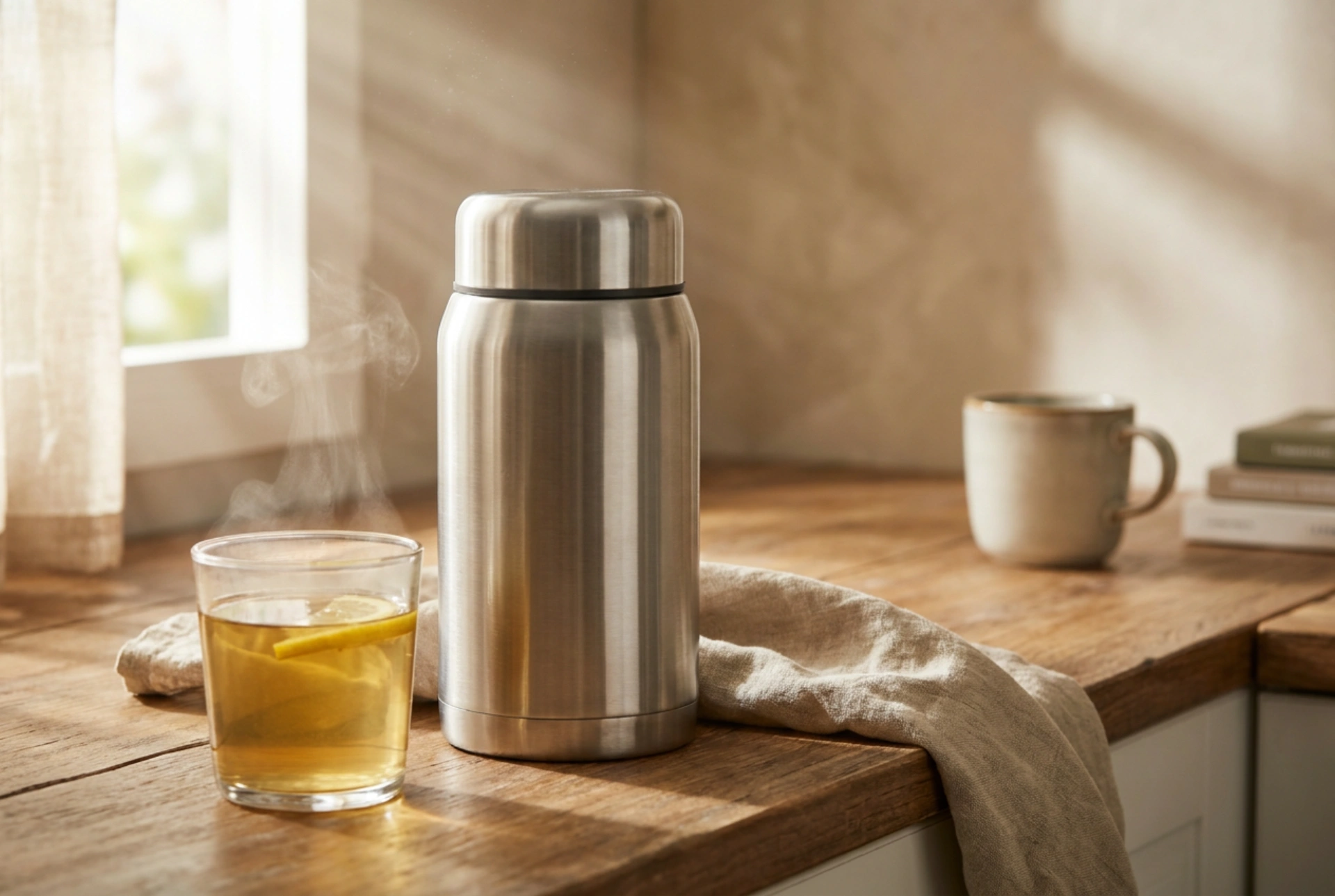


Maintaining the temperature of a warm drink in a school thermos requires understanding thermal energy transfer. By using basic thermodynamic principles, you can keep your child's beverage warm until lunchtime without relying on specialized gadgets.
The Physics of Thermal Insulation in Flasks
A quality school thermos relies on a double-walled construction separated by a vacuum. In physics, heat transfers via three main pathways: conduction, convection, and radiation. Conduction requires physical contact between molecules; convection relies on the movement of fluids or gases; radiation involves electromagnetic waves. The vacuum layer between the inner and outer stainless steel walls eliminates air, which virtually stops heat transfer by conduction and convection. However, radiation can still cause heat loss, which is why the inner walls are often reflective. Understanding this mechanism helps explain why any physical compromise, such as a dent or a damaged seal, dramatically decreases the flask's efficiency.
The Essential Preheating Step
The most common reason a warm drink turns lukewarm by midday is thermodynamic equilibrium. Stainless steel has a specific heat capacity. If you pour hot tea into a room-temperature flask, the colder steel immediately absorbs thermal energy from the liquid until their temperatures equalise. To prevent this initial heat loss, you must preheat the vessel. Fill the flask to the top with boiling water and seal it for five to ten minutes. This raises the temperature of the inner steel wall to near-boiling point. Empty the water immediately before pouring in the actual beverage. This simple step ensures that the heat from the drink remains in the liquid rather than being absorbed by the container's cold mass.
Optimising Liquid Temperature and Volume
When preparing the beverage, the volume of liquid and the remaining air space play crucial roles. Air is a poor conductor of heat, but the air pocket at the top of a partially filled thermos allows convection currents to form, accelerating heat loss through the lid. Always fill the flask to about one centimetre below the stopper thread. Minimising this air gap restricts convective heat transfer. Additionally, consider the safety of the child. While we want to maximise heat retention, pouring boiling liquid directly into a thermos meant for a young child can lead to severe scalds. Aim for an initial pouring temperature of around 70°C to 75°C. Combined with preheating, this temperature will naturally degrade to a safe, comfortably warm 45°C to 50°C by lunchtime.
Stopper Mechanics and Heat Loss Prevention
While the double-walled vacuum body is excellent at stopping heat transfer, the lid is the weakest thermal link. Most lids are made of polypropylene plastic and silicone gaskets, which conduct heat much faster than a vacuum. To mitigate this, ensure the silicone seal is perfectly seated and free of micro-tears. Even a microscopic gap allows warm water vapour to escape, which carries away significant thermal energy through latent heat of vaporisation. Teach children to seal the lid tightly but without overtightening, which can deform the silicone gasket over time and compromise its sealing ability.
Care and Maintenance of Stainless Steel
To preserve the thermal properties of the thermos, avoid harsh cleaning chemical treatments. Chlorine-based detergents can pit stainless steel, disrupting the smooth reflective inner surface that bounces heat radiation back into the liquid. Instead, clean the flask using a mixture of warm water and sodium bicarbonate (baking soda) or mild dish soap. Use a soft bottle brush to avoid scratching the internal walls. Scratches can harbor bacteria and weaken the material over time, leading to microscopic leaks in the vacuum seal.