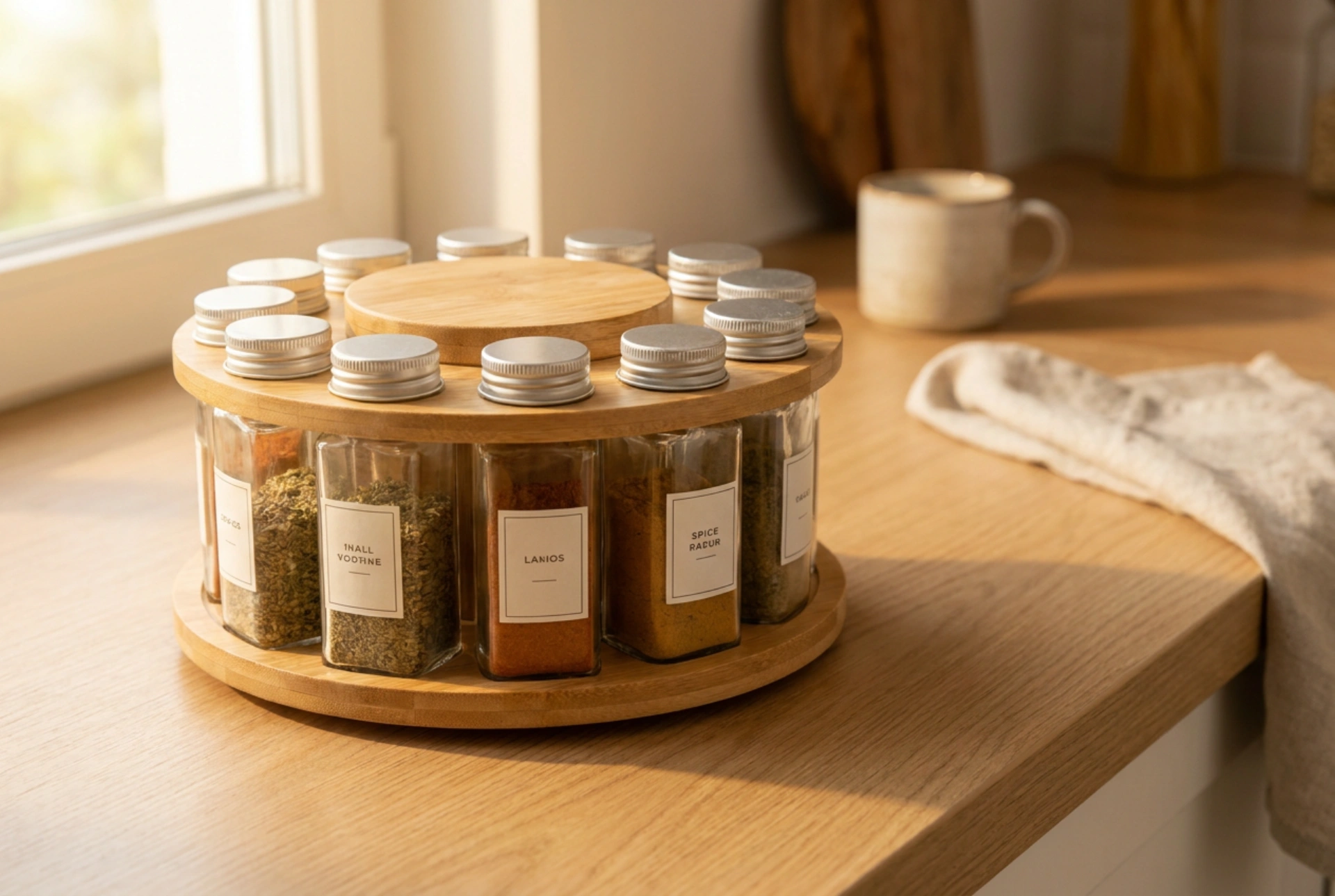


Choosing between a fixed spice shelf and a rotating organiser depends on kitchen ergonomics, cabinet depth, and the physics of reach. While shelves offer linear visibility, rotating carousels solve the issue of deep cabinet blind spots by bringing the back row directly to your fingertips.
The Physics of Reach: Overcoming the Deep Cabinet Dilemma
Standard kitchen wall cabinets typically range from 30 to 35 centimetres in depth. When storing small spice containers on a flat shelf, this depth becomes an ergonomic disadvantage. To reach a jar placed at the back, you must navigate around or temporarily remove the items in front. This linear storage system increases the risk of tipping, spills, and disrupted workflow during cooking.
A rotating organiser, often called a lazy Susan, transforms this linear depth into a circular path. By rotating 360 degrees around a central axis, it ensures that every item travels through the point of closest approach (the front of the shelf). Instead of reaching deep into a dark cabinet and straining your wrist, a simple rotational force brings the desired spice container directly to your hand. This reduces the physical search path and eliminates the need to rearrange multiple jars just to find one herb.
Spatial Efficiency in Corner Cabinets and Blind Spots
Corner cabinets are notoriously difficult to utilise efficiently because their depth exceeds the comfortable reach of an average adult arm. Rectangular shelves in these zones create dead space in the far corners, where items are easily forgotten and expire. A rotating organiser is mathematically the most efficient way to utilise these awkward volumes.
By fitting a circular carousel into a square or corner space, you sacrifice a small fraction of the outer corners, but you gain absolute accessibility to the entire surface area of the rotating platform. In physics terms, you trade static, unreachable volume for dynamic, usable surface. This is particularly valuable in high wall cabinets where the upper shelves are above eye level; a rotating system allows you to access items without needing a step stool, relying on tactile rotation rather than visual scanning.
Load Distribution and Mechanical Construction
To ensure a rotating spice organiser functions smoothly over years of daily use, understanding its mechanics is vital. A high-quality carousel relies on a ring of stainless steel ball bearings housed within a stable base plate. This design distributes the downward gravitational force of heavy glass jars evenly across the entire circumference, preventing the platform from tilting or binding under uneven loads.
When selecting or setting up a rotating organiser, material science plays a significant role. Friction is necessary to prevent jars from sliding outward due to centrifugal force when the unit is spun. Look for organisers featuring a high-friction thermoplastic rubber or silicone lining on the platform surface, combined with a raised outer rim. The rim acts as a physical barrier, countering the inertia of the jars and keeping them securely upright during rotation.
When to Stick to a Fixed Shelf
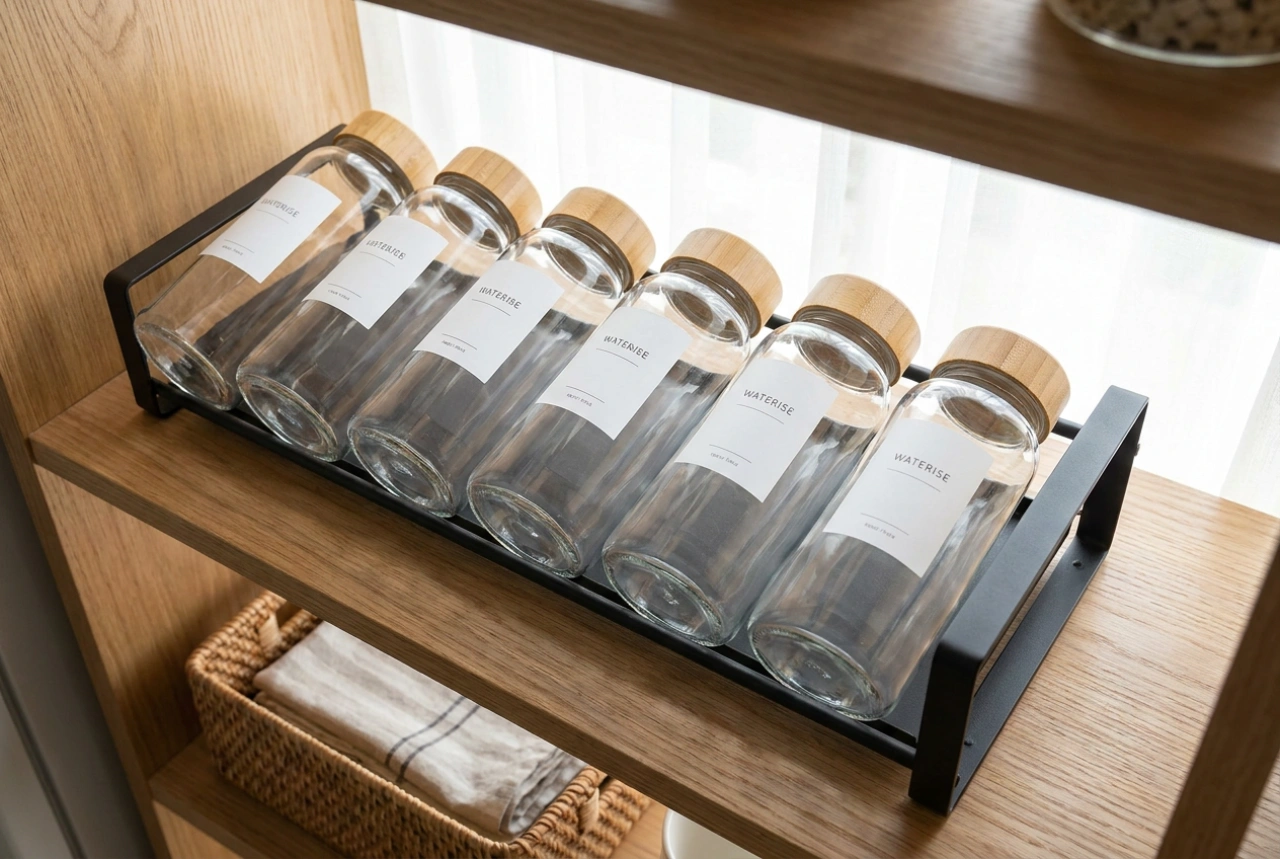
Despite the advantages of rotation, fixed shelves remain superior in specific scenarios. If your kitchen layout features shallow, eye-level recess shelving (less than 10 centimetres deep), a rotating organiser is counterproductive. Shallow shelves naturally expose every single jar in a single row, providing instant visual and physical access without any mechanical movement. Additionally, rectangular drawers equipped with angled spice inserts are more efficient than rotating carousels for under-counter storage, as they utilise 100% of the drawer’s rectangular volume and present labels at a readable 45-degree angle.
Quick Selection Criteria
- Choose a rotating organiser if: Your cabinets are deeper than 25 centimetres, you have blind corner cupboards, or you need to store spices on shelves above eye level.
- Choose a linear shelf if: Your storage recess is ultra-shallow (under 10 centimetres) or you have dedicated, shallow spice drawers with angled inserts.