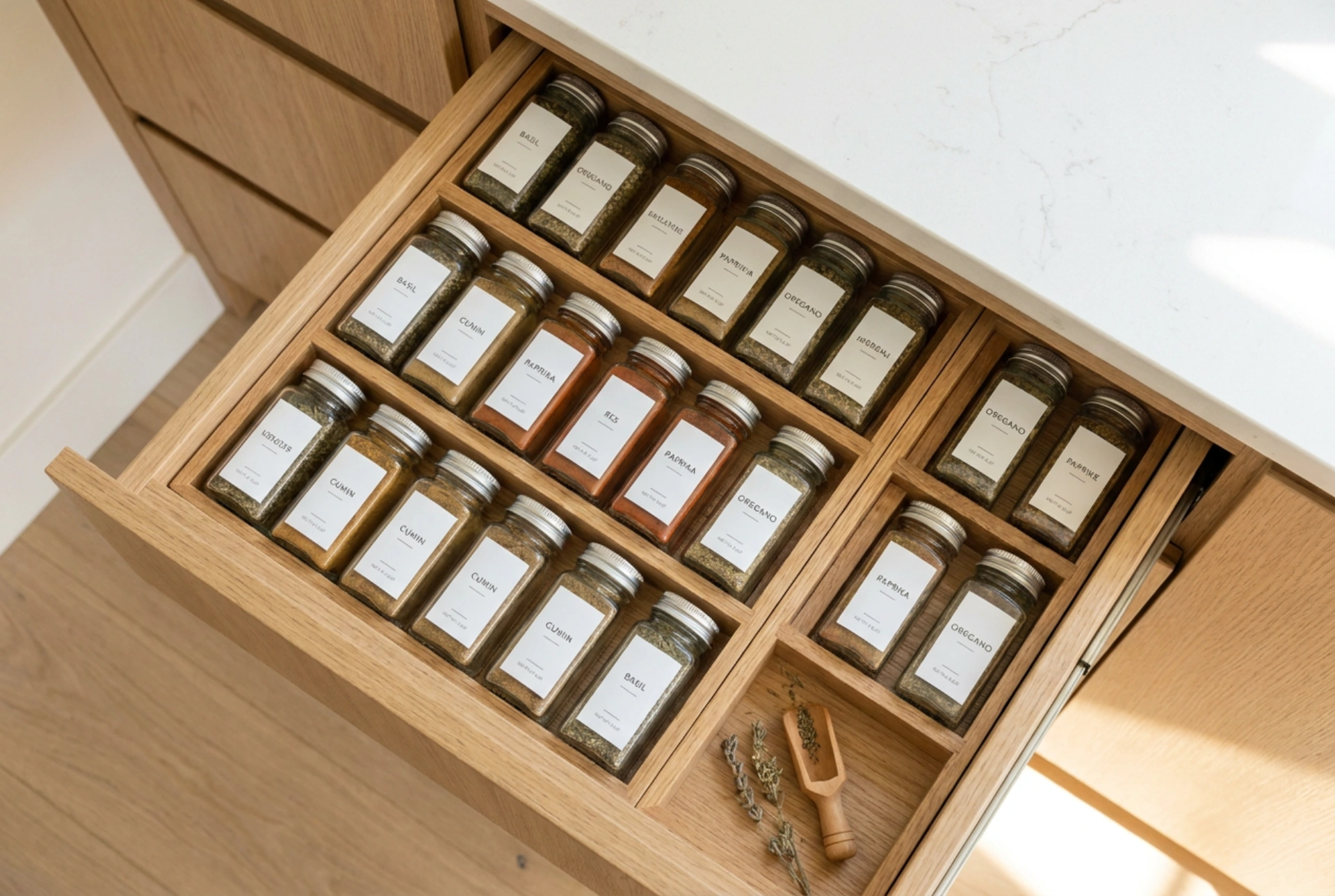


Labeling spice jars in a kitchen drawer requires a strategic approach to visibility, viewing angles, and material durability to prevent endless searching during active cooking. Organizing spices from a top-down perspective shifts the visual focus entirely, making traditional side-labeling obsolete and requiring specific material choices to withstand grease and moisture.
The Geometry of Drawer Storage: Finding the Optimal Label Placement
When spices are stored in a drawer, they are viewed from a vertical, top-down angle rather than the eye-level horizontal perspective of a pantry shelf. This physical layout dictates where the label must be applied. If your jars stand upright, the label must be placed directly on the flat surface of the lid. Placing labels on the sides of upright jars in a drawer forces you to lift each container to read its contents, defeating the purpose of organized storage.
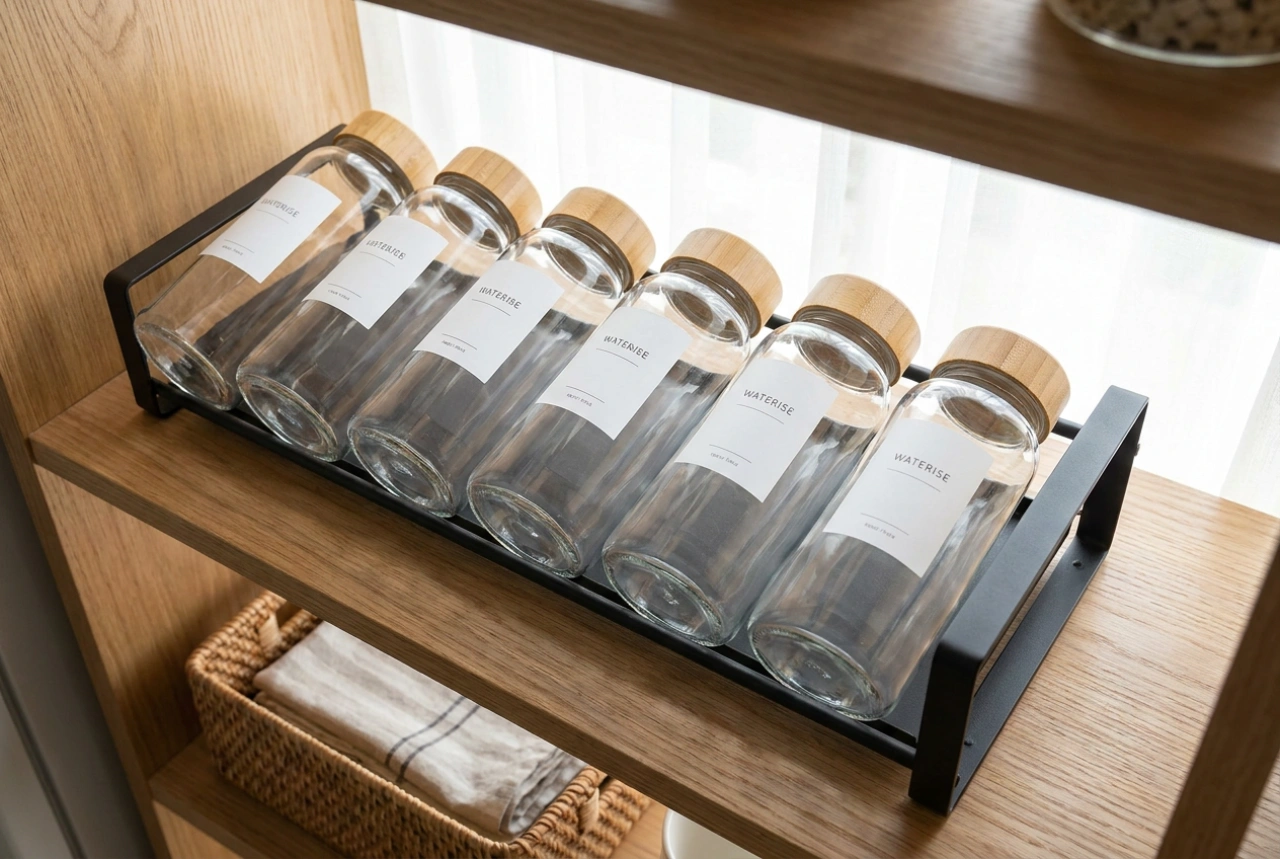
If you utilize angled drawer inserts where jars lie at a thirty to forty-five-degree incline, the labels should be placed on the upper third of the jar body or on the lid, depending on which surface faces directly toward your line of sight. For flat-lying jars, a horizontal label along the body of the glass is ideal. Before applying any labels, categorize your spices by usage frequency or alphabetical order, then dry-fit the jars in the drawer to test the legibility of your planned placement from your standing cooking position.
Material Science of Labels: Withstanding Heat, Grease, and Moisture
The kitchen is a challenging environment for adhesives due to high humidity, airborne grease particles, and temperature fluctuations from ovens and hobs. Standard paper labels absorb oils from your hands and moisture from steam, causing the fibers to degrade, the ink to bleed, and the edges to peel. To ensure longevity, opt for synthetic label materials such as biaxially-oriented polypropylene or polyester.
These synthetic polymers are hydrophobic, meaning they repel water and resist oil penetration, keeping the printed text crisp over years of use. When it comes to adhesives, select a medium-tack, removable acrylic adhesive. Unlike permanent rubber-based adhesives, which degrade into a sticky, yellow residue when exposed to heat, high-quality acrylic adhesives can be peeled off cleanly when you decide to swap a jar's contents, leaving no chemical residue behind.
The Chemistry of Clean Adhesion and Residue Removal
For any label to adhere properly, the surface of the jar lid must be chemically clean. Even microscopic oils from your skin or factory residues will prevent the adhesive from bonding securely. Before labeling, wash the lids with a surfactant like dish soap to remove polar soils, followed by a wipe-down with isopropyl alcohol of minimum seventy percent concentration to dissolve non-polar oils and evaporate completely without leaving a film.
If you are reusing old jars and need to remove stubborn adhesive residue, utilize the principle of like dissolves like. Since most adhesive backings are hydrophobic, non-polar solvents are highly effective. Applying a small amount of a vegetable-based oil or isopropyl alcohol breaks down the polymer chains of the old adhesive, allowing it to be easily wiped away with a microfiber cloth before the final degreasing step.
Typography, Contrast, and Ink Chemistry for Maximum Legibility
Quick recognition relies on visual contrast and typographic clarity. When looking down into a drawer from a distance of approximately one meter, the human eye processes clean, high-contrast shapes fastest. Use sans-serif typefaces with uniform stroke widths, avoiding cursive or highly decorative fonts. A high-contrast color scheme, such as crisp black lettering on a matte white background, or white lettering on a dark charcoal background, minimizes visual noise and speeds up identification.
The ink used is just as critical as the label material. Water-based inks found in standard inkjet printers or gel pens will smudge instantly when touched with damp cooking hands. Instead, use thermal-transfer printing, laser-printed labels which use heat-fused plastic toner, or write manually using a permanent, alcohol-based pigment marker. Pigment markers contain solid color particles suspended in a fast-evaporating solvent; once dry, these pigments resist water, oils, and mild abrasions.