

Managing household paperwork requires more than just shoving utility bills into a drawer; it demands a structured physical environment that protects paper from degradation while enabling rapid retrieval.
The Science of Paper Preservation: Protecting Your Records
Paper is an organic material made of cellulose fibres, which are highly susceptible to environmental factors. Exposure to moisture, fluctuating temperatures, and acidic materials accelerates chemical decomposition, leading to yellowing and brittleness. To prevent this, your home document cabinet should be placed in a room with stable relative humidity—ideally between 30% and 50%—and away from direct heat sources or damp external walls.
When choosing storage accessories, opt for acid-free and lignin-free folders. Standard cheap plastic sleeves often contain polyvinyl chloride (PVC), which releases volatile organic compounds over time, degrading ink and sticking to paper surfaces. Instead, look for inert plastics like polypropylene or polyester, or high-quality alkaline-buffered paper folders that neutralise ambient acids.
Material Choice: Steel versus Wood Cabinets
The physical structure of your cabinet affects its internal microclimate. Metal cabinets, usually made of powder-coated steel, offer excellent protection against pests and are non-combustible. However, steel conducts heat rapidly, meaning sudden ambient temperature changes can cause condensation inside if the cabinet is placed against a cold outer wall. Wooden cabinets provide better thermal insulation, buffering against rapid temperature shifts, but they must be sealed with non-gassing varnishes to ensure that natural wood acids, such as acetic acid, do not leach into the air and degrade stored papers. If using an older wooden cabinet, lining the shelves with barrier paper or using sealed polypropylene boxes is highly recommended.
The Three-Tier Archiving System
An efficient home archive relies on a clear separation of documents based on their lifecycle and frequency of access. Implementing a three-tier system prevents your active cabinet space from becoming congested with obsolete records:
- Active Files (Daily or Weekly Access): These include ongoing projects, unpaid invoices, and current tax-year receipts. Keep these in the most accessible upper drawer or a desktop organiser.
- Semi-Active Files (Monthly or Annual Access): Documents such as insurance policies, employment contracts, and utility agreements. These belong in the main body of your document cabinet.
- Archival Files (Long-term or Permanent Storage): Birth certificates, property deeds, and historical tax returns. These should be sealed in protective containers and stored in the lowest, driest part of the cabinet.
Physical Mechanics: Drawer Loading and Suspension Files
The mechanical setup of your filing cabinet dictates its usability and safety. To ensure smooth operation and prevent mechanical failures, always load drawers from the bottom up. Filing cabinets can easily become top-heavy, posing a tipping hazard when fully extended. Heaviest items, like thick archival binders, should reside in the lowest drawer. This lowers the unit's centre of gravity and ensures structural stability.
Suspension files are highly efficient because they relieve physical pressure on individual documents. When papers are stacked flat or packed too tightly horizontally, friction increases, making extraction difficult and damaging paper edges. Ensure there is a gap of at least two to three centimetres between the top of the suspension folder tabs and the drawer runner to prevent snagging.
Effective Categorisation and Colour-Coding
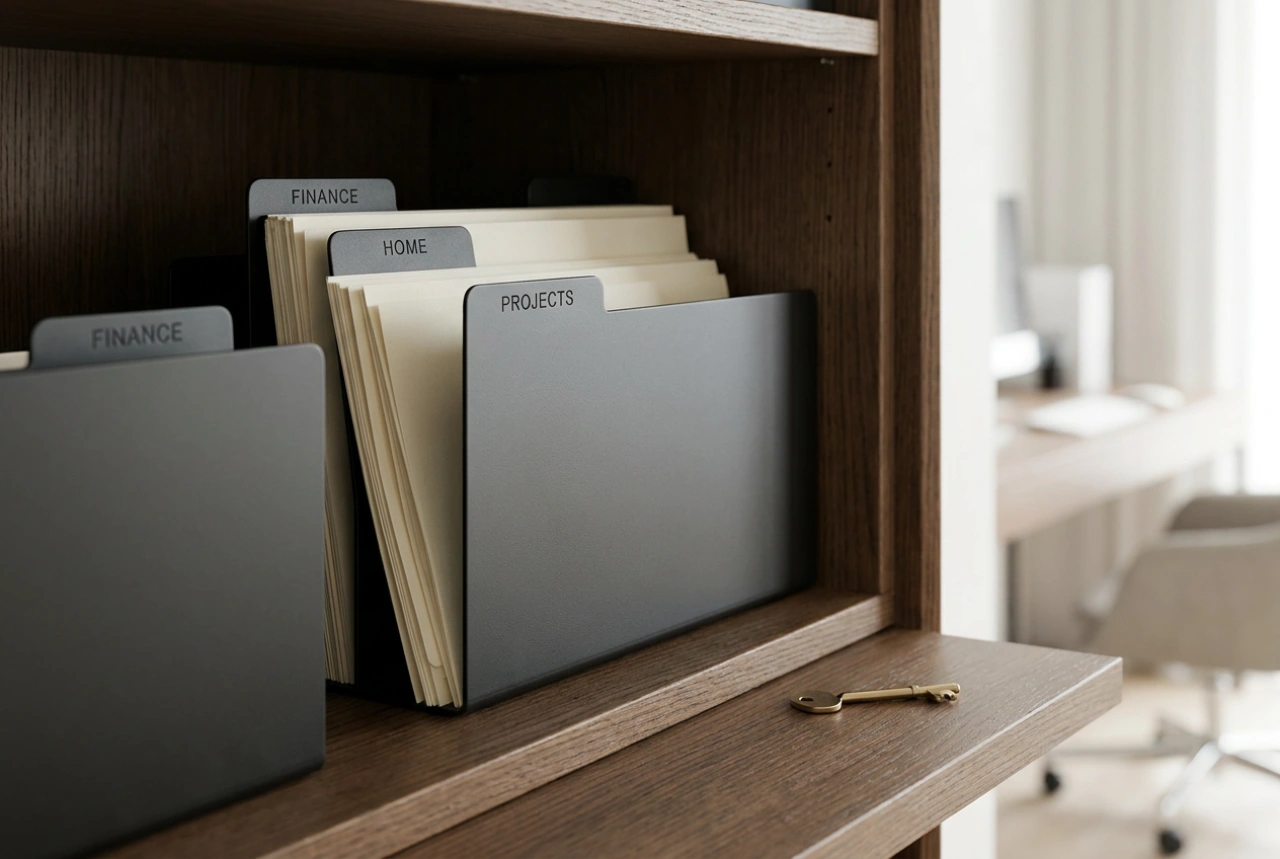
A functional archive bypasses over-complicated alphabetical systems in favour of broad, functional categories. Group files by logical domains: Finance, Property, Health, and Personal Identity. Assign a distinct colour to each domain using coloured plastic tabs or folder spines. The human brain processes colour significantly faster than text, reducing visual search times by up to eighty percent. Within each category, sequence documents chronologically, placing the most recent document at the front. This physical hierarchy mirrors your natural retrieval patterns, as older records are rarely accessed.
The Annual Purge: Maintenance Routine
An archive is a dynamic system that requires routine maintenance to prevent expansion beyond its physical limits. Set a recurring annual date to audit the cabinet. Apply the principle of statutory retention periods and immediately shred expired documents to reclaim valuable physical space.