

Integrating a laundry basket into a cabinet requires precise physical measurements and an understanding of fabric moisture dynamics to prevent stagnant air and mildew. Choosing the right built-in solution depends on balancing cabinet volume, mechanical load limits, and material breathability.
Calculating Cabinet Clearance and Weight Capacity
The most common error in retrofitting a laundry basket into a cabinet is failing to account for the spatial footprint of the hardware. To ensure smooth operation, you must measure the internal width, depth, and height of the cabinet carcass, subtracting the space required for hinges, door alignment, and runner tracks. For pull-out systems, side-mounted drawer runners typically require 12.5 mm to 13 mm of clearance on each side, reducing the usable width of your basket.
Furthermore, the physical weight of laundry changes significantly when damp. While dry cotton t-shirts weigh very little, damp towels or gym wear can easily double the load. When selecting a pull-out mechanism, ensure the ball-bearing slides are rated for dynamic loads of at least 30 to 45 kilograms. Overloading lightweight runners causes deflection in the steel rails, leading to friction, misalignment, and eventual mechanical failure of the soft-close dampening system.
Material Science: Selecting the Right Basket Core
The interior of a closed cabinet naturally traps humidity, creating a microclimate that accelerates the growth of mould spores (specifically Aspergillus and Penicillium species) on dirty fabrics. The material of your laundry container plays a critical role in mitigating this risk:
- Powder-Coated Steel Wire: This provides maximum airflow, allowing moisture from damp clothes to evaporate rapidly. The zinc-phosphate pre-treatment and powder-coat finish protect the steel from rusting due to high humidity.
- Perforated Polypropylene: Highly resistant to chemical degradation and moisture, plastic baskets are easy to sanitise. However, they must feature high-density perforation patterns to compensate for plastic's natural impermeability.
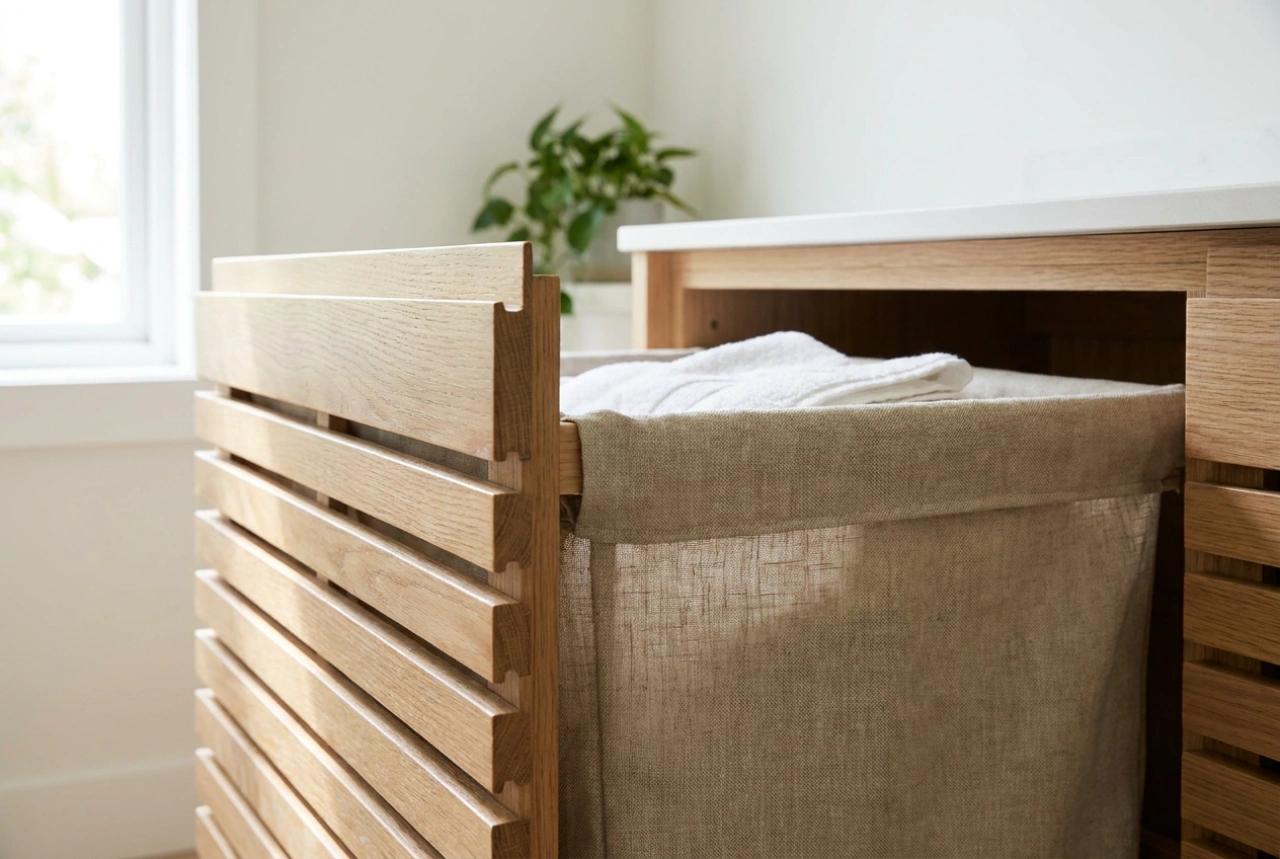
- Removable Canvas Bags: Often suspended on a metal frame, these offer excellent ergonomics as they can be carried directly to the washing machine. Ensure the fabric is a synthetic blend (such as polyester-cotton) treated with a hydrophobic coating, or wash the canvas lining at 60°C regularly to destroy embedded fungal spores.
Tilt-Out vs. Pull-Out Mechanics
The choice between a tilt-out cabinet front and a linear pull-out drawer dictates the physical strain on your cabinetry and the ease of access. A tilt-out system uses bottom-mounted hinges and a retaining chain or bracket. While space-saving in narrow utility rooms, the tilt-out mechanism concentrates gravitational pull on the lower door screws. Over time, this leverage can pull screws out of particleboard cabinet doors unless reinforced with expanding nylon inserts or back-plates.
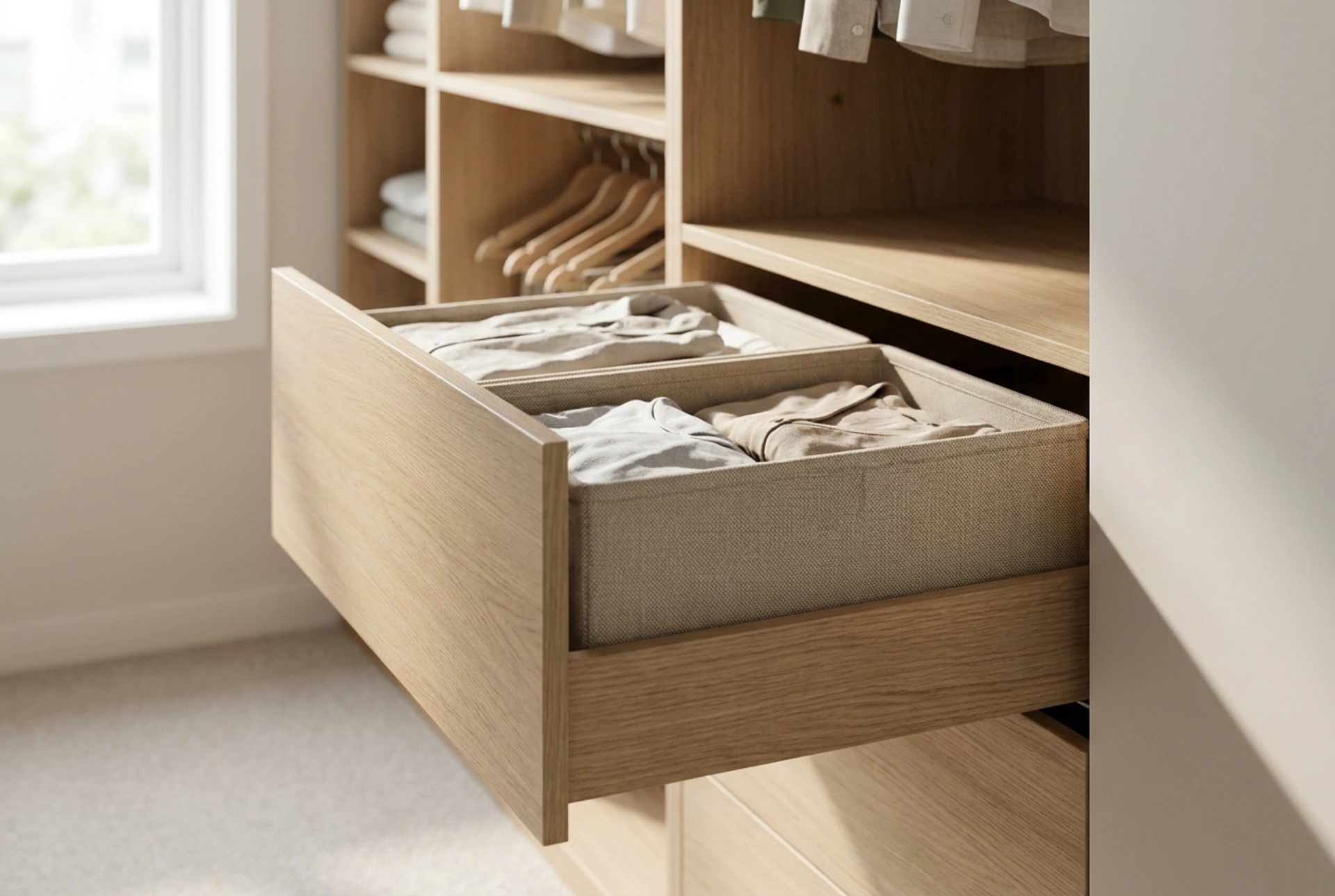
A linear pull-out drawer, mounted on heavy-duty base runners, distributes weight more evenly across the cabinet carcass. This configuration is structurally superior for larger, multi-compartment baskets, allowing you to pre-sort whites, darks, and delicates without putting asymmetric tension on the cabinet door.
Controlling Moisture and Volatile Odour Compounds
Dirty laundry emits volatile organic compounds (VOCs) produced by the microbial breakdown of sweat, skin cells, and sebum. In an enclosed cabinet, these gases concentrate, creating unpleasant odours that can cling to the cabinet wood. To prevent this, design an active ventilation path: cut a ventilation slot in the cabinet base or install a slatted back panel to facilitate passive air convection.
To chemically neutralise odours without synthetic perfumes, place an open container of activated charcoal or a sachet of natural sodium bicarbonate (baking soda) in the corner of the cabinet. Activated charcoal operates via physical adsorption, trapping odour molecules within its highly porous microscopic carbon structure, while sodium bicarbonate chemically neutralises acidic and basic volatile compounds, keeping the cabinet air neutral.