

Positioning your bathroom towel rail based on thermodynamics and room airflow is essential for preventing bacterial growth and musty odours. Selecting the correct location for your hanging fixtures directly determines how quickly moisture evaporates from dense cotton fibres after use.
The Physics of Towel Drying: Evaporation and Humidity
To understand where to install a towel rail, one must look at the science of evaporation. When a wet towel hangs, liquid water trapped within the capillary network of the woven cotton loops must transition into water vapour. This process relies on temperature, relative humidity, and air movement. If a towel is placed in an area of stagnant, saturated air—such as directly inside a poorly ventilated shower enclosure—the evaporation rate drops significantly.
Air can only hold a finite amount of moisture at a given temperature. When the microclimate surrounding the towel becomes saturated, drying stalls. To accelerate drying, you must place the rail in a location where the boundary layer of humid air around the fabric is continuously replaced by drier ambient air. This makes airflow the single most critical factor in towel rail placement.
Optimal Positioning for Maximum Airflow
To exploit natural convection and mechanical ventilation, towel rails should be positioned in path-of-airflow zones. Every bathroom has air entry and exit points, typically the gap under the door and the ceiling extraction fan. Placing the rail on a wall between these two points ensures that air constantly flows across the fabric, lifting away moisture.
- Avoid Dead Zones: Corners, deep recesses, and the spaces behind open doors are aerodynamic dead zones where air stagnates. Avoid mounting rails in these tight pockets.
- Utilise Heat Sources: Positioning a rail above or near a radiator or underfloor heating path utilises rising warm air. Warm air holds more moisture than cold air and rises naturally, creating a dry micro-draft through the hanging fabric.
- Maintain Distance from Wet Areas: While convenience suggests mounting the rail immediately next to the shower, this is often the most humid zone. A distance of at least 1 to 1.5 metres from the wet zone allows the towel to dry in a lower-humidity environment.
Rail Geometry and Fabric Surface Area
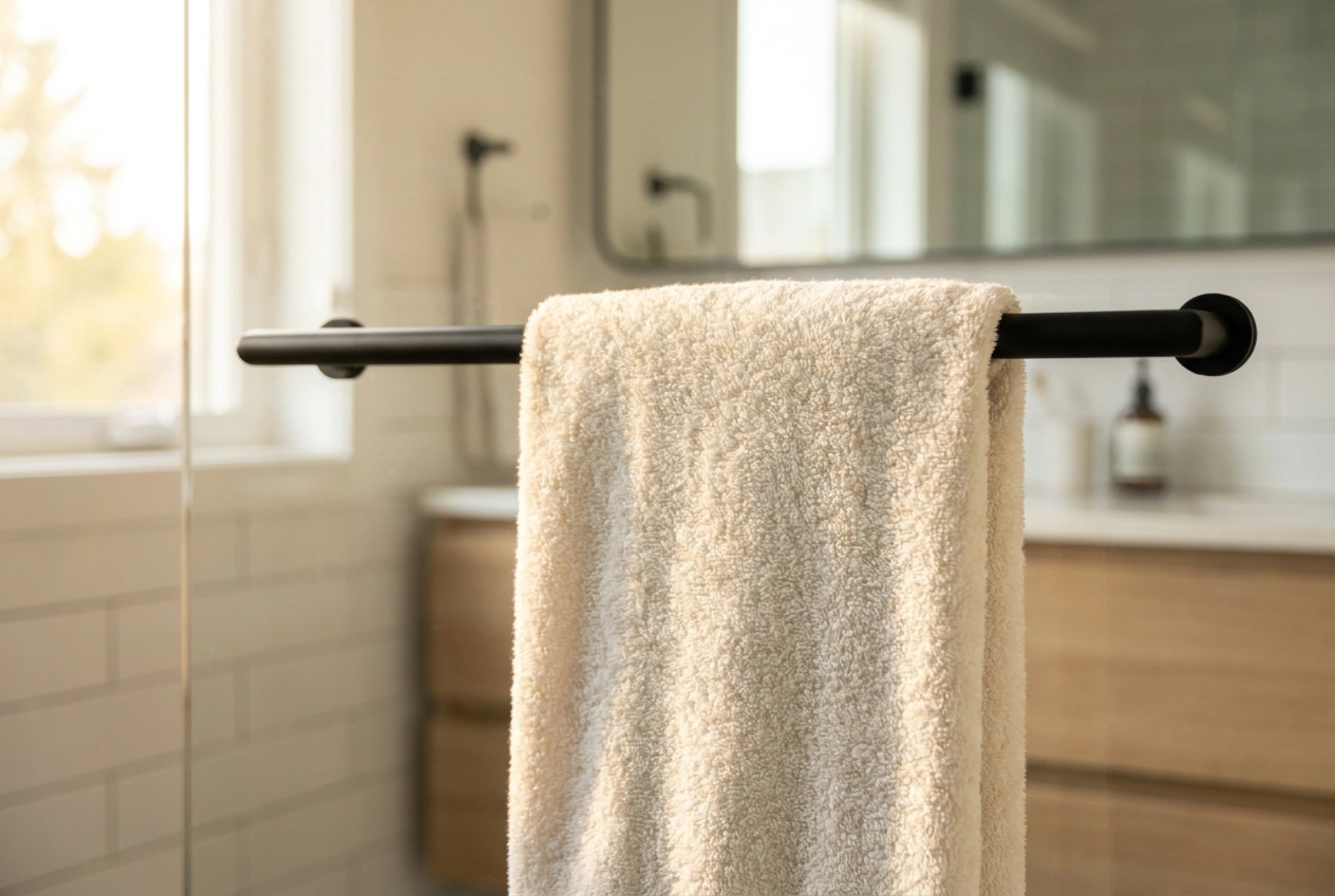
The physics of drying also depend heavily on how the fabric is suspended. A towel bunched up on a single hook dries up to four times slower than a towel spread flat across a wide rail. When fabric is layered or folded, moisture is trapped between the layers, creating a cool, dark, and damp environment perfect for bacterial growth.
When installing a rail, ensure its width matches or exceeds the width of your bath towels. A single, flat, horizontal bar allows the towel to hang unfolded, maximising the surface area exposed to the air. If you must use a double rail, ensure there is a gap of at least 50 to 80 millimetres between the parallel bars to permit adequate convective airflow between the hanging textiles.
Preventing Microbial Growth and Odours
Musty towel smells are not caused by clean water, but by the rapid proliferation of bacteria and fungi, particularly Brevibacterium and various mould species, which thrive in damp, warm environments. These micro-organisms break down skin cells and sebum left on the towel, releasing volatile organic compounds that produce that distinct sour odour.
To inhibit this microbial cycle, a towel must dry completely within four hours of use. If your bathroom cannot support this drying speed due to high baseline humidity, upgrading from a standard metal rail to a heated towel rail is a practical, physics-based solution. The constant, gentle heat lowers the relative humidity of the air immediately surrounding the fabric, drastically shortening the drying window and breaking the bacterial lifecycle.