

Integrating a freestanding towel rail into a small bathroom requires a strategic understanding of microclimates, airflow patterns, and material properties to prevent persistent dampness and visual clutter.
The Physics of Towel Drying in Confined Spaces
To dry a damp towel efficiently, water molecules must transition from a liquid phase within fabric fibers to a vapor phase in the surrounding air. This evaporation process is heavily dependent on ambient temperature, relative humidity, and the boundary layer of air directly adjacent to the fabric. In a compact bathroom, air can quickly become saturated with moisture, which significantly slows down drying rates.
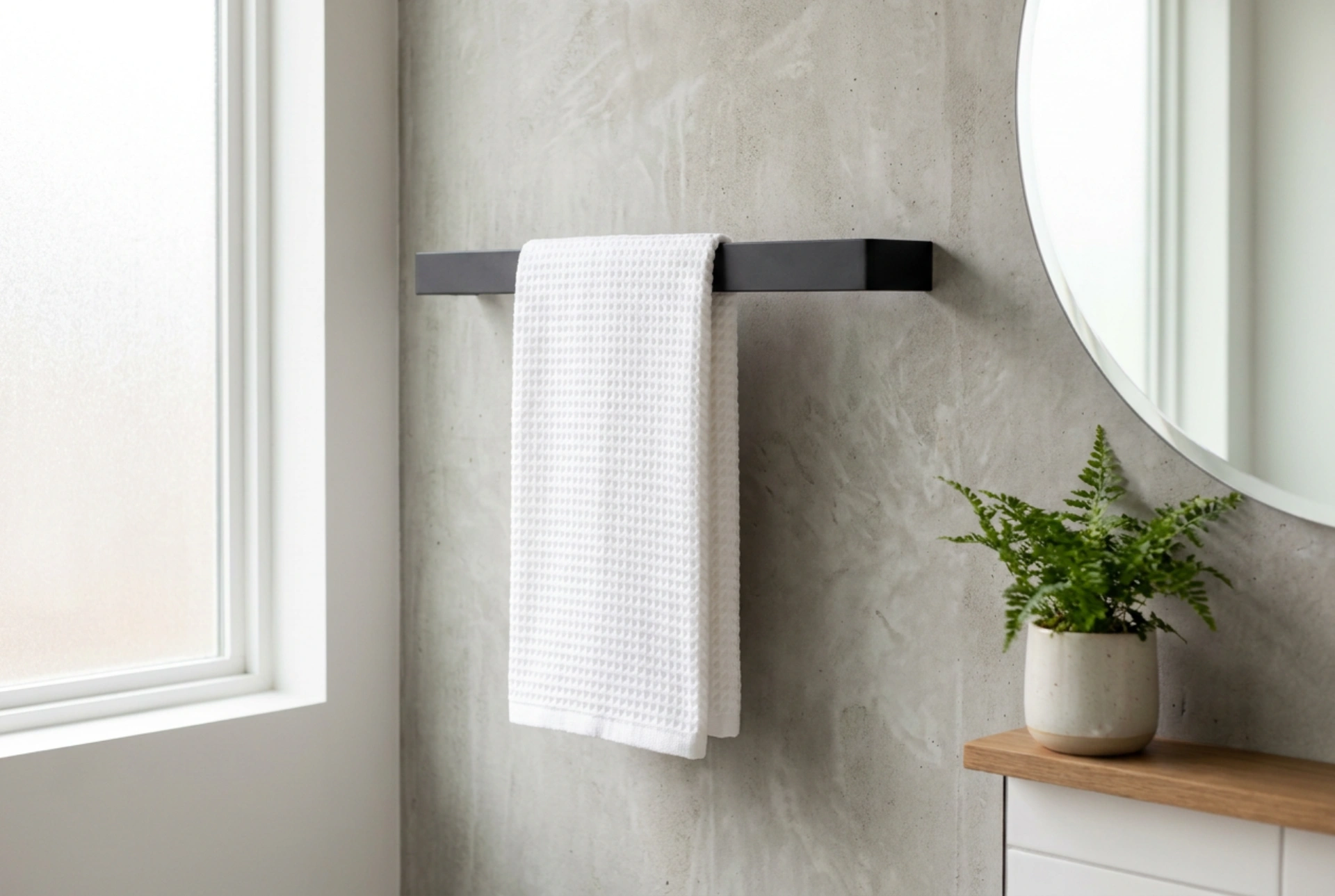
A freestanding towel rail facilitates faster drying than wall-mounted hooks because it allows the fabric to be spread flat, maximizing the exposed surface area. When a towel hangs flat, air flows along both sides of the textile. This dual-sided exposure prevents the accumulation of localized high humidity. To optimize this thermodynamic process, place the rail in a path of natural convective airflow—typically between a heat source and the ventilation exhaust, but never blocking the extraction grille itself.
Material Science and Moisture Resistance
The choice of material for a freestanding rack determines its longevity and hygiene in a high-moisture environment. Bathrooms are prone to rapid temperature fluctuations and high vapor pressure, which can cause vulnerable materials to degrade.
- Powder-Coated Metal: Matte black or metallic finishes rely on electrostatically applied powder coatings that are cured under heat to form a non-porous barrier. This barrier prevents oxygen and water from reaching the underlying metal, halting oxidation. Non-porous surfaces resist fungal spore adhesion, making them exceptionally hygienic.
- Stainless Steel: Stainless steel contains chromium, which naturally forms an invisible, self-healing passive layer of chromium oxide. This layer resists corrosion even when subjected to prolonged contact with damp cotton fibers containing trace minerals from tap water.
- Wood and Bamboo: Organic materials rely on capillary action to absorb water. Without continuous, high-grade sealants, moisture penetrates the grain, leading to cell-wall swelling, warping, and mold colonization. For small, poorly ventilated bathrooms, non-porous metals are scientifically superior.
Spatial Geometry and Placement Mechanics
In a small floor plan, every centimeter dictates the movement of air and occupants. A freestanding rail must be positioned to avoid physical collisions while maintaining clearance zones. Maintain a minimum clearance of 10 to 15 centimeters between the towel rail and adjacent walls. This gap ensures that convective air currents circulate behind the hanging fabric, preventing damp air from stagnating against wall surfaces, which can lead to condensation and paint peeling.
Additionally, consider the door swing radius and the pathway between the shower and vanity. Placing the rail within arm's reach of the shower exit prevents water droplets from wetting the floor tiles, preserving the dry zone. Ensure it does not obstruct the physical clearance required to navigate the space safely.
The Physics of Draping: Maximizing Surface Area
The method used to hang a towel directly impacts its drying rate. Bunching or folding a towel reduces the active surface area exposed to air and traps moisture within the layers. This trapped moisture, combined with warmth, creates an ideal environment for microbial growth, resulting in mildew odours.
For optimal results, drape a single towel over a single horizontal bar, ensuring it hangs completely flat. If the rail features multiple tiered bars, hang the thickest towels on the highest bar, as warm air rises, creating a micro-convection current that accelerates drying at the top first.