

Organising a corner cabinet requires more than just sliding books onto a shelf; it demands an understanding of geometry and physical stability to prevent volumes from slipping into hard-to-reach shadow zones. By utilising structural stacking techniques and balancing the friction of different cover materials, you can transform a deep corner into an accessible, visually balanced display that protects your collection from structural warping.
The Physics of Corner Stability: Friction and Mass Distribution
When a book stands vertically, gravity exerts a downward force, but even a slight tilt introduces lateral force. In the unique 90-degree intersection of a corner cabinet, books often lean at diagonal angles, which multiplies this lateral force and causes a domino effect. To counteract this, you must understand the friction coefficient of your book covers. High-gloss dust jackets have low friction and slide easily against each other, whereas matte paper or cloth-bound boards provide higher resistance. By interleaving high-gloss volumes with high-friction cloth covers, you naturally resist sliding forces.
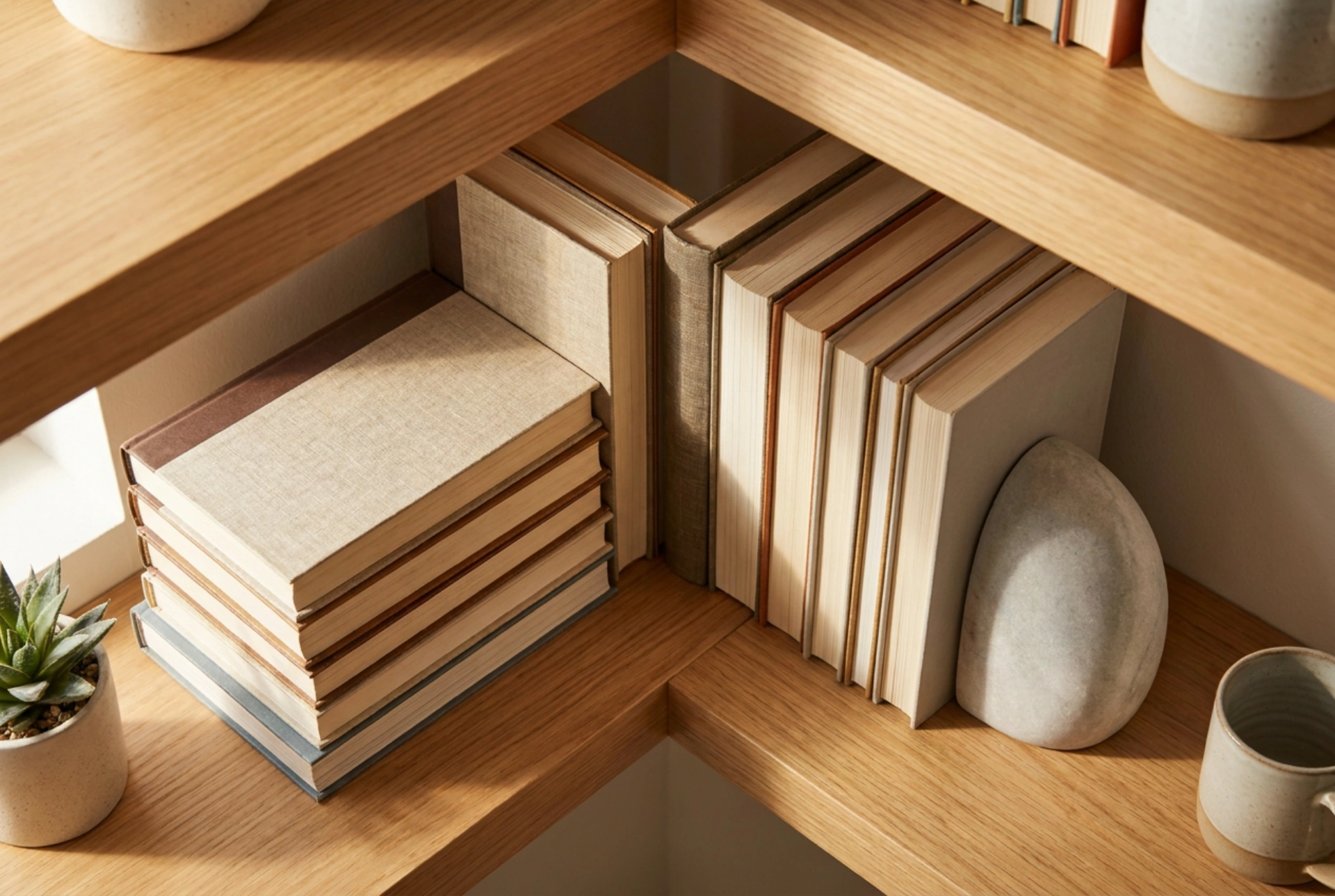
Furthermore, horizontal stacks act as excellent structural anchors. A horizontal stack distributes weight directly downwards, creating a solid, immoveable base. By placing a heavy horizontal stack at the apex of the corner, you create a natural bookend that easily absorbs the lateral forces pushed by adjacent vertical books. This combination of horizontal anchoring and friction balancing eliminates the need for bulky, space-consuming mechanical supports.
Overcoming the Shadow Zone with Tiered Geometry
Deep corner shelves suffer from a lack of ambient light, creating a dark dead zone in the rear angle. Pushing books deep into this corner makes them invisible and difficult to retrieve. To solve this, apply a tiered depth technique. Treat the rear corner as a platform. By placing a sturdy, wide horizontal stack of books directly in the corner, you create an elevated pedestal. You can then place smaller, vertical books on top of this pedestal.
This elevation ensures that the spines of the rear-most books remain visible over any volumes placed on the outer flanks of the shelf. Additionally, this layout encourages natural light reflection. Keeping the corner raised and open allows ambient room light to bounce off the horizontal pages, brightening the deep recess of the cabinet. Always align the front edges of your outer books in a straight line along the shelf edge, leaving the corner stepped back to create a sense of depth without sacrificing accessibility.
Protecting Bindings and Preventing Paper Creep
Paper is an organic material composed of cellulose fibres. These fibres absorb microscopic amounts of moisture from the ambient air, making them highly susceptible to gravitational creep—a slow, permanent structural deformation under continuous physical stress. When a book leans at an angle greater than 15 degrees, gravity pulls the internal page block downward, stretching the binding adhesive and permanently warping the spine. Over time, this causes the pages to sag away from the protective cover.
To prevent this physical degradation, vertical books must be supported at a precise 90-degree angle. Use dense, heavy objects like natural stone blocks or heavy wooden wedges as bookends at the outer boundaries of your rows. Push these supports firmly inward toward the corner apex to apply gentle compression. This compression holds the pages tightly together, preventing air pockets from forming and stopping moisture from infiltrating between the sheets, which preserves the structural integrity of the paper for decades.
Step-by-Step Corner Arrangement Protocol
To construct a stable and highly visible corner display, follow this systematic order of operations:
- First, thoroughly clean and dry the shelf. Ensure there is no residual moisture, which could transfer to the cellulose fibres of the book covers.
- Next, place the heaviest, widest books horizontally directly into the 90-degree corner apex. This forms your stable base pedestal.
- Then, align medium-sized books vertically on the left and right flanks of the corner, ensuring their spines face outward parallel to the shelf edges.
- Interleave glossy dust jackets with matte or cloth-bound books to maximise cover-to-cover friction.
- Finally, place a heavy, high-density bookend on the outer end of each vertical row, applying light pressure toward the corner to lock the entire structure in place.