

Organising spice shelves efficiently requires more than just choosing aesthetic jars; it demands an understanding of food preservation chemistry and ergonomic workspace design to prevent physical clutter and spice degradation.
The Science of Spice Degradation: Choosing the Right Microclimate
Spices owe their distinct aromas and flavours to volatile organic compounds, such as essential oils, terpenes, and aldehydes. These compounds are highly sensitive to thermal energy, ultraviolet (UV) radiation, and moisture. When planning spice shelves, the instinct to place them directly above or adjacent to the cooktop must be resisted. The convective heat rising from hobs accelerates the evaporation of these volatile oils, rendering spices bland over time. Furthermore, steam from boiling liquids introduces humidity into containers, causing hygroscopic spices like garlic powder or ground onion to cake and clump through moisture absorption. The optimal location for a spice shelf is a cool, dry zone away from direct sunlight and thermal sources, ideally maintaining a temperature below 20 degrees Celsius.
Material Selection for Spice Containers and Shelves
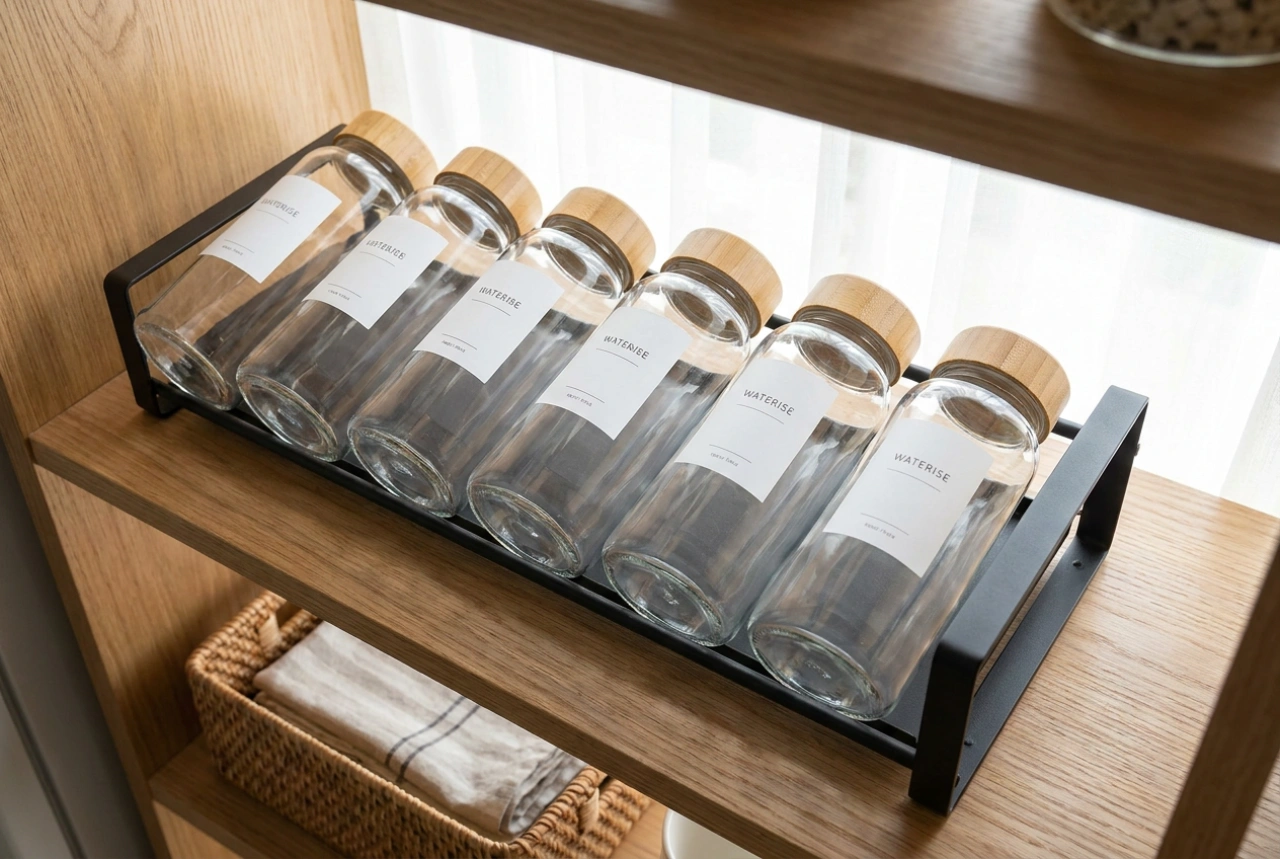
To prevent visual clutter, uniformity in container selection is essential, but material science should dictate the choices. Glass is the superior medium for spice storage because it is completely non-porous and chemically inert. Unlike plastic, which can absorb volatile compounds and slowly allow oxygen permeation over time, high-density glass acts as an absolute barrier to gas exchange. If your spice shelf is exposed to ambient daylight, amber or dark-tinted glass is highly recommended. UV radiation breaks down chemical bonds in organic matter, a process known as photodegradation, which destroys both colour and flavour potency. For closure mechanisms, opt for jars with high-quality silicone gaskets or dense screw-cap threads to create a hermetic seal, preventing the ingress of atmospheric moisture.
Ergonomics and Spatial Geometry on the Shelf
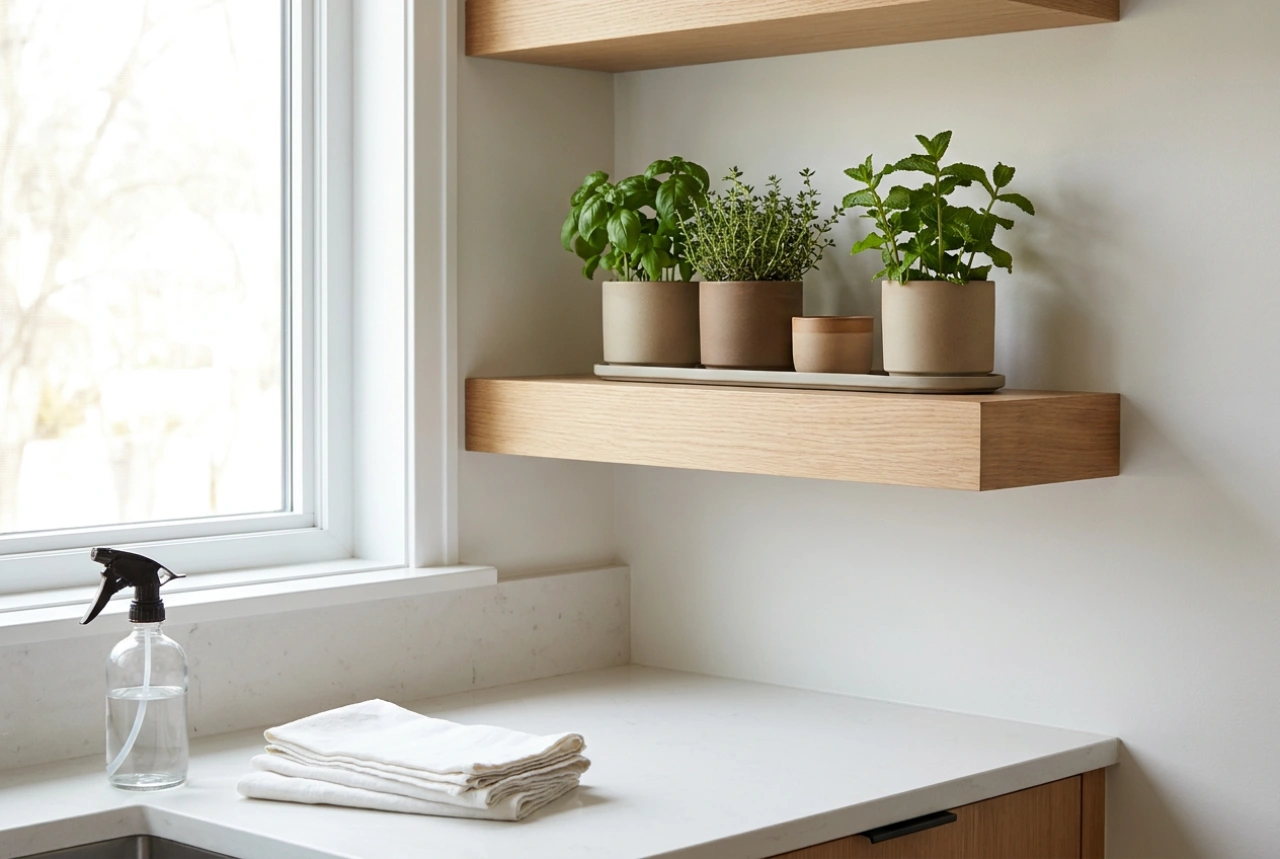
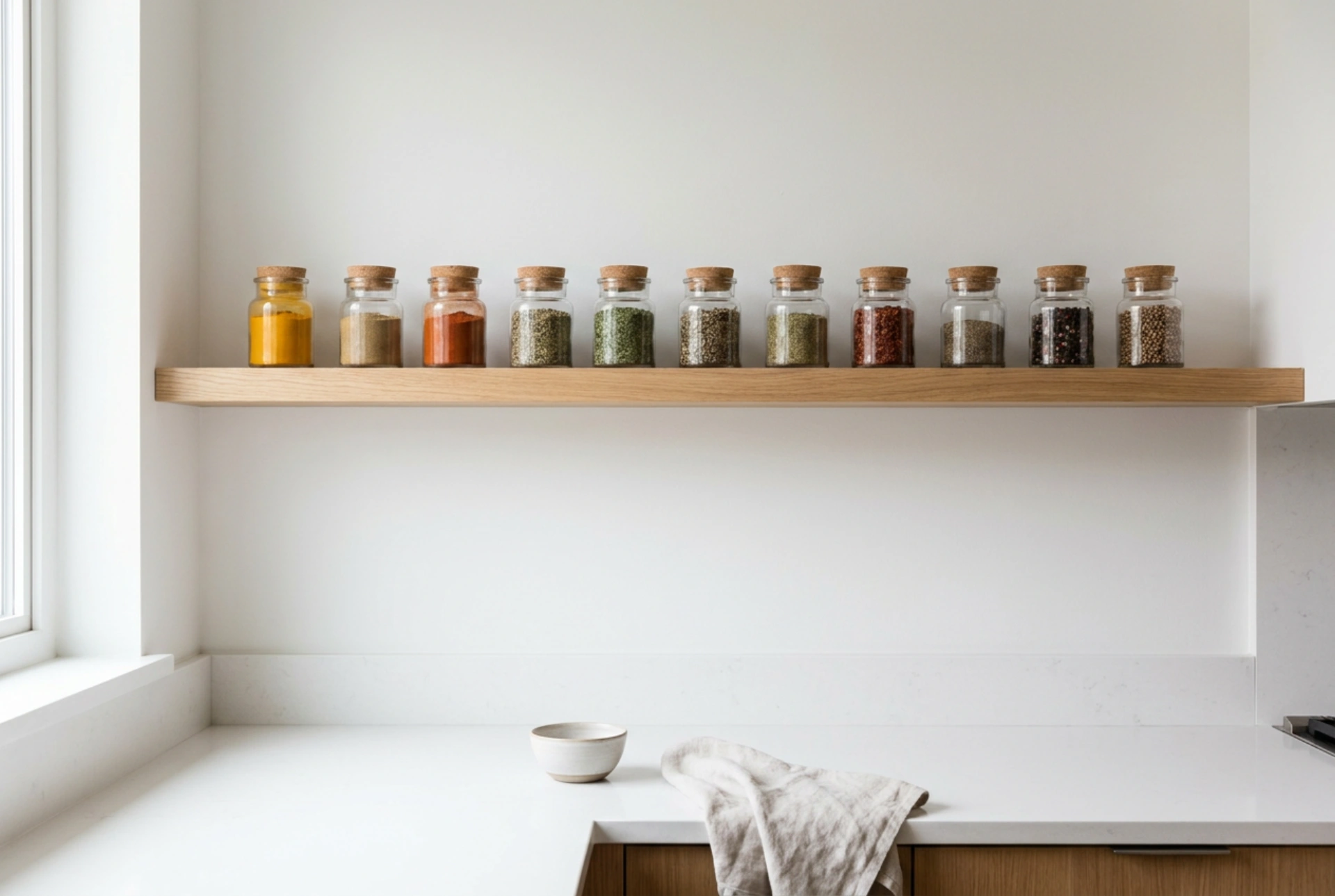
An efficient kitchen layout relies on the principles of ergonomic reach zones. The primary reach zone—the area comfortably accessed without stretching—should house your most frequently used spices. When designing the physical shelves, floating wooden or metal ledges with a shallow depth of 6 to 8 centimetres are ideal. This depth restricts storage to a single row of jars, preventing the common issue of double-stacking, which creates physical obstruction and forces you to rummage, leading to accidental spills. If vertical space is plentiful, installing tiered, step-like inserts on wider shelves allows for immediate visual identification of every jar. Keep a clearance of at least 5 centimetres above the tallest jar to allow your hand to grasp and lift the container without colliding with the shelf above.
Mitigating Visual Clutter Through Geometric Order
Visual clutter in a kitchen often stems from sensory overload caused by mismatched shapes, varying heights, and multicoloured commercial packaging. By decanting spices into identical, geometric jars, you eliminate this cognitive noise. Aligning the jars symmetrically creates a sense of clean, architectural harmony. When labelling, consistency in font size and placement is crucial. If your spice shelves are positioned below eye level (such as in a pull-out drawer system), apply labels to the lids for top-down visibility. For eye-level floating shelves, apply high-contrast, waterproof labels to the front face of the jars. Grouping spices by frequency of use or chemical classification (such as sweet baking spices versus savoury seed spices) ensures a logical workflow that reduces prep time and maintains organisation over long-term use.