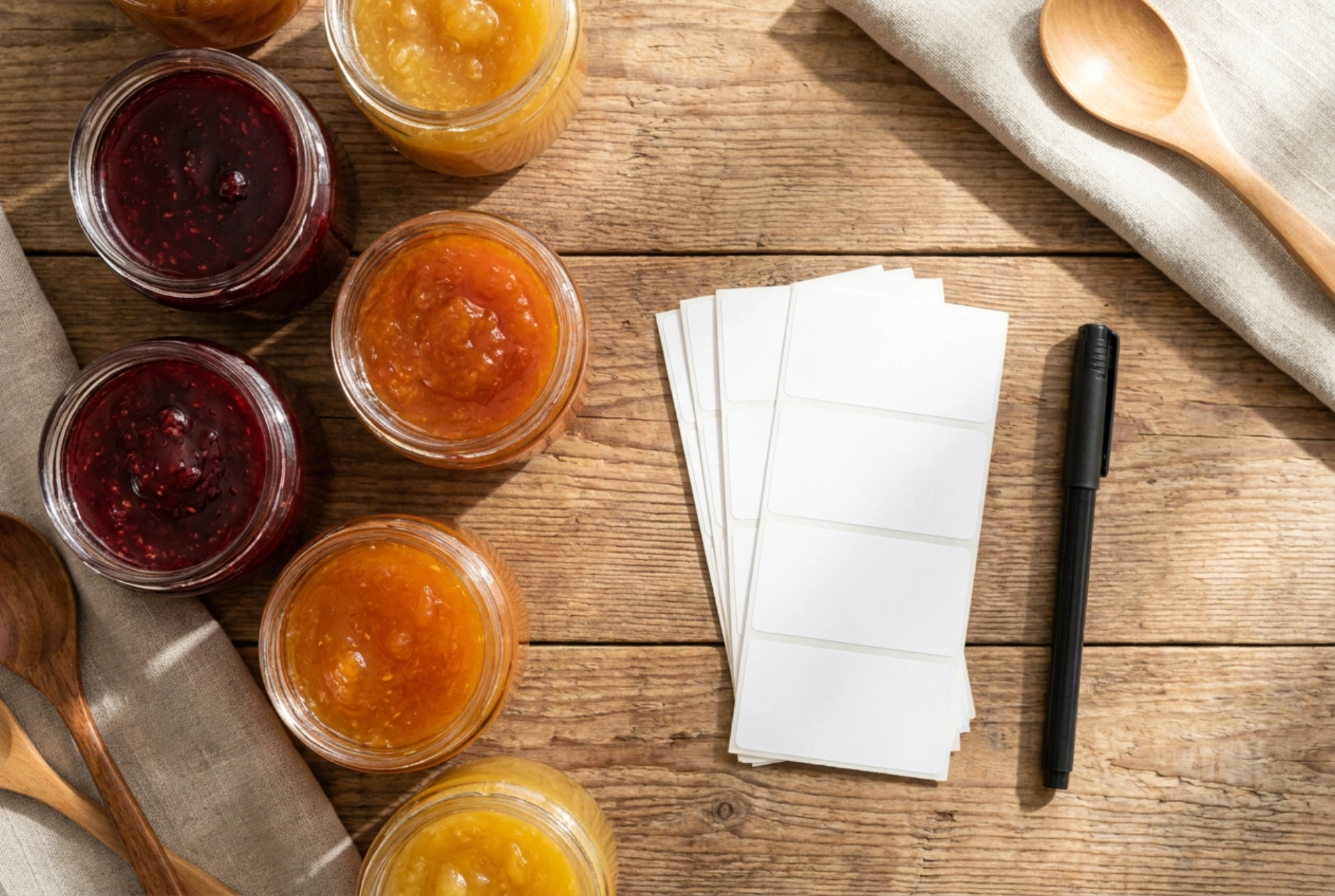


Creating durable labels for home preserves requires understanding how adhesives, paper fibres, and inks interact with temperature fluctuations and humidity. Whether storing jars in a cold larder or sterilising them in boiling water, selecting the correct materials ensures your organisation remains intact for months.
The Science of Adhesion: Selecting the Right Backing
Adhesive labels rely on pressure-sensitive adhesives (PSAs), which form a physical bond when pressure is applied. For glass jars used in home preserving, you must choose between acrylic-based and rubber-based adhesives. Acrylic adhesives offer excellent resistance to UV light, temperature variations, and moisture, making them ideal for long-term storage in damp cellars. Rubber-based adhesives provide a stronger initial tack but degrade faster when exposed to heat or light.
The label material itself also dictates longevity. Uncoated paper absorbs atmospheric moisture, causing the fibres to swell, warp, and eventually peel away. For preserves, coated paper or synthetic films (such as polypropylene or polyester) are superior. Synthetic films do not absorb water, making them completely waterproof and highly resistant to tearing, grease, and acidic spills.
Ink Chemistry and Printing Technologies
The method you use to print your labels determines how well the text resists fading and smudging. Standard desktop printers generally use either dye-based or pigment-based inks. Dye-based inks dissolve completely in liquid, meaning they bleed easily when exposed to condensation or water droplets. Pigment-based inks contain tiny solid particles suspended in a liquid carrier; these particles bind to the surface and offer significantly higher water and UV resistance.
- Laser Printing: Uses dry toner (plastic powder) fused to the label material via heat and pressure. This creates a highly durable, water-resistant layer that does not smudge, making it the gold standard for home labelling.
- Thermal Transfer Printing: Uses a heated ribbon to melt wax or resin onto the label. Resin-based thermal prints are virtually indestructible, resisting heat, water, and chemical cleaning agents.
- Inkjet Printing: Only suitable if using pigment-based inks combined with specialized water-resistant glossy or matte coated label sheets.
Step-by-Step Surface Preparation
Even the strongest adhesive will fail if applied to a contaminated surface. Glass manufacturing and handling leave behind microscopic oils, dust, and residues that prevent the pressure-sensitive adhesive from making full molecular contact with the glass. Follow this precise chemical preparation sequence:
First, wash the jars thoroughly to remove any physical debris. Once dry, wipe the application area with isopropyl alcohol (rubbing alcohol) using a lint-free cloth. Do not use denatured alcohol or household glass cleaners, as these often contain additives or synthetic perfumes that leave a thin film behind. Allow the alcohol to evaporate completely.
Apply the label at room temperature (approximately 18°C to 22°C). Adhesives flow better and form stronger bonds at moderate temperatures. Use a firm, wiping motion from the centre of the label outward to expel any trapped air bubbles and ensure maximum surface contact. Allow the adhesive to cure for at least 24 hours before exposing the jars to cold, damp storage conditions or condensation.
Removing Labels Without Damaging Glass
When reusing jars, you must remove old labels cleanly. Adhesives react differently to solvents based on their chemical structure. Acrylic adhesives dissolve efficiently in organic solvents like rubbing alcohol or acetone. Rubber-based adhesives are highly hydrophobic and respond better to lipids, such as vegetable oil or limonene-based cleaners. Applying a layer of oil to a rubber-based label weakens the polymer chains, allowing you to scrape the residue away without scratching the glass.