

Mounting a self-adhesive towel hook successfully depends entirely on surface chemistry and molecular bonding rather than mere physical force. Understanding how to prepare the substrate and allow the adhesive polymer to cure properly ensures your hook will support heavy, damp towels without peeling away.
The Science Behind Self-Adhesive Hooks
Most modern self-adhesive hooks rely on pressure-sensitive adhesives (PSAs). These materials are viscoelastic, meaning they exhibit both viscous characteristics like a dense liquid and elastic characteristics like a solid. When you press the hook against a wall, the adhesive behaves like a highly viscous fluid, slowly flowing into the microscopic peaks and valleys of the tile or wall surface. This process, known as wetting, maximises the contact area between the adhesive and the substrate.
Failures occur when this molecular contact is interrupted. If there is a barrier of dust, grease, water molecules, or surfactant residues from household cleaners, the adhesive bonds to the contaminant layer instead of the solid wall. When weight is applied, the weak contaminant layer shears, causing the hook to fail. Understanding this physical mechanism is the key to preventing adhesive failure.
The Degreasing Protocol: Eradicating Surface Contaminants
Standard bathroom cleaners often leave behind invisible thin films of surfactants, silicones, or scent oils that destroy adhesive performance. To prepare the surface for a long-lasting bond, you must strip away all organic compounds using specific solvents.
- Identify the substrate: Smooth ceramic tiles, glass, and polished metals are ideal. Avoid porous surfaces like untreated plaster, painted drywall, or heavily textured tiles, as they do not provide enough continuous surface contact.
- Choose the right solvent: Isopropyl alcohol (minimum 70% concentration, ideally 99%) is the universal standard for degreasing. It dissolves oils and evaporates rapidly without leaving any residue. For glass or glazed ceramics, acetone can also be used, but avoid it on plastics or painted surfaces, as it can dissolve the substrate.
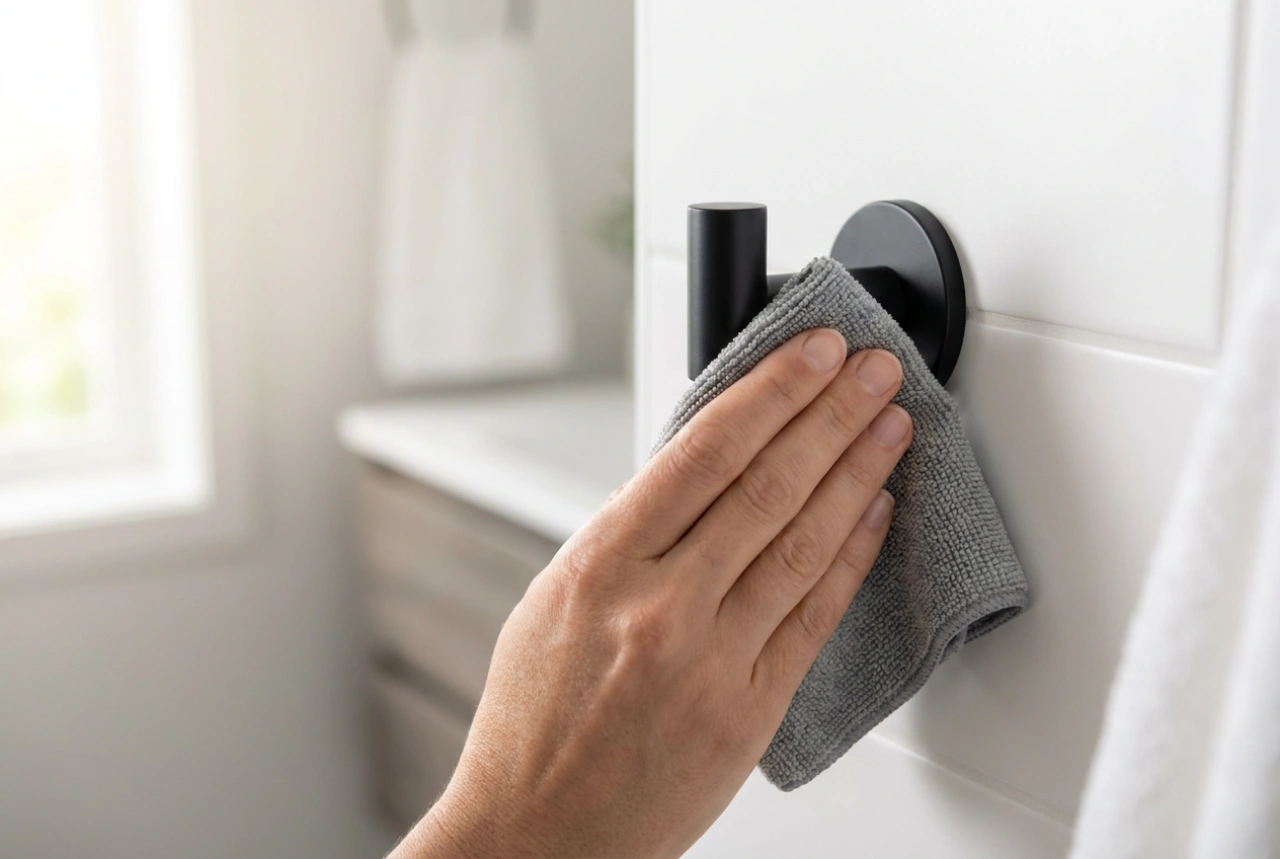
- The cleaning technique: Pour the isopropyl alcohol onto a clean, lint-free microfibre cloth. Wipe the target area vigorously in a circular motion, then finish with a straight, single-direction wipe to lift contaminants away rather than spreading them around. Allow the solvent to air-dry completely; this usually takes under a minute.
Thermal Optimization and Pressure Application
The viscoelastic properties of pressure-sensitive adhesives are highly temperature-dependent. If the room or the wall surface is too cold, the adhesive remains rigid and cannot flow into the microscopic crevices of the surface, resulting in a poor bond.
For optimal results, ensure the room temperature is at least 18 degrees Celsius. If the bathroom tiles feel cold to the touch, use a hairdryer to gently warm the target area for 30 to 45 seconds. This lowers the viscosity of the adhesive tape slightly, promoting immediate wetting. Remove the protective backing from the adhesive pad, being careful not to touch the exposed surface with your fingers, as skin oils will instantly degrade the adhesive chemistry.
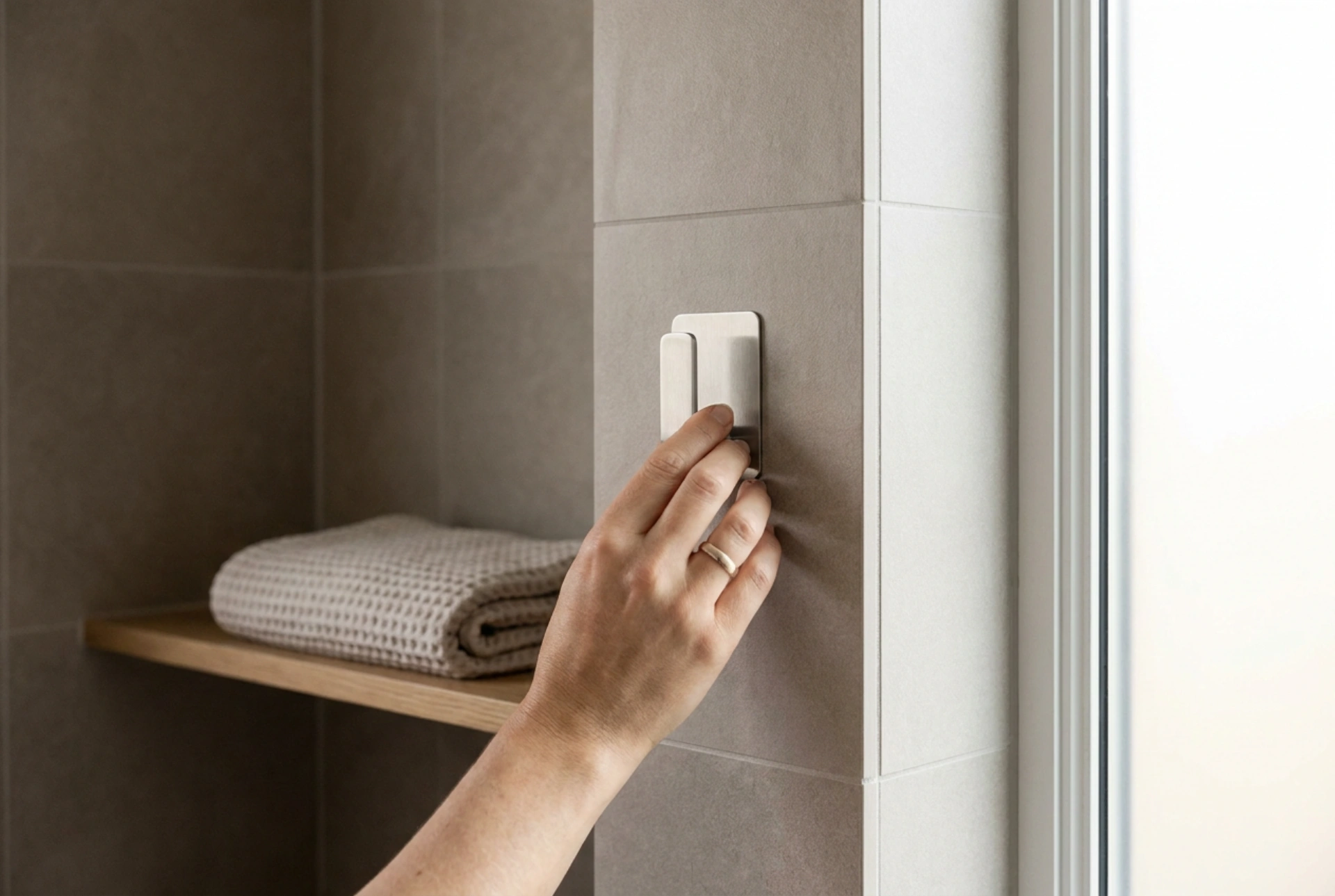
Align the hook carefully and press it firmly onto the surface. Apply heavy, steady pressure using your thumb or the palm of your hand, concentrating on the centre and then moving outward to the edges. Maintain this pressure continuously for at least 30 seconds. This physical force is what activates the pressure-sensitive acrylic polymers, initiating the mechanical interlocking process.
The Curing Phase: Why Patience Dictates Strength
The single most common mistake in mounting adhesive hooks is hanging items on them too quickly. Although the hook may feel secure immediately after application, the adhesive has only achieved a fraction of its potential bond strength.
Viscoelastic flow is a time-dependent process. It takes hours for the polymer chains to fully conform to the surface topography of the wall. Most high-performance acrylic adhesive tapes require a minimum of 24 hours to reach 90% bond strength, and a full 72 hours to achieve 100% cure capacity. During this critical window, keep the bathroom dry and well-ventilated to prevent moisture from condensing around the edges of the fresh adhesive pad, which could disrupt the curing process. Once this curing period is complete, the molecular bond will resist both the shear force of heavy damp towels and the high-humidity environment of a bathroom.