

Storing bread in a kitchen drawer is an elegant way to maintain clear countertops, but without proper air circulation, it quickly traps moisture and accelerates mold growth. By understanding moisture migration and implementing passive ventilation, you can design a built-in bread drawer that keeps loaves fresh and crisp.
The Physics of Bread Staling and Moisture Migration
To design an effective in-drawer bread box, it is essential to understand what happens to bread after baking. Staling is not merely drying out; it is a chemical reaction called starch retrogradation. During cooling, starch molecules recrystallize, expelling water from the interior crumb to the dry crust. If bread is stored in a completely sealed, unventilated drawer, this migrating moisture becomes trapped on the surface. The crust becomes leathery, and when relative humidity inside exceeds 60%, it creates an ideal microclimate for mold spores to germinate. Conversely, excessive drafts cause rapid evaporation, drying out the crumb. The goal of drawer ventilation is to maintain a stable relative humidity of approximately 50% to 55%.
Designing Passive Airflow Within Cabinetry
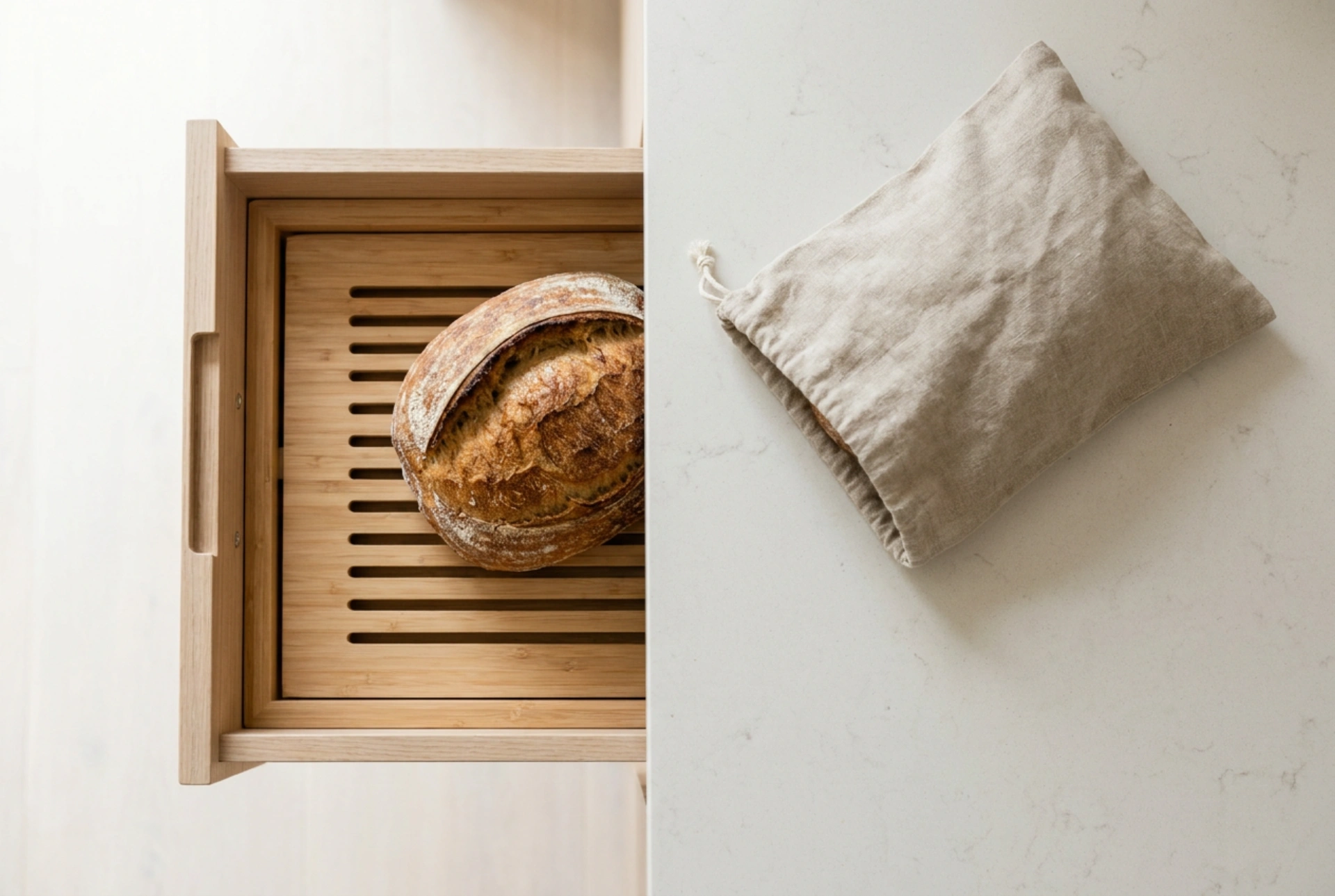
Standard kitchen drawers are relatively airtight. To convert this space into a functional bread box, you must facilitate passive convection. Warm air rises while cooler, denser air sinks, meaning you can harness physical principles to create natural airflow. The most effective setup involves a drawer with a slatted bottom made of solid wood or bamboo. The gaps between the slats should be between 3 to 5 millimeters—wide enough to allow air to pass through from the lower cabinet cavity, but narrow enough to support the loaves. Additionally, the back panel of the drawer should be slightly lowered by about 15 millimeters. This creates a low-pressure chimney effect: air enters through the gaps in the bottom, circulates around the bread, and escapes through the rear gap into the void behind the cabinet carcasses.
Material Science: Hygroscopic Buffers and Breathable Barriers
The materials lining your ventilated drawer play a crucial role in regulating humidity. Standard melamine-faced chipboard is non-porous and cannot absorb moisture, leading to condensation. Instead, the interior of the bread drawer should utilize hygroscopic materials such as unfinished, food-safe hardwoods (like maple or beech) or bamboo. These natural materials act as a moisture buffer. When the bread expels moisture, the raw wood fibers absorb the excess water vapor, preventing localized humidity spikes. As the air dries, the wood gradually releases this moisture back into the micro-environment, stabilizing evaporation. To complement this system, wrap artisan loaves in linen bags before placing them on the slatted wooden insert. Linen allows moisture to escape slowly while protecting the crust from direct drafts.
Strategic Placement and Thermal Protection
The microclimate inside a kitchen drawer is heavily influenced by external thermal energy. Avoid placing the dedicated bread drawer near appliances that generate heat or moisture, such as dishwashers, ovens, or under-counter refrigerators. Heat transfer through cabinet walls raises the kinetic energy of water molecules inside the bread, accelerating moisture evaporation and starch retrogradation. If the temperature inside the drawer fluctuates rapidly, it will cause condensation to form on the cooler interior surfaces, leading to rapid mold colonization. Position the bread drawer in a cool, shaded zone of the kitchen, away from major thermal sources, to ensure a consistent, stable temperature.
Hygiene and Crumb Management
A well-ventilated drawer must be designed for easy maintenance. Yeast and mold spores rely on organic matter to multiply, meaning crumbs left to decay in dark corners will contaminate fresh loaves. Therefore, the ventilated slatted insert should always be fully removable. Avoid gluing the wooden slats to the drawer box. Instead, design a drop-in tray that can be easily lifted out to vacuum or wipe down the solid drawer base underneath. Clean the wooden insert periodically with a dry brush or a slightly damp cloth, ensuring it dries completely before returning it to the drawer to prevent wood warping or mold growth.