

Establishing a consistent laundry routine in a child's bedroom relies on physical accessibility, clear visual cues, and appropriate material selection to turn a chore into an intuitive, repeatable habit.
The Ergonomics of Independence: Height and Accessibility
For a child to successfully adopt the habit of tidying, the physical environment must accommodate their anatomical scale and motor skills. Placing a standard, tall laundry bin designed for adults in a nursery or playroom creates a physical barrier. Children under the age of six struggle with high reaches and lack the leverage to push heavy lids open while holding garments.
To eliminate these friction points, select a laundry basket with a maximum height of 40 to 50 centimetres. This height aligns with the average child's waist level, allowing them to drop clothing inside without standing on tiptoes. Furthermore, opting for an open-top design or a soft, self-closing magnetic flap is critical. Traditional hinged lids require two-handed operation—one hand to lift and hold the lid, and the other to deposit the clothing. A lidless, wide-mouth container reduces the task to a simple, single-motion drop, which significantly increases compliance rates in young children.
Material Science: Selecting Safe and Breathable Fabrics
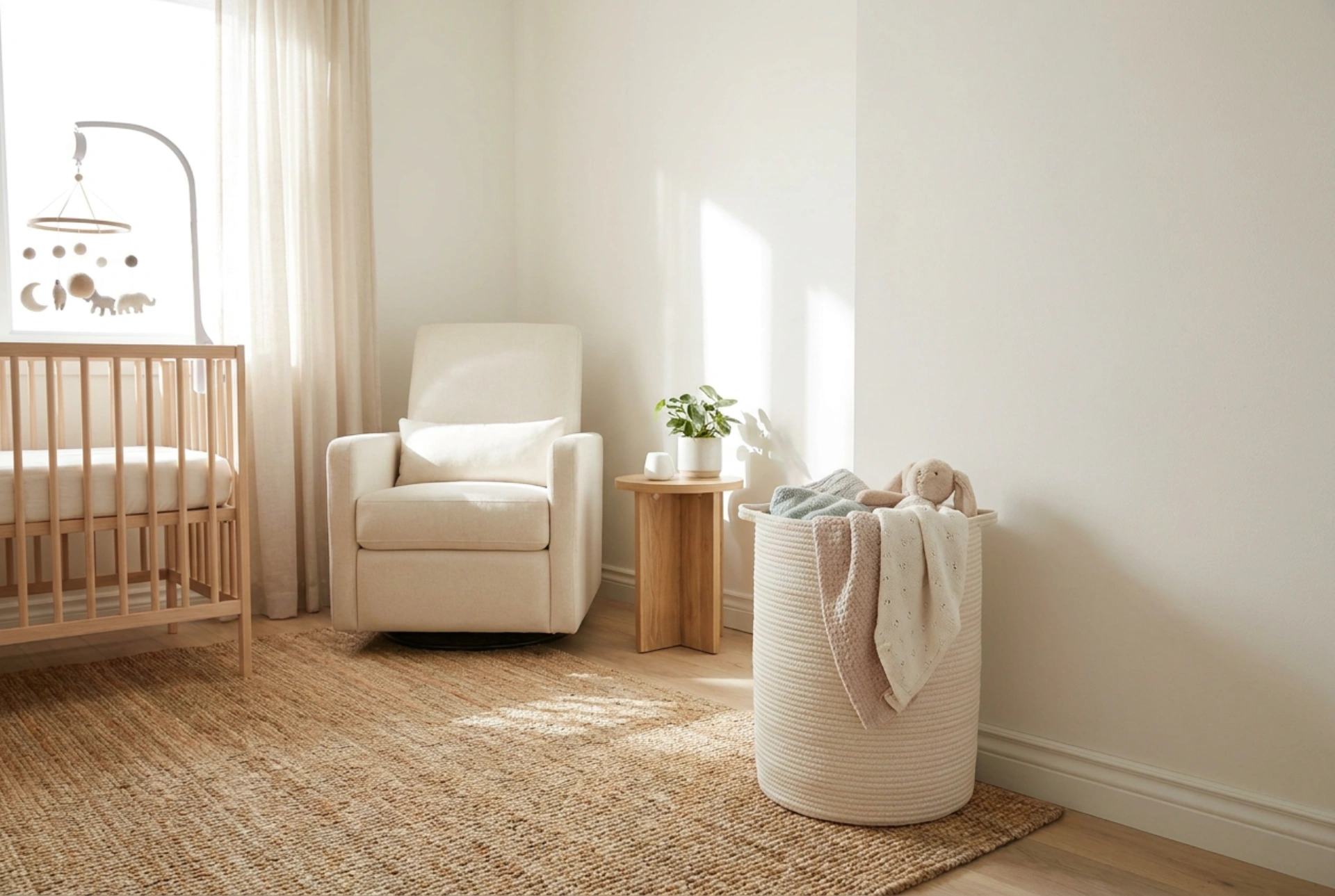
The materials used in a child's room must be resilient, safe, and hygienically sound. Traditional plastic baskets can crack under impact, leaving sharp edges, while wicker or rattan baskets can splinter and snag delicate fabrics or scratch sensitive skin. Woven cotton rope, heavy canvas, and felt are superior alternatives due to their structural compliance and safety profile.
Woven cotton fibres provide natural structural integrity while remaining completely soft to the touch. If a child bumps into or falls against a cotton rope basket, the material deforms and absorbs the kinetic energy, eliminating the risk of bruising or cuts. Additionally, cotton and canvas possess natural breathability. Damp garments, such as post-bath towels or sweat-dampened playwear, can quickly become breeding grounds for mould spores and mildew if trapped in an airtight plastic container. The microscopic spaces between woven cotton threads allow continuous air circulation, accelerating the evaporation of residual moisture and preventing the accumulation of volatile organic compounds that cause stale odours.
Optimising the Sorting Process with Visual Cues
Children process visual information and spatial arrangements much faster than textual instructions. Instead of a single large hamper, employing a two-compartment sorting system teaches basic categorisation and simplifies the washing process for parents. Using colour-coded baskets—such as a light-coloured canvas bin for whites and a dark-grey bin for coloured garments—transforms a chore into a pattern-matching activity.
This categorisation leverages basic cognitive development. By asking a child to match the tone of their clothing to the corresponding basket, they engage in active sorting. For younger children, tactile markers or simple embroidered icons (such as a t-shirt or a sock) sewn onto the front of the basket provide unambiguous indicators of where specific textiles belong. This direct visual association bypasses the need for reading comprehension, allowing toddlers to participate in the sorting process independently.
The Order of Operations: Establishing the Routine
To successfully integrate the laundry basket into a child's daily schedule, the basket must be positioned at the exact geographical point of transition: the undressing zone. This is typically adjacent to the bed or the changing table. Placing the basket in a remote corner or inside a wardrobe creates a physical delay between undressing and storing, which often results in clothing being discarded on the floor.
- The Transition Step: When changing into pyjamas, the child should stand immediately next to the basket, ensuring the physical distance between the body and the hamper is less than one step.
- The Direct Deposit: Teach the child to peel off socks and shirts directly into the wide opening, avoiding intermediate surfaces like the bed or floor.
- The Emptying Cycle: Once a week, involve the child in carrying the lightweight cotton basket to the washing machine, closing the loop of the household chore and demonstrating the physical result of their sorting efforts.