

Keeping breakfast cereals perfectly crunchy relies on understanding food physics and managing relative humidity within your storage environment.
The Science Behind Stale Cereal
Breakfast cereals are processed through extrusion or baking, which gelatinises the grain starch and removes almost all moisture. This leaves the cereal in a glassy, highly hygroscopic state. Because the water activity inside a fresh flake is extremely low, it acts like a dry sponge, actively pulling moisture from the surrounding air. When the relative humidity of the air inside the packaging exceeds a critical threshold of around forty percent, water molecules bind to the amorphous starch matrices. This process lowers the starch's glass transition temperature, causing the rigid, crispy structure to collapse into a soft, rubbery state. To prevent this texture degradation, you must control the vapour pressure gradient between the food and its storage container.
Selecting the Ultimate Airtight Barrier
The original cardboard box and thin plastic liner provided by manufacturers offer minimal protection once opened. Standard inner bags are often made of low-density polyethylene, which is semi-permeable to water vapour over time. For long-term preservation, transfer your cereals to dedicated containers made of non-permeable materials.
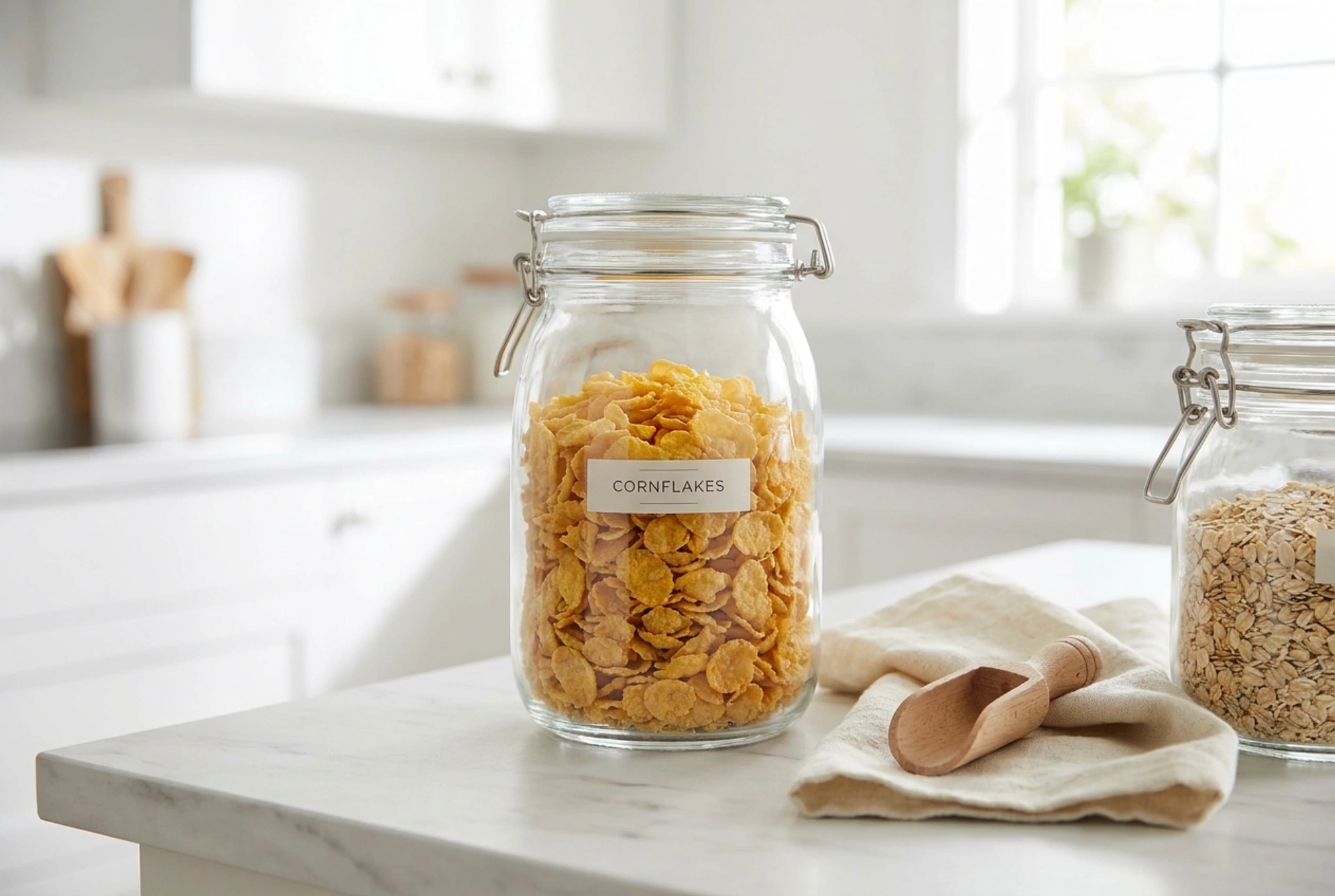
- Borosilicate Glass: Glass is completely impermeable to gases and moisture. It does not absorb food odours or oils, making it the most chemically inert choice for pantry storage. Ensure the jar features a lid with a thick silicone gasket and a mechanical clamping mechanism, which exerts uniform physical pressure to create a true hermetic seal.
- Rigid Food-Grade Plastics: Polyethylene terephthalate or high-density polyethylene containers with lid-locking mechanisms are excellent lightweight alternatives. Look for lids utilising a dry-boundary seal or a double-gasket system to prevent air exchange.
Optimising Your Pantry Environment
Where you store your cereal containers is just as crucial as the vessels themselves. Temperature fluctuations accelerate the movement of air and moisture. Avoid placing your storage jars near heat-generating appliances like ovens, dishwashers, or refrigerators, as local warm pockets can cause condensation to form inside the containers if there is any residual moisture. Store cereals in a cool, dark, and dry pantry. Exposure to direct ultraviolet light can degrade the fats present in whole-grain cereals, leading to oxidative rancidity and unpleasant off-flavours, even if the texture remains dry.
Techniques for Daily Handling
Every time you open a cereal container, you introduce fresh, humid air from the room. To minimise this exposure, practice efficient kitchen habits. Open the container briefly, pour the required portion, and reseal it immediately. Avoid using damp utensils or pouring cereal directly over a steaming bowl of milk, as rising water vapour will instantly enter the storage vessel and trigger the staling process. If you purchase bulk quantities, divide the cereal into smaller, portion-sized jars. This prevents the entire batch from being exposed to ambient air repeatedly.
How to Revive Soft Cereals
If your cereal has already absorbed moisture and lost its bite, the process can be reversed by thermodynamic dehydration. Spread the damp cereal in a single, even layer on a baking tray lined with parchment paper. Place it in an oven preheated to one hundred degrees Celsius for approximately five to ten minutes. This low-temperature heat supplies the energy required to break the hydrogen bonds between the water molecules and the starch, vaporising the trapped moisture without burning the cereal. Allow the cereal to cool completely on the tray before transfer; as it cools, the starch matrix will re-solidify back into its characteristic crunchy, glassy state.