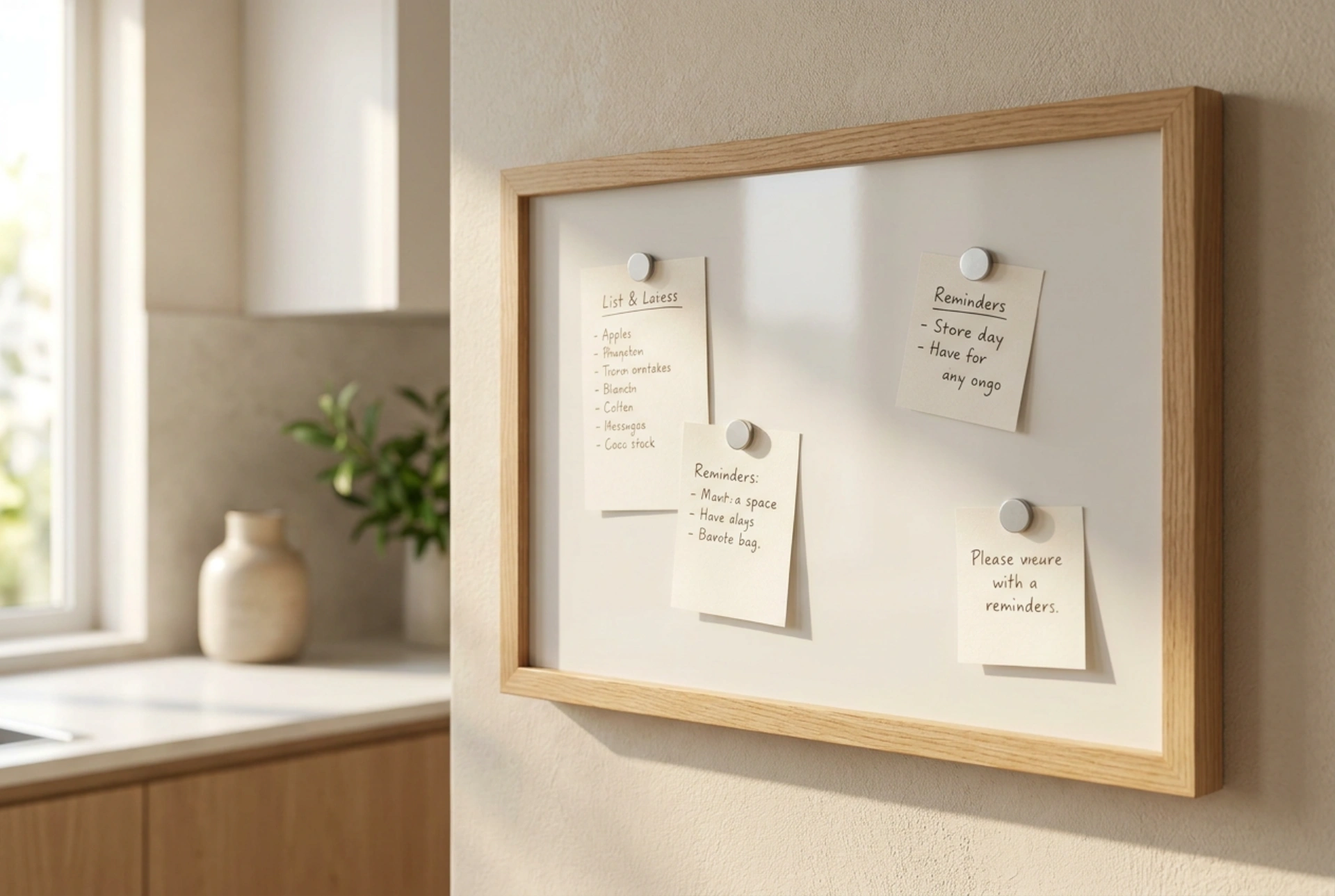


Managing household logistics requires a reliable system that reduces cognitive load and ensures essential tasks are not overlooked. A framed magnetic board serves as a highly visible, physical control centre that leverages spatial memory and visual cues far more effectively than easily dismissed digital notifications.
The Science of Visual Reminders and Cognitive Load
Digital reminders often fail because they require active interaction; you must unlock a device or open an application to see them. In contrast, a physical magnetic board utilises passive visual exposure. According to cognitive psychology, spatial memory—the cognitive map of your physical environment—associates specific tasks with their physical location on the board. This constant, peripheral reinforcement builds stronger mental triggers, reducing the energy needed to recall daily chores, appointments, or grocery lists.
For this system to work, the brain must distinguish between urgent and non-urgent information instantly. By structuring your magnetic board with clear spatial boundaries, you establish an external cognitive scaffold. This decreases mental fatigue, freeing up working memory for executing tasks rather than remembering them.
Choosing and Placing Your Magnetic Board
To optimise the effectiveness of your reminder board, material science and placement are critical. Look for a board constructed with a high-quality galvanized steel backing beneath the surface. Thin painted tin sheets often have weak magnetic attraction, causing notes to slip. A solid steel core ensures that even small, low-profile neodymium magnets can hold multi-page documents or heavy cardstock without sliding.
Placement should follow the natural traffic patterns of your home. The ideal location is a transition zone—such as the hallway near the main entrance or the wall adjacent to the kitchen prep area. Mount the board so its vertical centre rests at eye level (approximately 150 to 160 centimetres from the floor). This ensures that reading and writing do not require uncomfortable posture shifts, reducing friction and encouraging consistent use. Natural or warm artificial task lighting should illuminate the board to prevent shadows that obscure small print.
Establishing a Spatial and Colour-Coded Grid
A chaotic board leads to cognitive fatigue, causing the brain to ignore the information entirely. Establish a strict spatial hierarchy to guide the eye naturally. The standard reading pattern of left-to-right and top-to-bottom provides an intuitive timeline framework:
- Left Column (Incoming / To-Do): Place new bills, invitations, or unassigned tasks here. Use heavy cardstock to prevent curling.
- Centre Column (In Progress / Active): Reserve this space for the current week's schedule, immediate appointments, and urgent reminders.
- Right Column (Completed / Reference): A small section for reference phone numbers, shopping lists, or recurring weekly chores.
Utilise household chemistry and colour theory to enhance this structure. Use distinct, high-contrast colours for different categories—such as yellow for urgent tasks, blue for household maintenance, and green for family schedules. Ensure you use strong, small ceramic or neodymium magnets rather than large, bulky plastic ones, which block information and create visual clutter.
The Weekly Purge: Preventing Visual Habituation
The greatest threat to a physical reminder system is habituation. When a note remains in the same spot for more than a couple of weeks, the brain begins to treat it as part of the background environment, effectively rendering it invisible. To combat this, establish a weekly maintenance routine.
Every Sunday evening, clear the board entirely. Remove completed items, file away documents that are no longer active, and rewrite lingering tasks on fresh paper, shifting their physical location slightly. This physical movement resets your visual attention and forces you to re-evaluate the priority of each task, keeping the board dynamic, accurate, and functional.