

Managing damp or wet laundry requires specific material properties to prevent bacterial growth and mould formation before the washing or drying cycle is complete. Choosing the right wet laundry basket relies on understanding airflow dynamics, moisture resistance, and material science to maintain a hygienic home environment.
The Physics of Airflow: Preventing Anaerobic Environments
When damp fabrics are piled together, they create a high-humidity microclimate that is ideal for the rapid proliferation of bacteria and fungi, such as Aspergillus. Without sufficient oxygen circulation, anaerobic conditions develop, leading to the production of volatile organic compounds (VOCs) that manifest as sour, musty odours. A basket designed for wet clothes must actively combat this through structural aeration.
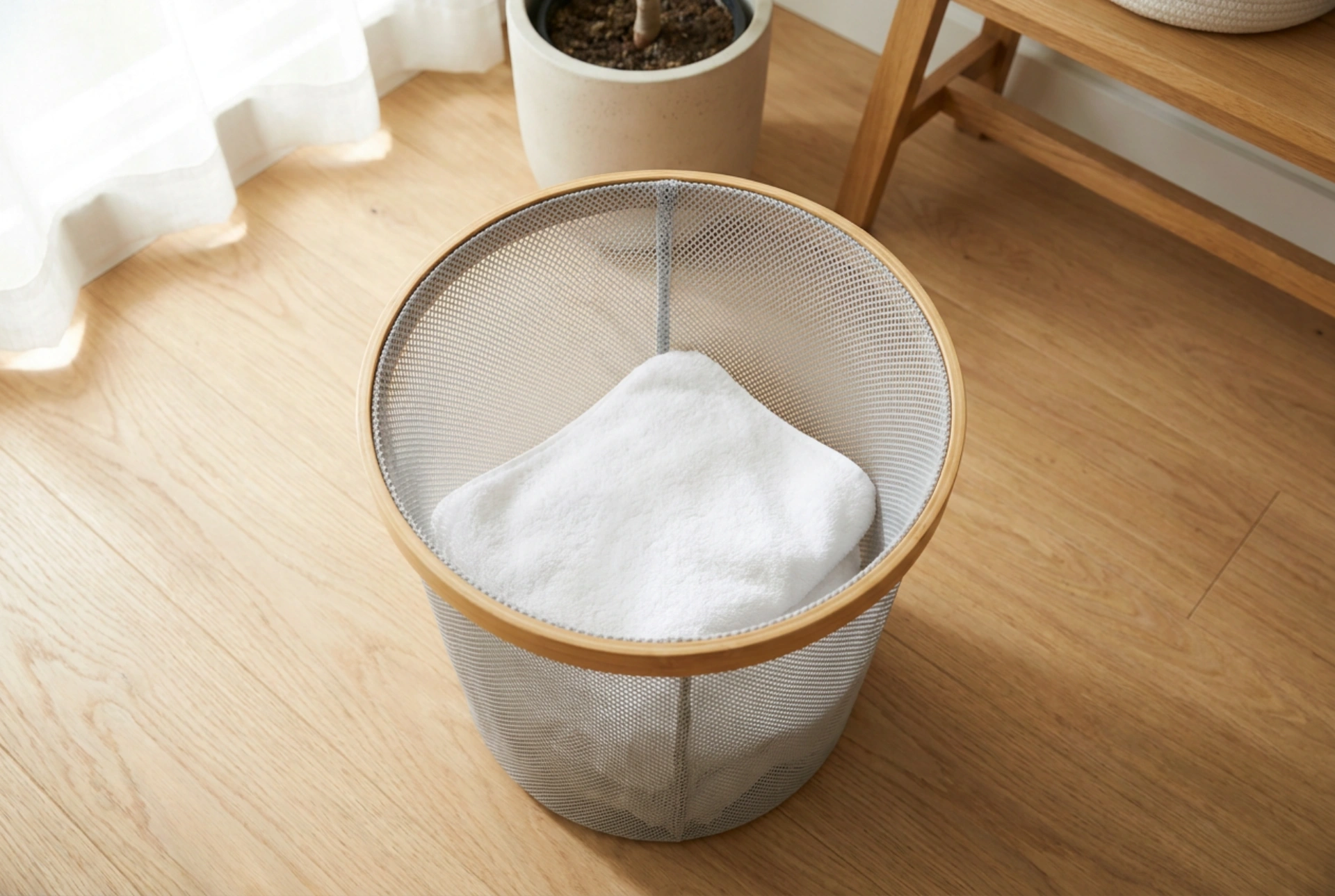
Open-weave structures, perforated patterns, or synthetic mesh fabrics facilitate continuous air exchange. As ambient air moves through the openings, it promotes the evaporation of surface moisture from the textiles, lowering the relative humidity inside the basket. This kinetic air movement breaks up static pockets of damp air, disrupting the lifecycle of mould spores which require stagnant moisture to colonise fabric fibres.
Material Science: Selecting Impermeable and Rust-Resistant Materials
The chemical composition of the basket is critical when dealing with constant exposure to water and laundry detergents. Traditional natural materials, such as wicker, wood, or untreated canvas, are highly hydrophilic. They absorb water via capillary action, which swells the fibres, causes structural degradation, and creates permanent breeding grounds for mildew within the material itself.
To prevent this, opt for inert, non-porous synthetic polymers or rust-proof metals:
- High-Density Polyethylene (HDPE) and Polypropylene (PP): These thermoplastics are naturally hydrophobic, meaning they repel water molecules. They do not absorb moisture, are highly resistant to chemical corrosion from detergent residues, and can be easily sanitised.
- Polyester Mesh: High-tensile polyester fibres coated with PVC provide flexibility and exceptional breathability. The synthetic mesh does not retain water and dries almost instantly.
- Stainless Steel or Treated Aluminium: If metal is preferred, it must be marine-grade stainless steel or powder-coated aluminium to resist oxidation. Standard iron or cheap steel will rapidly oxidise when exposed to wet fabrics, leaving permanent rust stains (iron oxide) on your garments.
Load Dynamics and Structural Integrity
Wet textile fibres hold significant volumes of water, increasing the overall weight of the laundry load exponentially compared to dry garments. Cotton, for instance, can absorb up to 27 times its weight in water. Therefore, a wet laundry basket must possess high tensile strength and structural rigidity to prevent warping or structural failure under load.
Look for baskets with reinforced rims and ergonomically designed, integrated handles. Handles moulded directly into the main body of a polymer basket distribute weight more evenly than attached parts, reducing mechanical stress points. Additionally, the base of the basket should feature slightly raised feet or a solid bottom panel beneath the aeration holes. This design prevents any dripping water from pooling directly onto your flooring, protecting delicate timber or laminate surfaces from moisture damage.
Maintenance, Sanitation, and Odour Control
Even with excellent airflow, a wet laundry basket requires regular chemical sanitisation to eliminate microscopic bio-films. Over time, skin cells, organic soil, and detergent residues from wet clothes transfer to the basket walls, providing nutrients for microbial growth.
To clean synthetic or plastic baskets, wipe the surfaces down bi-weekly using a solution of warm water and oxygen bleach (sodium percarbonate) or a highly diluted chlorine-based detergent. Oxygen bleach breaks down organic stains and sanitises through oxidation without releasing corrosive fumes. For mesh baskets, a light spray of isopropyl alcohol (70% concentration) effectively denatures bacterial proteins and evaporates quickly without leaving damp residues. Always allow the basket to dry completely in a well-ventilated area before reloading it with damp items.