

Misaligned cabinet doors that rub against each other or hang at uneven angles can be corrected quickly by understanding the mechanical principles of the European cup hinge.
The Anatomy of the Three-Way Concealed Hinge
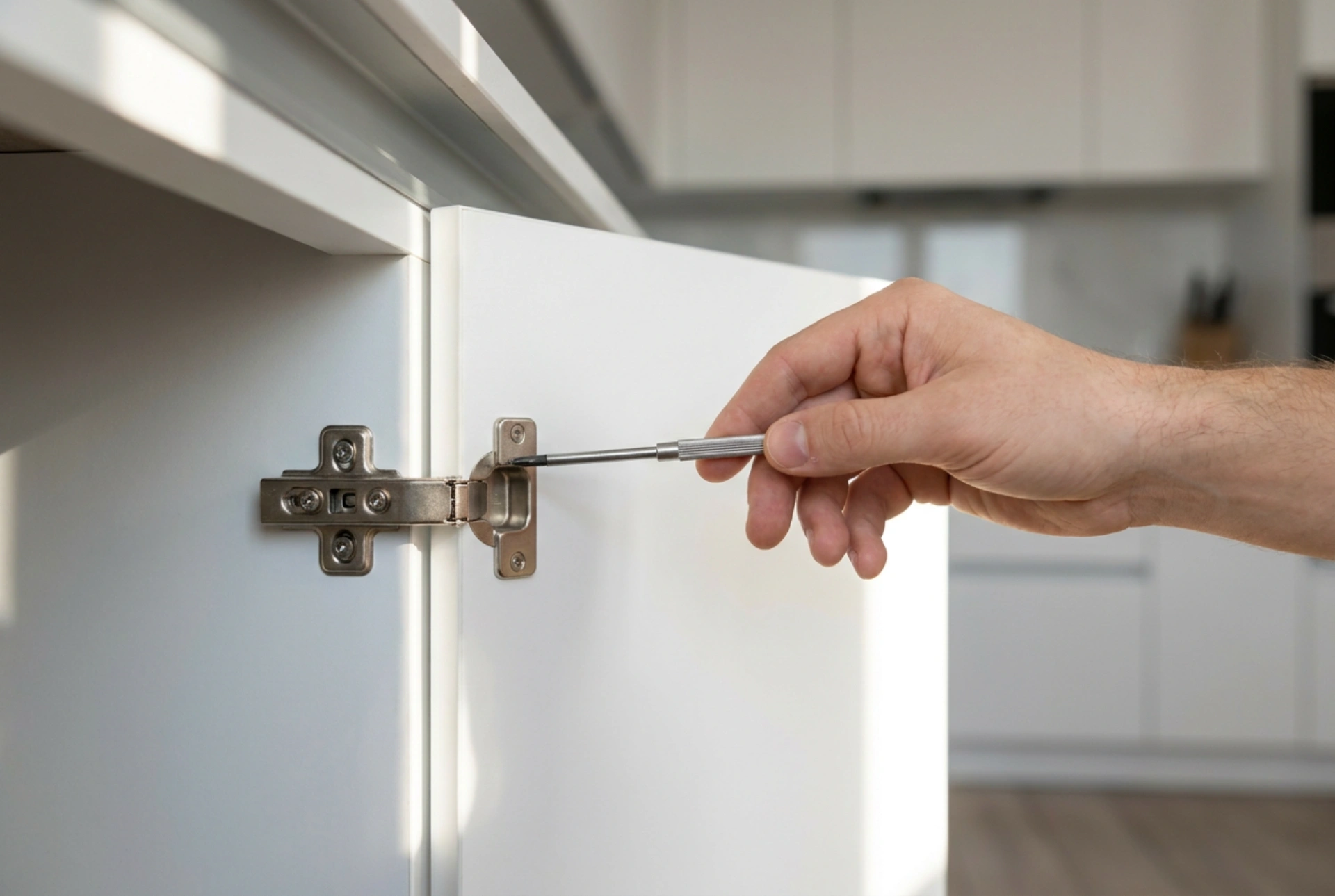
Modern cabinet doors rely on three-way adjustable concealed hinges, often called European hinges. These mechanical components are designed to control the door position across three distinct axes: lateral (side-to-side), vertical (up-and-down), and depth (in-and-out). Understanding which screw controls which axis is the key to a fast, damage-free adjustment.
Every standard cup hinge features two mounting screws that attach the hinge plate to the cabinet carcass, alongside two adjustment screws located on the hinge arm itself. Working systematically on one axis at a time prevents compounding misalignment errors.
Step 1: Correcting the Lateral Gap (Side-to-Side Axis)
If your cabinet doors have an uneven gap down the center, or if they overlap in the middle, you need to adjust the lateral screw. This is the screw located closest to the cabinet door itself on the hinge arm.
- To move the door closer to the outer edge of the cabinet frame, turn this screw clockwise. This increases the gap between double doors.
- To move the door inward toward the center, turn the screw counter-clockwise. This closes excessive gaps.
- Always make small adjustments of no more than a quarter-turn at a time, checking the alignment after each turn to monitor the physical shift.
Step 2: Adjusting the Height (Vertical Axis)
When one door sits higher than its partner, creating an uneven horizontal line at the top or bottom of your cabinetry, the height must be adjusted. This is controlled by the mounting plate attached to the cabinet wall.
- Locate the two screws holding the mounting plate to the cabinet body. Slightly loosen both screws on both the top and bottom hinges of the door.
- Physically slide the door upward or downward to the desired height.
- While holding the door firmly in place, retighten the mounting plate screws. For precise alignment, place a spirit level across the top edges of both doors before locking the screws.
Step 3: Aligning Depth (In-and-Out Axis)
If a cabinet door does not close fully, bounces back open, or is warped so that the top corner sticks out further than the bottom, you must adjust the depth. This is controlled by the screw located furthest from the door on the hinge arm.
- Loosen this rear screw slightly. This releases the tension holding the hinge arm to the mounting plate.
- Push the door in toward the cabinet body or pull it outward to ensure it sits flush with the adjacent units and does not bind against the cabinet frame when closing.
- Tighten the rear screw completely to lock the depth position in place.
Maintaining Mechanical Balance
Adjusting hinges changes the distribution of weight across the cabinet frame. Always ensure that the weight of the door is distributed evenly between the top and bottom hinges to prevent premature wear. If a door is exceptionally heavy, check that the middle hinge, if present, is adjusted to share the load. Avoid overtightening the screws, as this can strip the pre-drilled holes in the wooden composite panels of your cabinet carcass.