

Optimizing your closet capacity relies on a fundamental principle of spatial physics: organizing your hanging space by garment length rather than item category. By calculating the exact vertical clearance your clothes require, you can eliminate wasted air space and significantly increase your overall storage volume.
The Physics of Vertical Space: Single vs. Double Hanging
Most standard closets are installed with a single high rod, leaving a massive, unusable void underneath. To reclaim this valuable area, you must analyze the vertical dimensions of your wardrobe. The average length of folded-over trousers, folded skirts, shirts, and jackets ranges from 90 to 105 centimeters. Long coats, evening dresses, and jumpsuits require between 140 and 175 centimeters of uninterrupted drop.
By installing a double-rod system in at least one section of your wardrobe, you instantly double your hanging capacity for shorter garments. Place the top rod at approximately 200 to 210 centimeters from the floor, and the lower rod at 100 to 105 centimeters. This leaves enough clearance for both tiers of clothing to hang freely without pooling on the bottom shelf or touching the floor, which prevents fabric creasing and dust accumulation.
Calculating Weight Distribution and Rod Deflection
Before installing or repositioning a hanging rod, you must calculate the physical load it will carry to prevent bowing and failure. Wood, aluminum, and steel rods have different structural limits under stress. A standard linear meter of hanging clothing weighs between 15 and 25 kilograms, depending on fabric density (heavy wool coats versus lightweight cotton shirts).
- Steel Rods: Highly resistant to bending. A standard steel rod with a wall thickness of 1 millimeter can span up to 100 centimeters without mid-point support.
- Aluminum Rods: Lightweight but more prone to deflection. Support brackets should be placed every 80 centimeters.
- Wooden Rods: Highly aesthetic but susceptible to humidity and sagging. They require a center support bracket for any span exceeding 90 centimeters.
Always secure your mounting brackets directly into wall studs or use high-load heavy-duty anchors if securing to drywall. This ensures the structural integrity of the wardrobe under maximum load conditions.
The Depth Factor: Preventing Fabric Friction
A common error in closet planning is ignoring the depth of the cabinet or recess. Standard adult clothes hangers are 40 to 45 centimeters wide. When clothes are hung, they extend slightly beyond the hanger, requiring a minimum wardrobe depth of 58 to 60 centimeters.
If your closet is shallower than 55 centimeters, garments will constantly rub against the back wall and the front doors. This friction causes premature wear on fabrics, wrinkles collars, and prevents sliding doors from closing smoothly. For shallow spaces, consider transversal pull-out rods that hang clothes facing forward, converting depth limitations into an organized vertical display.
The Zone-Based Hanging Strategy
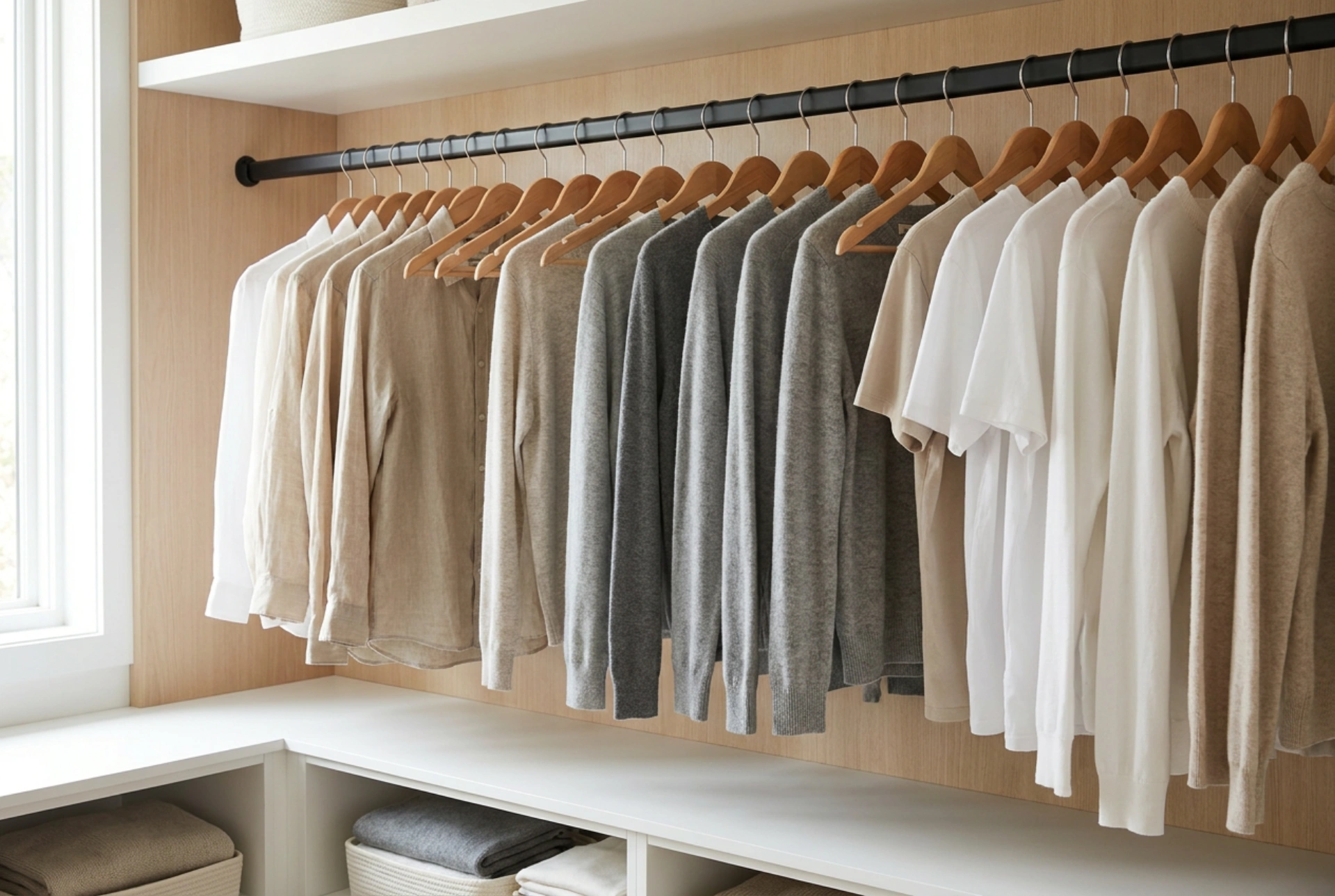
To maintain order and maximize efficiency, group your garments systematically by length, from left to right. Begin with the longest items (dresses and coats) on one side, transitioning gradually to mid-length trousers and skirts, and ending with short shirts and jackets.
This cascading arrangement naturally opens up a clean, rectangular block of floor space underneath the shorter garments. Use this reclaimed floor zone for modular drawer units, shoe racks, or storage boxes, ensuring that every cubic centimeter of your closet is utilized effectively.